SEARCH

Print Issues: Issue 27

What if we treat people, from the beginning, as imaginative, intelligent, playful creatures who deserve to be understood as such?
Jeff Govoni kicks off this issue by writing about literal “making”—the power of construction projects in elementary school. Aneesa Jamal shares a strategy for helping students reconnect to their questioning abilities, Michelle Jaconette has suggestions for how to launch inquiry-rich lessons, “Dr Project” has ideas for helping students critique “models” and make high quality products, and Brad Blue offers advice on how students can curate their own work after a project. Robert Talbert and Sarah Strong both share ideas for making assessment meaningful and student-centered. And Elizabeth Brown, Paula Espinoza, and Amber McEnturff share stories and strategies that challenge us not just to help students “make the world differently.”
Following the COVID-19 pandemic, Ferdinand T. Day (FTD), a Title 1 elementary school in Alexandria, Virginia, noticed an alarming increase in chronic absenteeism rates that disproportionately impacted Hispanic students
Much like a movie’s opening scene, the launch of a lesson should grab everybody’s attention, spark curiosity, and get students asking questions.
Last spring I was standing in my fifth-grade classroom, mid-project, rearranging student groups when I realized we had a problem. My students were building scale models of dog houses and cat condos that they had designed—and would ultimately build—to donate to a pet-adoption event later that spring.
As a new teacher, I faced the same dilemma every fall: What to put on the walls of my classroom?
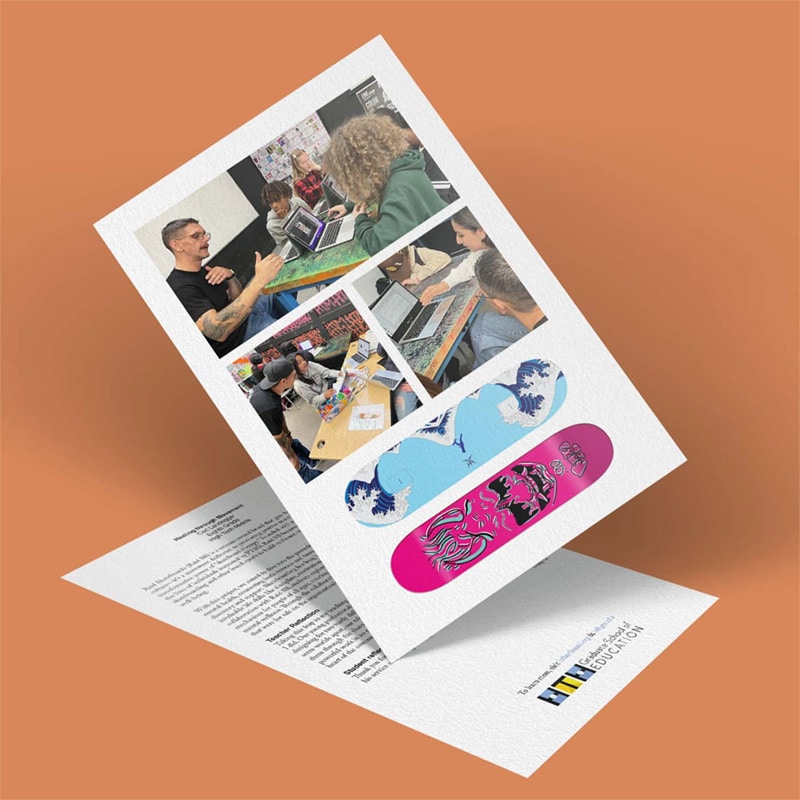
Students designed deck graphics that intersected skateboarding and mental health
“Grading” for me means more than just marking mistakes and putting a number or letter on an assignment. This is because, for the last ten years, I have used specifications grading in all my classes.
Students explored personal and inspirational forms of power through reflection, research, and creative storytelling.
Every two weeks, my Network for College Success (NCS) colleagues and I connect with each other to learn and grow our practice as Transformation Coaches.
Skip to content