Adriana is a tall, quirky, Latina ten year old. She lives about 10 miles north of the US/Mexico border and attends the school where I teach, a project-based learning school of choice. Starting spring break of her second grade year, Adriana spent nearly 18 months learning on Zoom due to the high rates of Covid in our neighborhood. She returned to in person learning fall of fourth grade. Her fourth grade teacher noticed that Adriana struggled to write or type, and created a formal plan to monitor Adriana’s progress and ensure that she made adequate progress in fourth grade.
My school uses Fountas and Pinnell assessments, also known as F and P, to monitor students’ reading progress. Adriana came into fifth grade reading at a level O, which is a third grade reading level. When it was my turn to test Adriana’s reading, I sat down at my kidney bean table with her, picked a small book at level O (a third grade level) and asked her to read. She began to read haltingly. She paused at words longer than six or seven letters, and made lots and lots of mistakes.
Adriana read “grumbled” as “groaned.” She read “complainer” as “comma.” She paused at “uprooted,” and then skipped that word altogether.
After finishing her assessment, I wrote the word “uprooted” on a small whiteboard. I asked Adriana to sound out the word, letter by letter. She looked at me blankly. I tried again. I covered everything except the prefix “up” with my finger and asked her to read it. She read it correctly. Then I covered up everything except the base word, “root.” Adriana did not know what that word said. I asked her what sound the letter “r” made and she got flustered. I asked her what sound “oo” spelled and she told me she didn’t know.
I felt a wave of panic. Adriana didn’t remember all of her letters and sounds. Yet she was testing on our F and P assessments as an average reader in my classroom. About 30% of my students were reading at a first or second grade level, about 30% were reading at a third grade level, and the last 40% were reading at a fourth or fifth grade level.
I’m a fifth grade teacher at High Tech Elementary Chula Vista, a project-based learning school at the border of the United States and Mexico. Our school is a public charter school that mostly serves families of Mexican and Filipino origin. As a classroom teacher, I work with my team to design and teach project-based curriculum based on our own passions and our students’ identities and interests. I also participate in lesson study to improve my practice. Lesson study is a team-based professional development in which teachers work together to create a well-crafted lesson that advances student learning and solves a problem of practice.
Sold a Story and the Science of Reading
If Adriana’s story sounds familiar to you, it’s probably because the podcast Sold a Story brought new attention to the science of reading, and new public scrutiny to Fountas and Pinnell assessments. Listening to this podcast, along with observing Adriana and other students in her situation, inspired me to explore literacy through my lesson study process. Over the past year, I have engaged in two lesson study cycles about literacy – the first about peer feedback in writing, and the second about improving reading comprehension through morphological awareness.
The science of reading is the set of research and literature from developmental sciences such as psychology, neuroscience and linguistics that investigates how children learn to read (Duke and Cartwright 2021). According to findings from science of reading researchers, there are five main domains of literacy development: phonemic awareness, phonics, vocabulary, fluency, and comprehension. In order to become proficient readers, students must develop competence in each of these literacy domains.
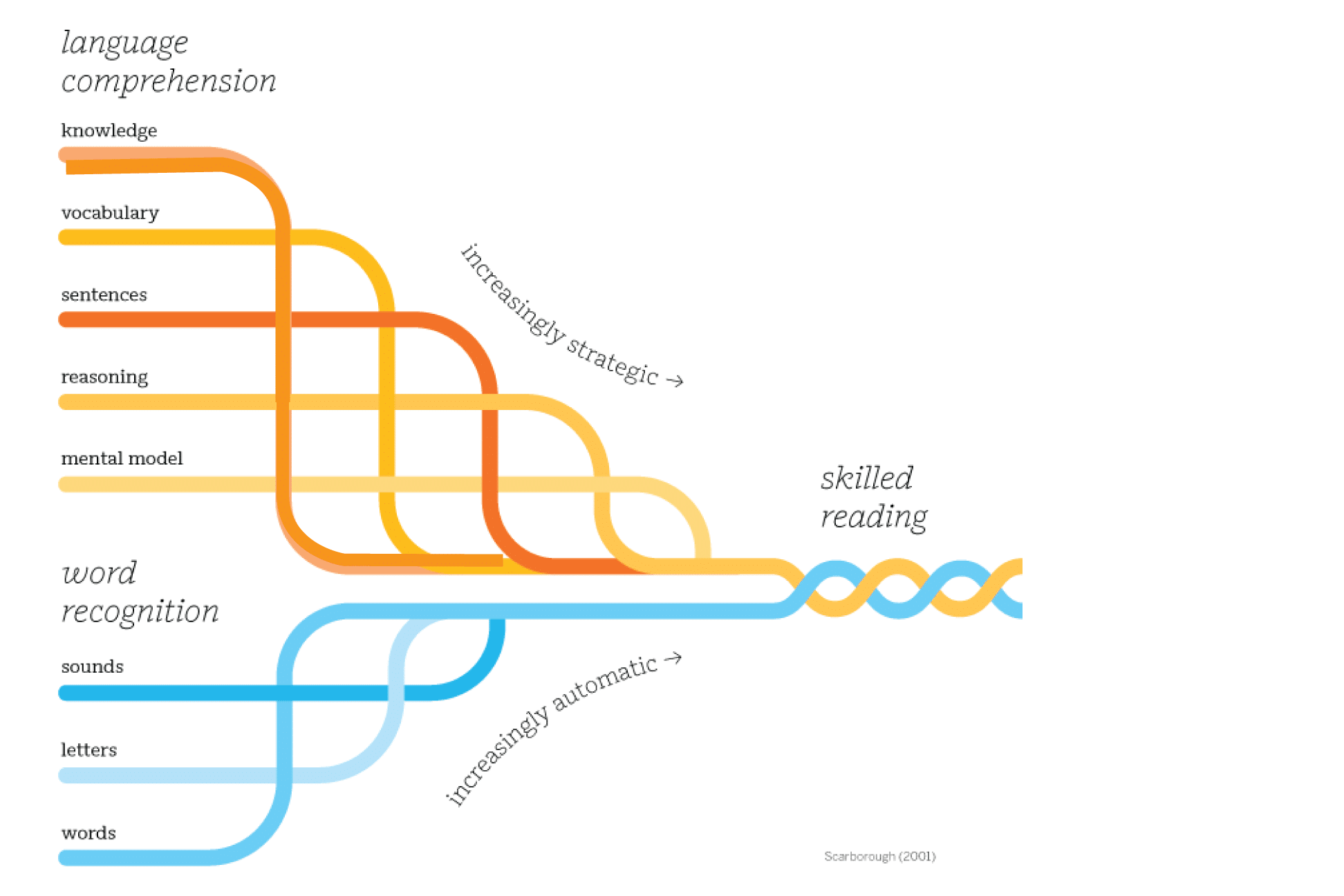
One of the insights from the science of reading is a model known as “Scarborough’s rope” (Scarborough, 2001). Scarborough breaks down various literacy skills that lead to reading proficiency. My lesson study team used these models of reading to understand and analyze our student data.
Data collection drives lesson study
My lesson study team collected data on our students’ literacy skills in order to identify a problem of practice. First, we assessed our students’ phonics and phonemic awareness by administering the Words Their Way spelling inventory. This is a progressive spelling program that measures students ability to encode common phonics patterns. Based on this assessment, we saw that the majority of our students could spell (and therefore decode) well.
We also collected information on students’ reading comprehension. Based on state and classroom assessments, we could tell that most of our students were reading two or more levels below grade level.
Using the Scarborough’s Rope model, we analyzed this literacy data. Our students’ spelling data was proficient and their reading data was not proficient, so we deduced that our students were in need of more support in the “language comprehension” strand of Scarborough’s model. We decided to focus our lesson study efforts on vocabulary and language structures.
More data collection
We spoke with several veteran teachers to understand how to support students with vocabulary and language structures. Rebecca, a veteran special education teacher and reading interventionist, has experience working with older students with dyslexia or other reading challenges.
Through research and discussion with experienced teachers such as Rebecca, we identified morphology as a missing skill. Morphology is the study of how word parts encode meaning. We investigated research on reading comprehension and vocabulary. In one article, the researchers explain that morphology is a helpful strategy for teaching secondary literacy in content areas (Hendrix and Griffen 2017). Morphology is defined as the smallest building block of meaning within words. The authors argued for ongoing rather than isolated morphological instruction as a way to improve vocabulary knowledge, reading comprehension, and spelling skills for upper-elementary to secondary learners. The authors recount four morphological approaches to help students learn the structures of words—
The most common morphemes that students encounter are prefixes, root words, and suffixes. Teachers can guide students in breaking down the words into their morphemes to glean clues about the word’s meaning. For example, imagine that students encounter the word “informational.” This word consists of the morphemes inform, -tion, -al. Each morpheme gives a clue about the word’s meaning. Another example is breaking down the word “unchangeable.” “Un” is a prefix that means “not.” Change is the root word which gives the word its main meaning. “Able” is a suffix that means “capable of, fit for, or worthy.” If you put these morphemes together, you get “un + change + able = unchangeable.” Unchangeable means “not being capable of being changed.”
Bringing morphology to students
We had completed the first three steps of the lesson study process. First, we reviewed student data to identify a problem of practice. Next, we studied academic literature to understand our problem of practice from a researcher’s lens. Then, we spoke with veteran teachers to understand our problem of practice from a practitioner’s lens. Together, these steps had given us a clear roadmap: to support our students’ language comprehension, we needed to teach them morphology (prefixes, suffixes and root words).
Next, it was time to interview our students about their understanding of language and of morphology. As part of the lesson student process, I selected three focus students. I was curious to learn more about their thinking and to closely monitor and track their progress over the course of our lesson study project.
When I interviewed these students, I asked them how often they see words inside of words. I asked them to look at the word “informational” and tell me how many words they could see inside of it. I was hoping that they would say words like in, form, inform, information, etc. Interestingly, many of my focus students struggled to identify these words inside of informational but were able to see words like I, in, for, mat, etc.
Next we did a whole class lesson on morphology, where we worked together to identify word parts in complex words like “informational.” After introducing this routine and practicing it, I could see students start to pick up this routine on their own and break down words into word parts.
Creating a shared lesson
The final step of lesson study was to create a shared lesson. I worked with my lesson study team (a seventh grade humanities teacher and a ninth grade humanities teacher). Together we designed a ninth grade humanities lesson that supported students’ morphological development. We used what we learned about morphemes to create one lesson for ninth graders, using the same routines that I use in my fifth grade class.
We used a routine that we found in Hendrix and Griffen’s article about supporting morphological development. This routine was:
In our lesson, ninth grade students listened and read along to an engaging, complex text (Demon Copperhead, by Barbara Kingsolver). They found one word that they didn’t recognize and that was morphologically complex. They wrote that word on an index card, and then they used the routine to break that word into morphemes, hypothesize the meaning, and check the meaning against context. Then, they read an article independently and applied the same routine to words in that article.
Applying Our Lesson Study Findings to My Own Practice
After conducting this lesson study in my colleague’s ninth grade humanities class, I began to reflect on my own practice as a fifth grade writing teacher. I saw how my fifth graders’ skills needed to build over the next several years towards more advanced word study skills. The most important way that I could support my own students’ morphological knowledge was supporting their understanding of common root words, prefixes and suffixes. This is summarized in one of the Common Core standards for language: CC.5.L.4.b Vocabulary Acquisition and Use: Use common, grade-appropriate Greek and Latin affixes and roots as clues to the meaning of a word (e.g., photograph, photosynthesis).
For example, each week with my students we complete a word work packet. After finishing this lesson study, I plan to add morphological routines to our word work packet so students can practice breaking down the words into their component parts. I will give my students word lists with prefixes, root words and suffixes so that they will separate the words into prefix-root word-suffix alongside their student-created definition. After completing this lesson study, I have a much deeper understanding of this standard. I understand the research on how affixes and roots (also known as morphemes) help students build their vocabularies, and know several practices for supporting students in building their knowledge of affixes and root words. Finally, I understand how this skill builds from one year to the next, allowing students to tackle progressively more difficult vocabulary.
Reflecting on lesson study
Lesson study has been an amazing opportunity for me to work with teachers outside of my grade level team. My favorite part of lesson study was the opportunity to observe in other teachers’ classrooms. This form of professional development allowed me to learn from and teach other teachers.
The most important thing about lesson study was the opportunity to work with teachers in my same discipline. Lesson study works best when teachers share the same disciplinary focus and the same grade level. It works especially well for areas of teaching that have rigorous research, like the science of reading.
I suggest lesson study for administrators looking to disseminate the science of reading practices among their teachers, and transform classroom level practices. This form of professional learning explicitly transforms research into practice, which is perfect for the science of reading (where a clear research consensus exists but there is more variability in the practical approaches of teaching reading).
Citations:
Hendrix, R. A., & Griffin, R. A. (2017). Developing enhanced morphological awareness in adolescent learners. Journal of Adolescent & Adult Literacy, 61(1), 55-63.