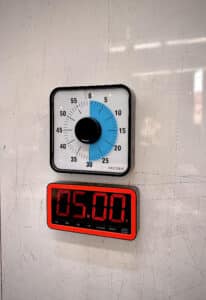
It started with a simple idea: to bring a 60-minute visual countdown clock into my class. What began as a classroom management tool turned into something bigger—a small shift that made the room more predictable, accessible, and humane for every learner.
Before I brought in the clock, my classroom was a guessing game. Students were constantly asking how much time was left, and I was juggling activities while trying to keep an eye on the time. Now, the visual clock gives my students independence while giving me peace of mind.
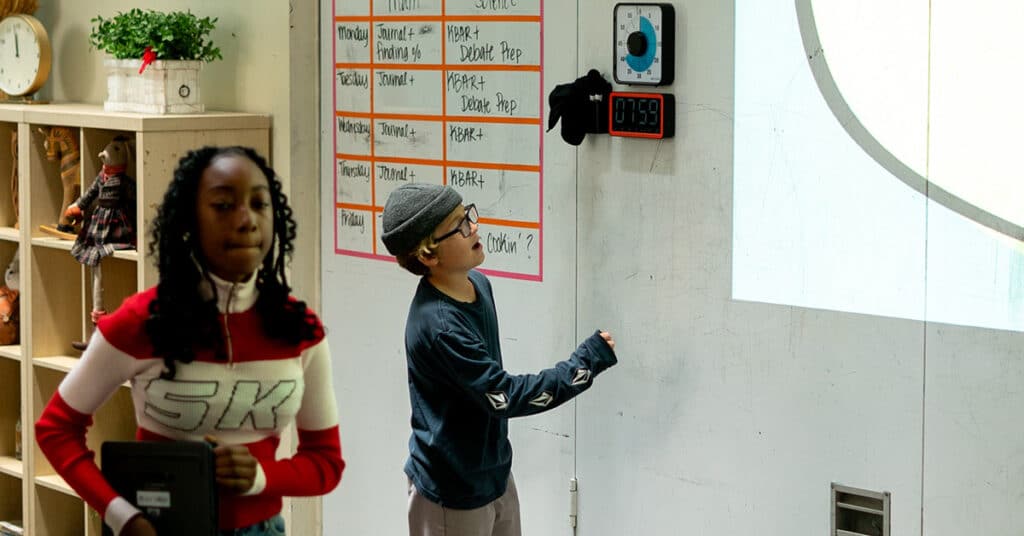
You may be thinking “What’s the big deal? I already have a clock in my classroom.” What makes this clock different from a regular classroom clock is its design. Instead of requiring students to read numbers or calculate minutes, it makes time concrete and visible. The shrinking wedge of color is intuitive, which means it supports all learners—those who can’t yet read a traditional clock, those who struggle to grasp the abstract concept of time, and those who simply benefit from a clear visual cue.
It didn’t take long to see how this change benefited the whole class. That little clock quietly honors students’ needs. For example, it gives every learner access to the invisible: time itself. Some students rely on the visual cue to stay engaged, others use it to self-regulate emotions when a task feels overwhelming, and still others gain confidence because they no longer need to keep asking, “‘How much longer?”’ That one clock transforms something abstract into something concrete.
But the real magic happened when I paired the visual clock with a smaller digital timer I started using for everything else. Five minutes of reading? Timer. Three minutes for a round robin discussion? Timer. One minute to present your point? Timer. Debates suddenly had a shape. Peer sharing felt fair. Even transitions were smoother because the clock gave us all a shared sense of accountability.
The bonus? It also happens to be a beautiful example of Universal Design for Learning (UDL), which emphasizes providing multiple means of representation so every student can access the same information (CAST, 2018). In fact, a growing body of research, such as a systematic review on visual schedules and behavior regulation in children with ADHD (Grey et al., 2009) and studies on how visual timers affect anxiety and performance (Hallez & Vallier, 2025), suggests that visual timers can help reduce anxiety, improve focus, and support executive functioning skills by giving students a clear sense of predictability and control.
Now, the visual clock gives my students independence while giving me peace of mind. Instead of mentally calculating how much time remains in the period, I can glance once and know instantly whether we have a lot or a little time left, and adjust my pacing on the spot. Pairing it with a digital timer creates a powerful rhythm: The visual clock grounds the students in the flow of time, while the digital timer helps me structure transitions and keep activities on track. Together, they form a perfect marriage—the clock provides the big picture, the digital timer sets the rhythm, and both work in harmony to create a smoother, calmer, more focused classroom for everyone.
These days, my classroom runs on two rhythms—the steady sweep of the 60-minute countdown and the quick beats of the digital timer. Together, they keep us moving, balanced, and honest with our time. More than just tools, they’ve become a quiet framework for respect: respect for the task, each other’s voices, and the minutes we share together each day.
It started with a timer, but what I really found was a way to give my students ownership of their time. And that, it turns out, was the most powerful classroom shift of all.
CAST. (2018). Universal Design for Learning Guidelines version 2.2. Retrieved from https://udlguidelines.cast.org
Curtin, E., Fletcher, A., Mallory, S., & CDS DNEA Team. (2024). DNEA resource guide: Visual supports: Visual timers. Delaware Network for Excellence in Autism.
Grey, I. M., Honan, R., McClean, B., & Daly, M. (2009). Using a Time Timer™ to increase appropriate waiting behavior in a child with developmental disabilities. Behavioral Interventions, 24(4), 249–254. https://pubmed.ncbi.nlm.nih.gov/18926663/
Hallez, Q., & Vallier, V. (2025, October 17). Time on their side: How visual timers affect anxiety, performance, and on-task behavior in elementary math assessments. [v1] | Preprints.org. https://www.preprints.org/manuscript/202510.1341
Thomas, N., & Karuppali, S. (2022). The efficacy of visual activity schedule intervention in reducing problem behaviors in children with attention-deficit/hyperactivity disorder between the age of 5 and 12 years: A systematic review. Journal of Child & Adolescent Psychiatry, 33(1), 2–15. https://doi.org/10.5765/jkacap.210021
Wennberg, B., Kjellberg, A., & Gustafsson, P. (2017). Effectiveness of time-related interventions in children with disabilities: A systematic review. Neuropsychiatric Disease and Treatment, 13, 2681–2706. https://pubmed.ncbi.nlm.nih.gov/28956183/