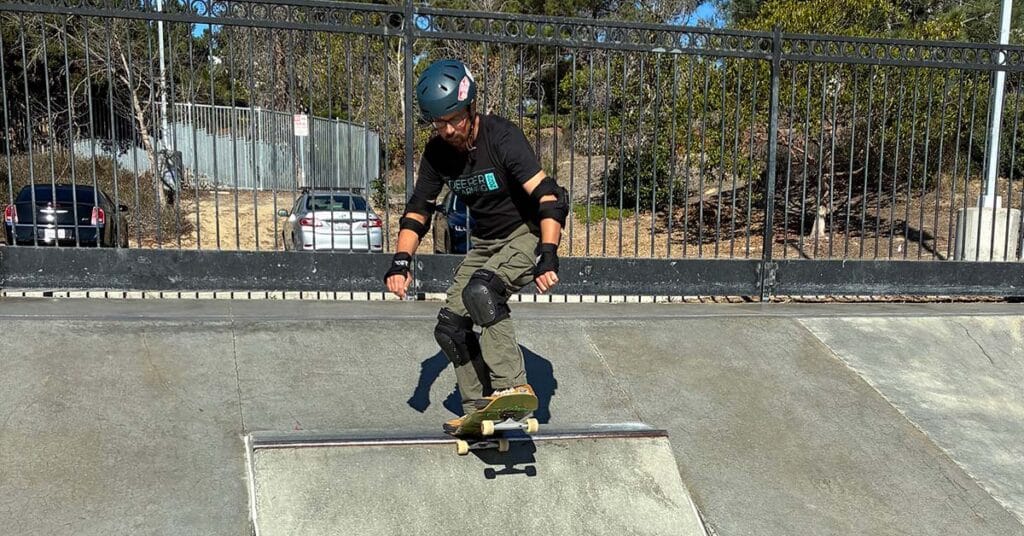
Last month I took a skateboarding lesson. I wanted to get more comfortable dropping in (that is, doing what I’m doing in the picture at the end of this letter). I could do the move, but I didn’t feel confident about it. And more than one person had told me THEY felt scared when they watched me drop in, which didn’t help.
I had explained this to the teacher when I booked the lesson, but that had been a few weeks ago, and the teacher—apparently deciding this was my first time trying to drop in—stood in the bowl bowl underneath me so I could grab his hands.
Apparently this reassures some people. It did not reassure me. I should have asked him to get out of the way, but I figured “he’s the teacher,” stepped on my board, and dropped in.
Then the predictable happened: I couldn’t figure out what to do about having a guy standing next to me, my board shot out from under me, I scrabbled for his hands, and in an instant I was lying on my side.
I got up, checked I was basically OK, and asked the teacher if he could just give me more space, and dropped in perfectly. In fact, my teacher told me my drop in looked great and I should ignore everybody who said otherwise.
I left the lesson with an aching hip and my confidence rattled despite the teacher’s encouraging words, but I had a perfect example of a learner being harmed by over-scaffolding, and the bruises to prove it.
In fact, maybe it’s misleading to talk about “over-scaffolding” and “under-scaffolding” at all, because the only way to get scaffolding right is to know what the learner needs, and you get that by gathering data—which might mean anything from from an “empathy interview” to a written assessment.
This issue is all about listening to students, learning from data, and recognizing that what students tell you is data!
Enjoy, and stay safe out there, whatever you’re trying out!
Alec Patton
Editor-in-chief