 Every student learns at their own individual pace. Some kids go through material fast, while others need more time. But in most math classes, all students are expected to keep up with the pace of the teacher. They go through a unit. They take a test. Then they move on to the next unit, whether they’re ready or not. Kids that never really mastered the current topic are still expected to do well in the next topic. That’s Albert Einstein’s definition of insanity: doing the same thing over and over and expecting different results. Eventually students become disengaged, and mutter those common words, “I hate math!”
I’ve often pondered this dilemma, and the solution came to me during a community meeting at my school. The after-school program leaders were introducing sports they were offering, and a Judo instructor was answering some questions. A student asked, “How long does it take to become a black belt?” The instructor replied, “It depends on the person. Everyone goes at their own pace.” That’s exactly what I believed about student learning! So I went online to learn more about Judo. I found that the purpose of learning Judo is to develop character, body, and mind, so that one can contribute something of value to the world. I absolutely loved that message for my students. So I decided to frame my math class around these ideals. One of the core principles of Judo is cooperation: working for mutual welfare and benefit. I wanted to create a motivated and disciplined learner, one who respects the craft of mathematics. Judo Math was born!
“Can this principle [of Judo] be applied to other fields of human activity? Yes…it can also be applied to the improvement of intellectual and moral power, and in this way constitutes mental and moral education.”
—Professor Jigaro Kano, founder of Judo
Like the martial art practice, Judo Math incorporates varying degrees of belts. My 8th grade students decided to use rubber bracelets to signify the belt, called an obi. In ancient times the obi was developed to put the student in the appropriate state of mind. In our class, when students put on their obi, it signifies that they are ready to learn math.
In Judo Math there are four areas of focus, called disciplines, that we study over the course of the year. These are math fundamentals, problem solving, graphing, and polynomials. Within each discipline, there are four topics that must be mastered (see the table at the end of this article). I talked with several 9th grade teachers to find out what they really wanted the kids to know coming into their classes. I was able to sum up all of first year Algebra I in 16 key topics. This follows the “depth over breadth” model used in countries that score the best in international math comparisons. In Singapore, for example, teachers focus in-depth on just 12 math concepts per year; in the United States, most math teachers are expected to hit seventy or more.
Each topic in Judo Math represents a belt color. Once we start a discipline, the students start training for a belt. The first topic is represented by a yellow belt, followed by orange, blue and then black. Depending on the material of that topic, we’ll spend maybe one or two weeks on activities and lessons, followed by a belt test at the end. If a student gets 80% or better on their test, they have achieved mastery and progress to the next belt. If a student falls short, then they need another week of training to review similar material. No student moves on to the next topic until they’ve mastered the current one. They can take the test as many times as they’d like until they’ve reached mastery. Some students take one week, while others may take three.
Since Judo preaches working for mutual welfare, those who have already achieved their yellow belt status then become mentors to the rest of the class, helping them through the concepts. It’s everyone’s job to help the entire class reach black belt. In the meantime, the yellow belts start their quest for an orange belt, and the class is split into two groups, both working at their own pace.
Before too long, grades don’t even matter to the kids. It’s all about the belts. We make a big deal out of it. Moving from one belt to the next is celebrated as a monumental achievement. On the Monday after a Friday test, I hold a “presentation of belts,” where each student who advanced is called up in front of the class to receive their new belt. I congratulate them in Japanese by saying “Omedetou gozaimasu watashi no gakusei” (congratulations, my student with honors), while the rest of the class applauds.
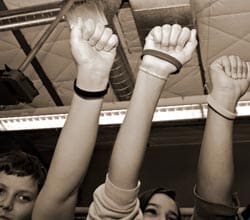 There is a sense of pride when moving from one belt to another. The students’ confidence level increases throughout the year due to the marking of their achievements. Judo Math motivates all students to take responsibility. There are no ability groups, just pacing groups. By the end of each discipline, everyone is a black belt rank, reinforcing the unity of the class.
Early finishers can keep going by preparing for their “sensei” belt. This belt, which is green, signifies that they’ve become a master. They go beyond Algebra into Geometry and Trigonometry. The sky’s the limit for what they’ll learn. No student is held back, and no student is left behind. We’re all in it together. Once everyone reaches a black belt in a given discipline, we hold a big class party to celebrate the achievement. Then the process starts over again with the next discipline.
When I first implemented this idea I was extremely excited. I worked with the kids to get them to buy in, and they were excited as well. But it all got out of control rather quickly once kids started zipping through belts. By the end of the third week, I had yellow belts and orange belts and blue belts and black belts and kids that wanted even more! All at the same time! I was scrambling around trying to teach five different topics to five different groups of kids. It was absolute mayhem!
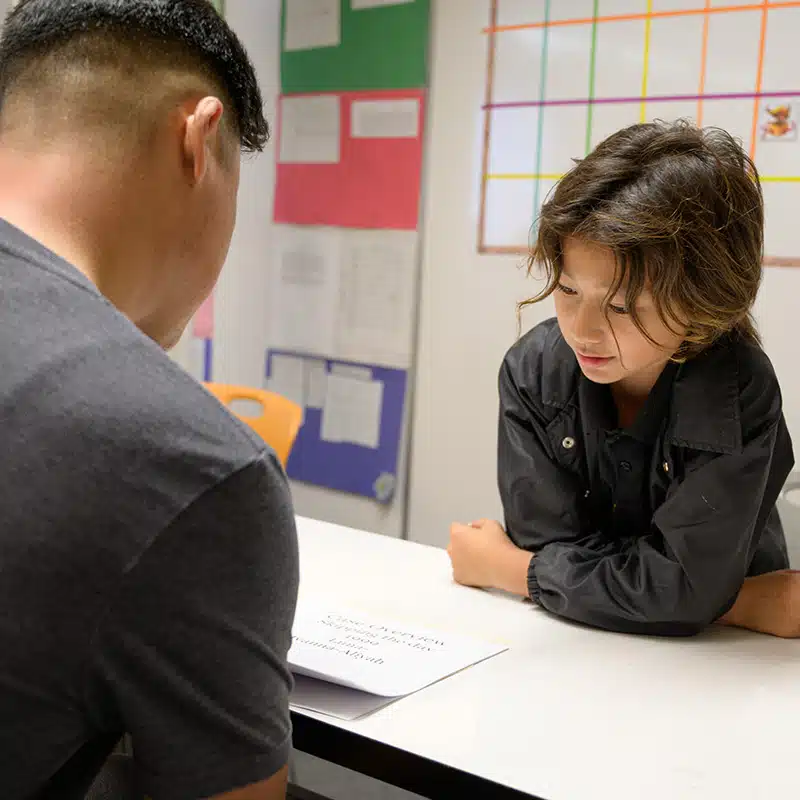
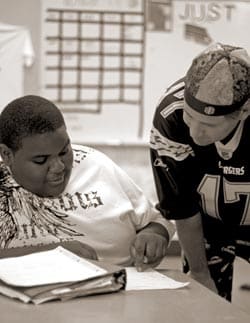
Something had to be done to preserve my sanity, and the answer came from the kids themselves. They came up with the idea of peer mentors. Turning the kids into teachers after they achieve mastery in a topic proved to be the cure-all tonic. It’s the glue that holds Judo Math together. When one student gets to be two belt levels ahead of anyone else, they are paired up with another student that is slower paced. It becomes their job to get that student a belt. They work with them one-on-one in class and encourage them. They become personally invested in the success of another student. Once they help that student get a belt, then they start training for their own higher level.
To encourage collaboration, we celebrate those students who help others. The student that helps the most kids earn their belts gets to sit in the “best seat in the house” for a week. It’s a leather recliner, much better than the stiff school chairs they usually have to sit on. Pretty soon I had a group of tutors in my class ready to teach any topic. Teaching helps deepen their understanding of the material, and as a bonus, management becomes much easier.
When we begin a new discipline, I teach some lessons and do some activities with the entire class, just as you would do in a traditional math classroom. After the first belt test, however, the class is split into two groups—those who’ve already achieved mastery and those who need more practice. I start the next week by reviewing concepts with the kids that didn’t get their belt. Then I pull aside my brand new yellow belts and give them a lesson on the next topic. I end up teaching to smaller groups of kids, a practice that holds their attention much more effectively.
The fast kids who zip through the belts move onto the “sensei” challenge on high level math topics. These kids tend to be independent learners, so I use web quests so they can advance at their own pace. They can also earn a subscription to an online software program like ALEKS or ExploreLearning, where they can learn even more topics and I can monitor them electronically. In the meantime, they’re still helping every kid that needs it and monitoring their personal mentee’s progress.
“Judo Math makes you feel really good about yourself,” says Brian, a former student. “It’s really exciting to see my classmates pass because they did something that maybe they didn’t think they could do before.”
In this model, students gain confidence by finally seeing some success. How many times have you heard someone say, “Math is just not my thing”? Wes used to think like that. He considered himself a good student, getting mostly B’s in school, but he never saw himself as being exceptionally smart. After going through Judo Math last year, he came to my class recently to tell me about his current math class in 9th grade. He said, “You should see me Mr. T.! I’m like a math genius now! I’m the one helping everyone else! This stuff is so easy!”
This model works for all types of kids, because they’re all going at the pace that is comfortable for them. Yolanda was a student who always considered herself to be “dumb” at math. Like all kids, she had readily identified who the smart kids were. They always got A’s, and she always got D’s. But once she started Judo Math that changed. Yolanda had never been able to retake tests before. She was used to failing her test and then moving onto the next topic. At first she was skeptical. She saw the “smart” kids getting their belts in one week, while it took her three. But gradually she started to understand the math better. Other kids were applauding her for moving up in the belts. Once everyone earned a black belt in our first discipline, I gave a cumulative exam on all the topics. Yolanda got an A and could hardly believe her eyes. She said, “You must’ve graded it wrong! I’ve never gotten an A on a math test before!” She told me it was the first paper she’s ever been able to put on her refrigerator at home. One of the so-called “smart” kids came up to her and congratulated her. Yolanda actually had a better score than she did! I pointed this out to Yolanda, “See! Who cares how long it took you to master it? The fact is, you know exactly as much about this material as the kids that went fast. The important part is that you understand.”
My hope is that Judo math will help all students recognize the importance of effort, perseverance, and mastery. And that the confidence they gain in my classroom will apply, not only to math, but to other areas of their lives as well.
To learn more about Judo Math, visit Dan Thoene’s digital portfolio at https://dp.hightechhigh.org/~dthoene. A version of this article will also appear in the forthcoming book, Learning by Design: Projects and Practices at High Tech Middle, available in May 2010 at the HTH bookstore: https://www.hightechhigh.org/books
Judo Math Curricula for 8th Grade
| Discipline/Topic | Suggested Projects |
| The Fundamentals | |
| Fractionology | The Lollipop Project—manipulate recipe amounts involving fractions to change the amount of servings. |
| Ratio and Scale | The Real Barbie—compare proportions of dolls and action figures and project them to actual humans. |
| Percent Reasoning | Game of Life—use shopping to explore percent increase and decrease by setting up a mall in class; then budget their life by earning a salary and calculating their federal income tax. |
| Combining Terms | Like Term Games—make card games to mimic negative and positive integers with or without variables (examples include Zero Out and Rummy). |
| Problem Solving | |
| Modeling equations | Payment Plans—use equations to find when it’s more cost efficient to become a member at a gym as opposed to paying daily fees. |
| Modeling inequalities | Del Mar Fair Trip—given a set amount of money, deduct fair admissions and food to calculate how many rides you can go on. |
| Manipulating Variables | Temperatures—convert temperatures from degrees Celsius to Fahrenheit and vice versa during labs. |
| Distance, rate, and time | Velocity Olympics—compete in various events that involve distance and time to compute speed as an individual and as a group average. |
| The Meaning of Graphs | |
| The Basics | Build a Staircase—explore slope by designing a staircase for HTM. |
| Linear Equations | Scientific Relationships—conduct experiments of linear relationships such as ball bounce vs. drop height, shoe size vs. height, etc. to present to class and make future predictions. |
| Linear Inequalities | Graph-It-Art—create straight-line pin-hole pictures with yarn using the Cartesian coordinate system to plot, write equations and find the domain and range of each line. |
| Solving Systems | Burgerama—vie for a marketing analyst job at a fast food restaurant by using data on supply and demand from a previous promo to create a cost-analysis for a future one. |
| Polynomials | |
| Combining | Adding/subtracting/multiplying polynomials |
| Factoring | The Box Store—use polynomials to maximize the volume of a box for your box company. |
| Simplifying | Rational expressions |
| Quadratics | The Water Fountain—design a water fountain using quadratics to determine the arc and distance of the water spray. |