SEARCH

African Bushmeat Expedition

By

PUBLISHED November 4, 2008

PUBLISHED November 4, 2008

A person wearing a hat is smiling during an expedition while several small green chameleons crawl on the hat. The blurred background suggests outdoor surroundings, conveying a playful interaction with wildlife.

Share this

In the summer of 2008, Jay Vavra and a group of High Tech High students traveled to Tanzania on a safari with a purpose—to combat the African Bushmeat Crisis, the illegal trade of meat from protected species, usually disguised as meat from a lawful origin.

Over the course of three years, students in Dr. Vavra’s biotechnology course studied the bushmeat trade and conservation forensics. They developed and practiced ways of identifying species via DNA barcoding, a technique they hope will aid scientists, environmental groups, and prosecutors in tracing illegal bushmeat back to its localized animal populations. While in Tanzania, the HTH team’s focus shifted from animals to people; they filmed and interviewed tribesmen and park officials talking about their lives and how poaching affected them. They presented their work to scientists and began an exchange of ideas for combating the crisis and developing education programs in East Africa and the United States. They returned home with hours of documentary footage and a greater understanding of wildlife conservation practices, the effects of illegal hunting on biodiversity, and the challenges being faced by those hoping to prosecute poachers.

To learn more about the African Bushmeat Project and the Tanzania expedition, visit Jay Vavra’s digital portfolio: https://hthbiotech.sandiegostc.org
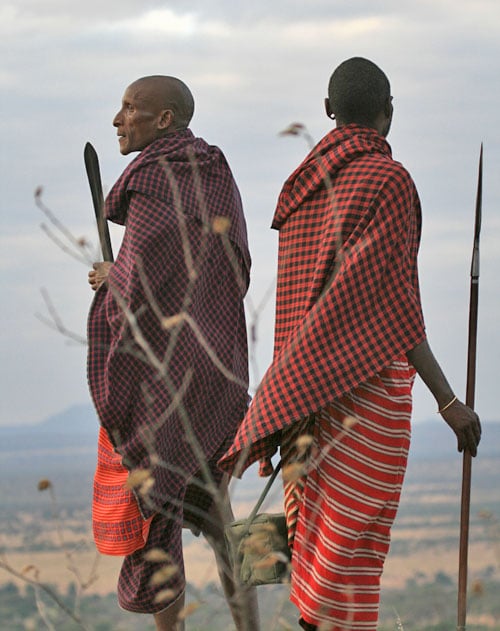
 

Two people dressed in traditional Maasai attire stand on a hill, holding spears. They overlook a vast landscape under a cloudy sky, with one wearing a red checkered shawl and the other a striped one. Sparse vegetation is visible in the foreground.
Maasai tribesmen, photographed by HTH junior Steve Pye. The pastoralist Maasai tribe at Oldonyo Sambu, the mountain near our base camp, taught us much about coexisting with surrounding wildlife, including how to identify different animals’ tracks and scat. On our way to a dried out watering hole, we spotted fresh lion tracks, giraffe droppings, and foliage trampled by elephants. It was incredible to see evidence of so many different species in one small area.


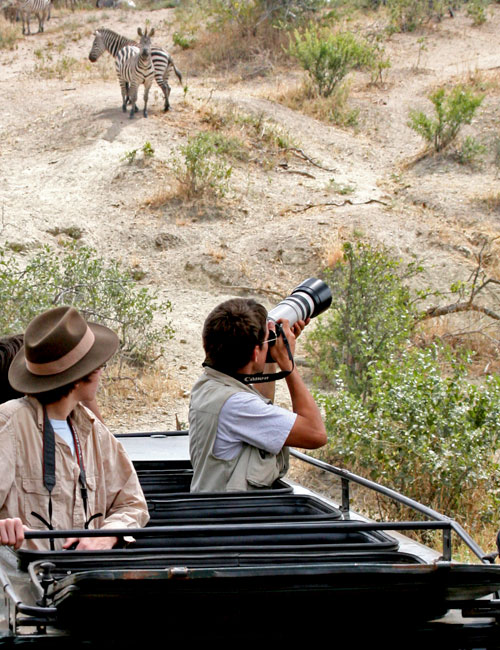
Two people on a safari in an open-top vehicle. One is photographing zebras in the distance with a large camera lens, while the other looks on. The landscape is dry and rugged with sparse vegetation.
HTH junior Steve Pye documenting a herd of zebras, photographed by Jay Vavra. Throughout our journey, we encountered animals both rare and common to the African plains. While wild meat can be differentiated from domestic meat by smell and look, species-specific identification is usually impossible. Nelson Mwakafwila, a Tanzanian National Park Ranger, noted that the meat of a rare animal such as the Topi or Oryx can easily be mistaken for that of common gazelle or zebra.


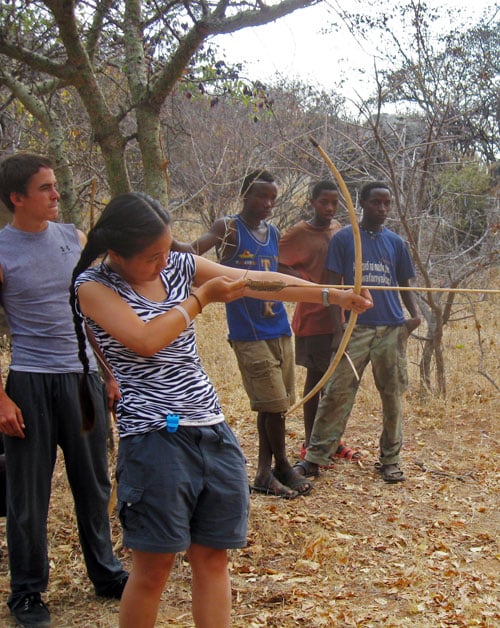
A woman in a zebra-striped shirt practices archery with a bow in a dry, wooded area, watched by four men. Three of the men stand in a line behind her, and one stands to her side, observing closely.
HTH senior Megan Morikawa practicing archery with Hadza tribesmen, photographed by HTH sophomore Tyler Taylor. The Hadza, a hunter-gather tribe, taught us a great deal about how to survive on the land. Following a lesson on arrow-making they took us along on a hunt. While we did not witness a kill, we learned that when a kill is made, the Hadza people set up camp and cook all of the meat on the spot. This allows everyone to benefit from one kill, rather than making several kills and not utilizing all of the fresh meat. The Hadza understood that their survival relies on keeping wildlife abundant.


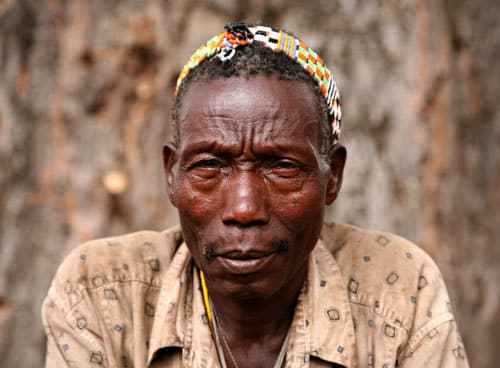
A man wearing a patterned headband and a beige shirt is looking at the camera. The background is a tree bark.
Siagi, an elder of the hunter-gatherer Hadza tribe, photographed by Jay Vavra. Interviews with the Hadza tribe were challenging, as we needed translation from English to Swahili to Hadzabe, a beautiful language filled with clicks and pops. Our interview with Siagi went beyond words. When asked how tribesmen communicate with each other during the hunt, Siagi showed us a variety of signals and acted out a series of hunts. It was as if the lion or cape buffalo, and Siagi’s hunting partners, were really there.


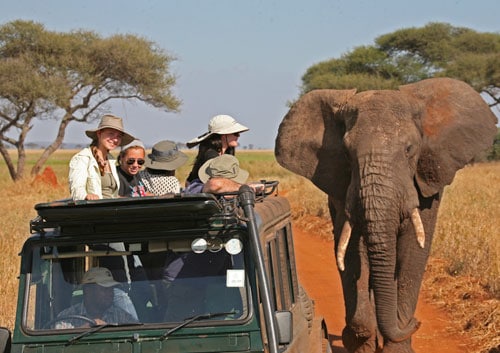
A group of people in a safari vehicle observe a large elephant walking on a dirt road in a savannah landscape with scattered trees. The sky is clear, and the scene conveys an adventurous, wildlife-watching experience.
An encounter with a great African elephant (tembo in Swahili) in the Tarangire National Park, photographed by Jay Vavra. These gentle giants would get frighteningly close to the vehicles, trotting along beside us and on one occasion, when we accidentally separated a baby from its mother, trumpeting behind us in hot pursuit. Observing the tembo in their natural habitat solidified our commitment to help preserve such animals and their environments.


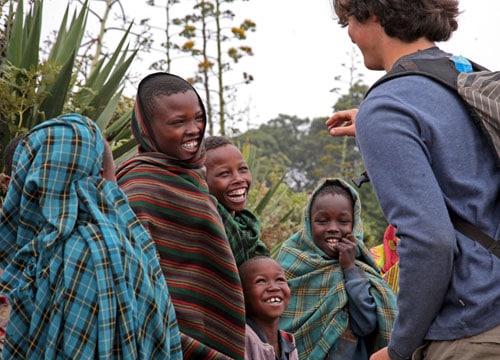
A group of children wrapped in colorful blankets smile and laugh outdoors, engaging with a person wearing a blue shirt and a backpack. There is greenery in the background, creating a lively and cheerful scene.
Iraqw children with HTH senior Alex Bozzette, photographed by Jay Vavra. HTH students discovered that juggling was a great way to engage with people, particularly children, and begin conversations about wildlife conservation. Each member of our expedition realized that education was key to solving the bushmeat crisis; we emphasized that live animals had much greater worth than dead animals.


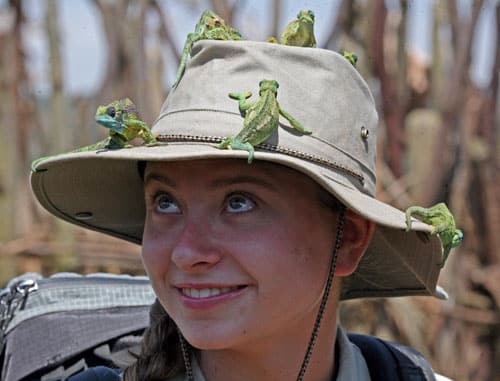
A person wearing a wide-brimmed hat is smiling while multiple small chameleons rest on the hat. The background is blurred, suggesting an outdoor setting.
HTH junior Beth Jacobs with chameleons, photographed by Jay Vavra. While documenting the wildlife conservation practices of the agriculturist Iraqw people, we learned that the Iraqw believed chameleons were poisonous. After seeing our excitement in holding and photographing the harmless reptiles, a group of Iraqw children ran ahead on our path through the forest and gathered a dozen chameleons for us. They later vowed to not kill these lizards, but to help protect them and to tell others they are good.


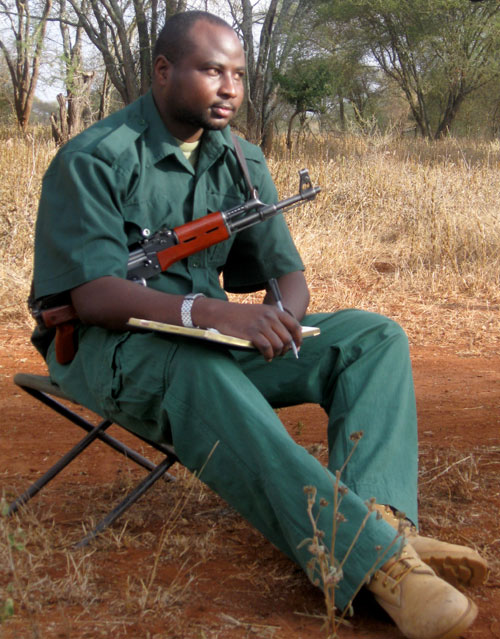
A man in green work clothes sits on a folding chair in a dry, grassy landscape, holding a pen and notepad. An automatic rifle is slung over his shoulder, and he wears tan boots. Sparse trees are visible in the background.
Lazarus Saruna, park warden & anti-poaching commander of Tanzania National Park, photographed by HTH sophomore Tyler Taylor. We had the opportunity to interview Lazarus after a chance meeting at a watering hole. He discussed the challenges in patrolling such vast areas, and emphasized the importance of techniques like ours in identifying bushmeat so that poachers could be prosecuted in court. Two weeks after our expedition we heard from Lazarus; he encountered a poaching camp containing slaughtered and partially processed animals. He estimated twelve zebra, six wildebeests and two impala.


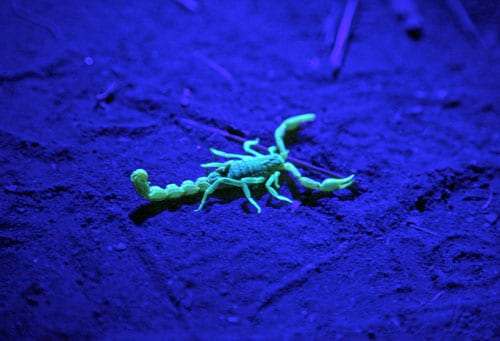
A scorpion glowing under ultraviolet light on a dark surface, highlighting its distinct, bright appearance against the dark background.
Scorpion, photographed by HTH junior Steve Pye. Senior Megan Morikawa writes, “Tanzanian nights were filled with all sorts of surprises. From strange noises in the bush, to glowing eyes, to a great diversity of arachnids and insects, the students got to experience the true night time of Africa, when the animals take over. With caution and a critical eye, students learned not only to master their fear of the African night, but to appreciate each creature for their unique adaptations. The scorpion carries a protein which will fluoresce under UV light. Students got to witness this up close one night in the Yaida valley.”

TAGS

Most Recent Articles

Skip to content