We are excited to share this piece with you, originally published as a pamphlet in 1981, with a new introduction by one of the co-authors, Adria Steinberg.
You can access a full digital facsimile of the pamphlet here.
In 1971 I started working at The Group School (TGS), an alternative high school in Cambridge, Massachusetts. My connection to TGS started shortly after I ran afoul of the administration at the high school where I had been teaching, for sponsoring an event that included speakers from women’s liberation and gay liberation, and for publicly calling for a school walk-out to protest the escalating war in Vietnam. As I was casting about for a new teaching job, I heard there was a group of working-class young people in my North Cambridge neighborhood who were fed up with being disrespected and discarded by their schools and, with the help of several youth workers and disaffected teachers, were planning to open an alternative high school.
From our very first meeting, I knew I wanted to be part of this unusual effort. I jumped into developing and teaching courses based on student needs and interests, while also serving as an advisor to a student group and participating in various student-faculty committees. Within a few years I became the academic coordinator, a role that included developing the master schedule and finding and supporting volunteer teachers, as well as the more outward facing work of codifying some of our most popular courses, developing workshops for other schools and youth programs, and assisting with fundraising.
Over my ten years at the school I learned incredibly valuable lessons about the centrality of democratic decision-making, experiential learning, and critical explorations of class, race, and gender in creating liberating educational spaces where young people feel a sense of belonging and agency. These are lessons I applied throughout the following 45 years of working with and advocating for 16-to-24 year olds.
One of my first attempts to describe these lessons is the pamphlet reproduced here, first published in 1980 as part of a series of publications that also includes Math Survival Skills; Demystifying Science; Write On: Ideas for Reluctant Writers; Growing Up Working Class: Course Materials on Class, Race, and Sex; and Linking Schools and Jobs. These pamphlets are just a few of the dozens of resources now available on the recently launched Group School Archive and Resource Center. (www.thegroupschool.org)
The website grew out of a series of Zoom reunions of TGS student and faculty alumni that began during the pandemic. These sessions gave us an all-too-rare opportunity to share the profound longitudinal impact of the school’s principles and practices on graduates and faculty alike. Alumni shared how their experiences at TGS had helped them grow a sense of self-worth, find their voices, and develop the courage to tackle difficult things. They also reported ways that the school had a multi-generational impact in their families—from inspiring parents and siblings to go back to school to making sure their own children and grandchildren graduated from college. Alumni and staff shared how their realization that things don’t have to be the way they are, and that you can work with other people to change things for the better, has affected their personal, professional, and political lives. Our conversations also revealed that many of us still had boxes of artifacts, course descriptions, curricular materials, photos, and student writings stored in our cellars and closets. We were amazed by what and how much we found.
Although the school had been certified in 1971 by the Mayor and School Committee to give Cambridge diplomas, there was no provision for tax dollars to follow the students into the school. To raise the funds for this non-tuition alternative school, we turned to state, federal, and foundation grants, most of which required us to operate as a kind of laboratory of innovation for other schools and youth programs. As a result, we had extensive documentation of the governance, pedagogy, and curriculum, as well as of workshops we held for other educators and youth workers.
Recently, when we began to share pieces of this archive with contemporary educators, we were surprised by how resonant and relevant they found these documents from over 50 years ago. They were searching for ways to create spaces where students felt they belonged and had a voice, and how they could help them make meaning of their lives.
In that spirit, we encourage you to start with the description of TGS offered here and see what questions it raises for you about life in today’s schools. Read and discuss with colleagues and students. Or dive into the documentary film in the archive to see students and staff who founded the school in the very process—as one colleague often said—of “building the plane while flying it.” You’ll find a space on the website for sharing stories, questions, and ideas with us. Please do. We will get back to you!
Author’s Note: On a personal note, one especially rich phase of the educational work I have engaged in post-TGS were my years collaborating with Larry Rosenstock and Rob Riordan on the reinvention of career and technical education at the Rindge School of Technical Arts in Cambridge. I brought many lessons from my TGS experiences to that work and have enjoyed watching and occasionally participating in the evolution of those ideas as High Tech High took shape.
–Adria Steinberg
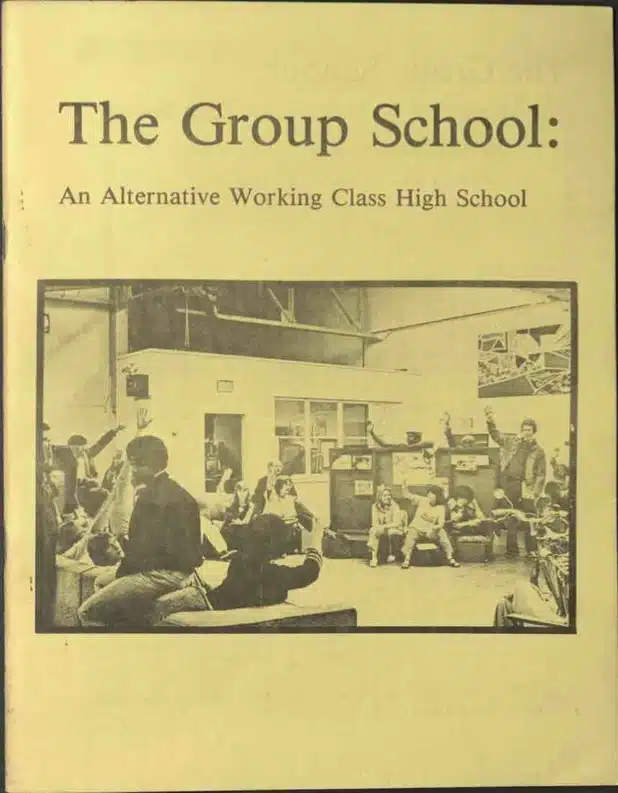
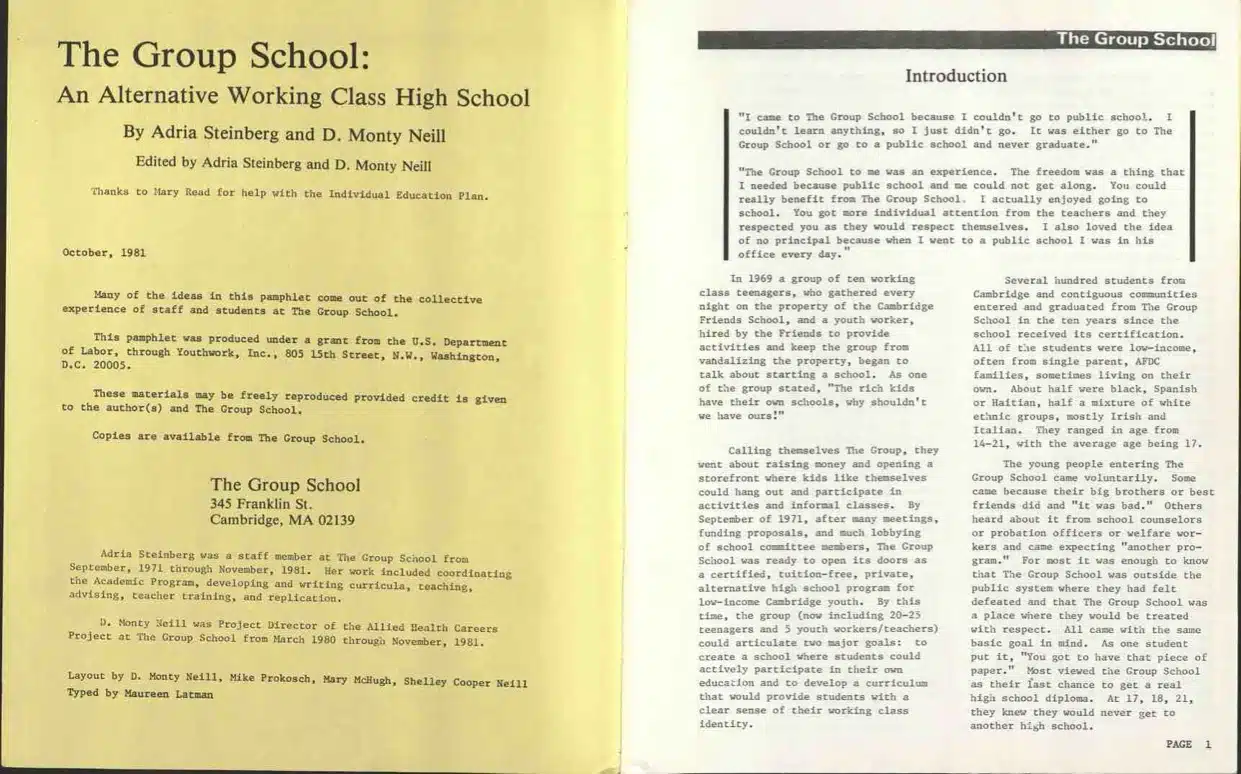
INTRODUCTION
“I came to The Group School because I couldn’t go to public school. I couldn’t learn anything, so I just didn’t go. It was either go to The Group School or go to a public school and never graduate.”
“The Group School to me was an experience. The freedom was a thing that I needed because public school and me could not get along. You could really benefit from The Group School. I actually enjoyed going to school. You got more individual attention from the teachers and they respected you as they would respect themselves. I also loved the idea of no principal because when I went to a public school I was in his office every day.”
In 1969 a group of ten working class teenagers, who gathered every night on the property of the Cambridge Friends School, and a youth worker, hired by the Friends to provide activities and keep the group from vandalizing the property, began to talk about starting a school. As one of the group stated, “The rich kids have their own schools, why shouldn’t we have ours!”
Calling themselves The Group, they went about raising money and opening a storefront where kids like themselves could hang out and participate in activities and informal classes. By September of 1971, after many meetings, funding proposals, and much lobbying of school committee members, The Group School was ready to open its doors as a certified, tuition-free, private, alternative high school program for low-income Cambridge youth. By this time, the group (now including 20-25 teenagers and 5 youth workers/teachers) could articulate two major goals: to create a school where students could actively participate in their own education and to develop a curriculum that would provide students with a clear sense of their working class identity.
Several hundred students from Cambridge and contiguous communities entered and graduated from The Group School in the ten years since the school received its certification. All of the students were low-income, often from single-parent, AFDC [Aid to Families with Dependent Children] families, sometimes living on their own. About half were black, Spanish, or Haitian, half a mixture of white ethnic groups, mostly Irish and Italian. They ranged in age from 14-21, with the average age being 17.
The young people entering The Group School came voluntarily. Some came because their big brothers or best friends did and “it was bad.” Others heard about it from school counselors or probation officers or welfare workers and came expecting “another program.” For most it was enough to know that The Group School was outside the public system where they had felt defeated and that The Group School was a place where they would be treated with respect. All came with the same basic goal in mind. As one student put it, “You got to have that piece of paper.” Most viewed the Group School as their last chance to get a real high school diploma. At 17, 18, 21, they knew they would never get to another high school.
The Group School’s success in reaching out and providing an education to this population of young people can only be understood in terms of its unique history, structure and funding base. The school was started by young people at a time when there was a great deal of support for alternative education, and a great deal of concern about the problems and consequences of poverty. The Group, Inc. was able to obtain primarily public funding to run a private school. The school could thus remain tuition-free and small (never more than 80 students), with a low student-teacher ratio. Perhaps more important, the students and staff had the freedom to develop a democratic decision-making structure that allowed for a great deal of student involvement and participation in all areas of the program — from hiring of staff to determination of credit requirements for graduation. And the school could create its own curriculum based on the needs and interests of working class, low-income and minority teenagers.
For the original group of teenagers and adults, a collective process based on mutual respect and trust was a fundamental part of the experience. Although students and staff were sometimes from different socio-economic backgrounds, we were not that far apart in age –— and a burgeoning youth culture provided common ground. We also shared a comfort in being “outside the system” and a belief that alternative institutions should be available to poor as well as rich. The most important work of that early period was figuring out how to infuse respect, trust and equality into the school program, how to institutionalize the informal collective process that had evolved among the original group.
The pamphlet which follows outlines the essential elements of the pedagogy, curriculum and organization of The Group School as it evolved over the past 10 years. We have largely set aside the historical flow of problems which, as with any living organization, continuously erupted. What we are presenting, therefore, is a distillation of our experiences, a model drawn from our successes. We are doing so in the hope that a great deal of what we discovered about teaching and learning, about advising and counseling, about decision making and power, can be valuable to people in a range of settings serving low-income youth such as other schools, agencies and organizations.
We must also indicate, however, that The Group School itself is undergoing a serious crisis. (See Postscript) The coming together of people, concerns and support that shaped and gave substance to The Group School cannot be recreated. In a political climate that offers little support for educational innovation and little commitment to providing quality services for low-income people, The Group School itself has had to modify its program and reduce its services. No doubt elements of this model will be changed in the new circumstances. Yet we feel it is in large part because of the previous successes of The Group School that the school will continue in the future, and that it will retain certain essential elements: the self-empowerment of students, the cooperatively run self-governing core, an advisor system which provides close support for students, and a curriculum which springs from the history and needs of the multi-ethnic working class population of Cambridge.
PEDAGOGY AND CURRICULUM
“Before I came to The Group School my inner feelings were locked inside. The rage I felt was inexpressable. My thoughts were locked in by my status in society. My status, well, just a poor half illiterate kid from the ghetto. Half illiterate because of the idiotic prejudices, thoughts and feelings conveyed upon me and all poor people through the injustices of society. Through The Group School those idiotic prejudices and feelings have been erased. But the rage is still there. It will never be wiped out until the unjustness of society has been corrected.”
“The Group School is not like any other school. It’s a school where you can learn and be yourself at the same time. I feel that I have learned more at The Group School than at any other school I have ever gone to. Going to The Group School has made me feel differently about myself in ways I can’t explain. But one thing is for sure, if you want to learn, The Group School is the place to be.”
An important part of the identity of young working class people is who they are on the street and in their neighborhoods. In learning to cope with the difficulties of growing up poor, black, working class in America they have developed amazing strength and resilience. They have gained a maturity incommensurate with their years; they have developed survival skills. These skills are accorded little or no recognition in most school settings. In the traditional educational institution, students are expected to give up their street identities, to move beyond their neighborhood ties, to hide or denigrate the knowledge they have picked up on the street, or in their struggles with institutional discrimination or official condescension.
For many of the young people entering The Group School, school represented a record of their past failures. Labeled “slow”, “unmotivated”, “behavior problem”, they had come to concur in these judgments of themselves. They felt stupid because they had gone to school for so many years and had never learned to read, write or compute competently. The very ideology being taught in the schools reinforced these feelings of personal failure and inadequacy: If this is a society based on equal opportunity, those who are not “making it” have only themselves to blame. For some, their embarrassment led to despair and withdrawal. Their attitude became one of “serving time”; a debilitating passivity set in. Others displayed hostility and anger. They acted out against the institution, became “troublemakers” and protected themselves with the pronouncement that school was irrelevant to their lives.
When The Group School opened its doors in September of 1971, the teaching staff found itself faced with the monumental task of creating a whole new curriculum. We knew that available remedial approaches would not work with most of the students. New streamlined workbooks, updated, more “relevant” textbooks, even combined with individualized attention, would resonate with old failures and trigger old reactions and patterns. By teenage, the students had developed specific skill blocks and overall school anxiety that would not be overcome with traditional remediation.
We felt that it was crucial to reverse the process of their previous schooling — to give students back their identity and self-respect in a school setting. We wanted to start by respecting the students, by acknowledging and legitimating their experiences and realities. Our goal was nothing short of the empowerment of the learners and a revival of their faith in themselves as capable, intelligent human beings. To be successful in reaching that goal, we knew we would have to make our primary focus not the low academic skill levels of the majority of the students, but rather the wide disparity between their skill levels and their maturity levels. Few of the available materials in any subject area seemed to acknowledge that gap.
We began to develop courses that would help students learn new skills and develop competencies in new areas while building on their already existing strengths and skills, courses that would help them build a positive identity as working class, black and white young women and men. Each new course led us to new insights and discoveries, until finally we could begin to articulate our educational goals and pedagogical principles. Having stated to each other what we were trying to do, we could then return to curriculum development with a sharpened focus and heightened sense of purpose.
Although teachers constantly developed new courses, we began to refine and finally put into writing some of our core curricula. Grants from diverse private and public sources enabled us to publish several of these curricula and engage in replication activities with other programs wanting to adapt our materials to their needs. Specific examples of how our educational goals and pedagogical principles informed and shaped the curriculum can be found in other pamphlets in this series, as well as in two of our publications: Changing Learning/Changing Lives: A High School Women’s Studies Curriculum from The Group School, and Neighborhood, Youth and Class: An Introductory Course on Class and Ethnic Identity.
Educational Goals
To help students:
Pedagogical Principles
STRUCTURE
“Walking into The Group School the first day was weird. I wasn’t used to seeing staff and students sitting around like that. But then I felt like I had been here all year long. I have really enjoyed The Group School. I got elected to The Admissions Committee and then I really got to know how the school is run. It is run by students and staff. Students have as much to say as a staff person. Before I knew it I was on every committee. I got a lot of academic skills from being on these committees, as well as from taking classes.”
“The thing I like most about the school is, I had just as much say on what goes on as the teachers. If I didn’t like something I would take it to community meeting and have it straightened out.”
Feelings of powerlessness can lead to despair and passivity or anger and acting out. Many of the students entering The Group School had school and work histories that included one or both of these patterns. Cognizant of these patterns, the people who started The Group School put into place the elements of a structure that would give everyone a sense of ownership of the program and that would further the overall goal of empowerment.
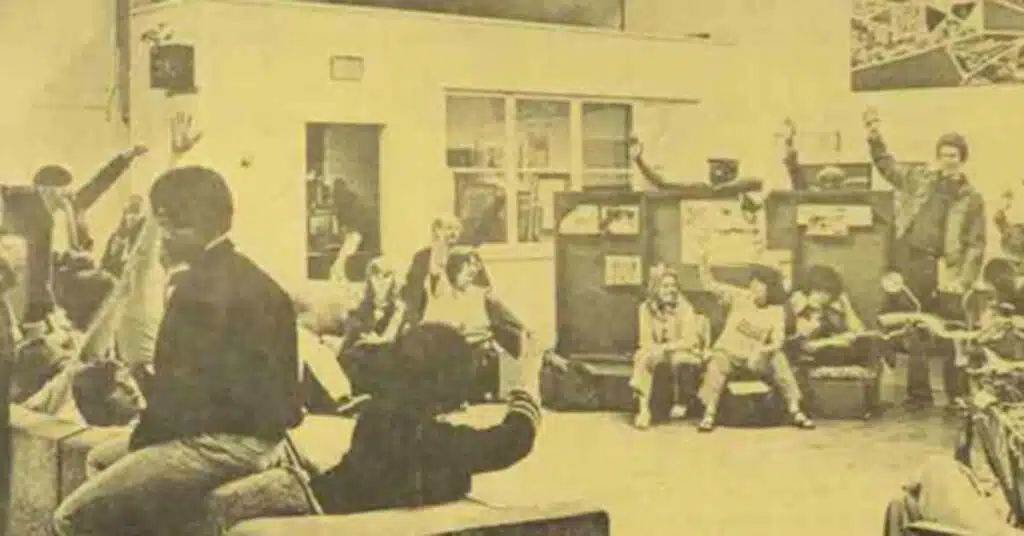
From the moment students entered the program they were expected to take responsibility for their own learning and progress, and were encouraged to play an increasingly active role in the maintenance and development of the program as a whole. The center of The Group School structure is its Community Meeting. Members of The Group School community included students, staff and volunteer teachers, each of whom could hold office, speak and vote. Community Meetings were held once a week and were the forum for discussion of school-wide issues and the “court of last appeals” for any problems not fully resolved elsewhere. The meeting was chaired by a student (usually from the Governance class) with the chair rotating weekly. Votes were normally by majority, though some issues required a 2/3 majority and a quorum was required “on demand.” The community delegated powers in several ways: to a Board of Directors, to the staff, and to committees. Most of the continuing work of the school was done in one or another of these groups.
The Board of nine members was composed of students, staff, graduates, parents and other interested persons in the Cambridge community. Five had to be students elected by the Community Meeting for one-year terms. The Board hired and (if necessary) could terminate staff, oversaw the finances and approved the budget and generally planned development for the schools. Its decisions could be overturned by the Community (hiring/firing and financial) or required community ratification to be implemented. The Board met as often as weekly and as rarely as monthly, depending on the business before it.
The community created several permanent committees to carry out continuous business. Each committee had staff and students, with a majority being students. Whether or not a student served on a committee, s/he was likely to have business with at least one of the committees at some point during the year and hence have the experience of seeing peers in decision-making roles. Below are brief descriptions of the major committees:
Admissions: This committee interviewed prospective students, proposed admissions policies to be considered by the Community, and implemented Community decisions (e.g. that there should be an equal number of males and females), oversaw recruitment and conducted the lottery The Group School held to enroll eligible applicants.
Academic: This committee dealt with curriculum and credit issues. The group reviewed proposals for courses from volunteer teachers, and requests for credits for special work by students. The committee also met with students having academic difficulties and attempted to resolve any problems or indicate requirements a student might have to meet to remain in or graduate from The Group School.
Activities: This committee dealt with problems of student behavior, and, where necessary, imposed penalties up to expulsion. At times the group would propose new rules to the community. This committee, as all committees, were accountable to the community and decisions could be appealed and overturned.
The staff, aside from its participation in Community Meetings, and the Board and committees, had its own structure and meetings. It, too, was accountable to the community. One continuously arising issue was that the staff –— older, more experienced, and the implementers of most of the school’s daily business –— often wielded a power beyond their proportional numbers in the community and on the committees.
The staff as a whole met two or three times a week. It discussed its own internal business, provided training of various sorts, dealt with student issues (special situations, student-staff relations, etc.) and more generally discussed the operation of The Group School. On the one hand the staff had to stay within policy limits set by the community, and, on the other hand, in many areas these policy limits were quite flexible, providing staff with substantial space to shape The Group School. For example, no courses at The Group School were required and the curriculum for each term had to be approved by the Community Meeting; but most courses were actually designed by staff, who collaborated with varying degrees of student input, in determining the courses to be offered and their scheduling. When the process worked best it was due to close cooperative interaction among staff and students and within the staff in ways that could not simply be mandated.
Structurally, in addition to its regular meetings, the staff had several component parts — Administrative, Academic and Advisory — each headed by a Coordinator. Most staff members were involved in at least two (and often three) of these components, i.e. teaching and advising, administering a particular grant and teaching, recordkeeping and advising. Each of the three Coordinators made sure her/his component was running smoothly and had particular training and supervisory tasks. Together, the Coordinators formed a Steering Committee that planned agendas for staff meetings and had overall responsibility for staff evaluation.
In its first years, The Group School had a director. The staff, gaining consent of the Board and Community, switched from this system to the Coordinator/Steering Committee system. The experience of the Steering Committee, however, was problematic. The necessity of supervision of staff led to serious problems of collectivity vs. hierarchy, accountability and “professional courtesy.” The Group School, like many organizations, wrestled continuously with these issues. The one definite conclusion was that the problems are continuous: no structure by itself is “perfect,” all structures require continuous effort as circumstances and people change.
THE STUDENT’S EXPERIENCE
“I think the main reason I got so much out of the school is because I could relate to it easier than other schools. The school is coordinated around working class people and is populated with working class students. It makes you feel comfortable knowing that everyone is equal. The Group School has also taught us how to go out after what we want when we leave school. We were taught by the school to take responsibility for ourselves and our lives in a way that we felt good about.”
“I really didn’t think I’d last here, I didn’t have faith in myself, but the teachers here did. I didn’t have any goals in my life, but since I’ve been here I can see that whatever I set my mind to do I can, and I’ll have The Group School’s support. I’m just sorry I didn’t come here sooner.”
Every aspect of The Group School program, from the intake procedures to the graduation requirements, were designed to convey to the students a fundamental respect for who they were, their experiences and their histories, as well as a concern for their future development and growth. Students entered The Group School uncertain of what to expect from the institution and wary of what would be expected from them. They knew what their previous schools had been like and they knew The Group School was supposed to be different. But how would these differences manifest themselves? Just what would the quality of this experience be like?
Enrollment Orientation
The initial Admissions interview began to provide answers to these questions. One or two students and a teacher from the Admissions Committee interviewed the applicant, asking questions about her/his schooling history and educational goals and plans. They then informed the applicant that the community had agreed to accept X number of students for the next term and if (as was often the case) there were more applicants than openings, a lottery would be held to determine who would be enrolled. Occasionally an applicant with a high enough income to attend another private school, or an applicant whose particular needs seemed beyond the resources of The Group School, was screened out. In most cases, however, everyone interviewed went into the lottery. The lottery was balanced for age (over and under 15) and for sex. The Group School community discussed how to balance the school ethnically and decided to do broad recruitment rather than to have lotteries by ethnicity.
Once accepted, new students participated in several days of orientation, in which they 1) attended a Community Meeting, where school procedures and policies were described and the schedule for the term discussed, modified and/or ratified; 2) met staff and students through an all-school activity such as a picnic or roller skating party and through work projects, like painting and fixing up the building; and 3) joined an Advisor Group.
Advisor Program
Every student in the school and most staff members participated in Advisor Groups. The groups consisted of 8-14 students and two staff. They met weekly to discuss school, community and personal issues and concerns. The curriculum for the groups was set by the Advisor Coordinator in consultation with the Academic Coordinator, other advisors, and an outside counseling professional. The curriculum consisted of interactive exercises, designed to lead to open-ended discussions around particular themes. One month the focus might be on restructuring the credit system of The Group School, another month on drugs and alcohol use and abuse. Groups could diverge from the curriculum to take into account the particular needs, interests and dynamics of their members. Each student in the group had one of the two staff members as her/his advisor throughout the time s/he was at The Group School. New students were asked to indicate which group they would most like to join or they could simply express a preference for a particular advisor.
The relationship between student and advisor and the peer support students received through Advisor Groups had a great influence on the quality of the student’s experience at The Group School. The advisor functioned as homeroom teacher, guidance counselor, mentor and friend to the student. The advisor was the person who stayed aware of a student’s attendance patterns, who helped the student stay in school through periods of illness, or family or personal problems, who advised the student concerning her/his selection of courses, who advocated for the student when s/he was making special requests for transfer credits or extracurricular credits, or was in trouble for a rule infraction, who made referrals when appropriate for the student or her/his family to available community resources.
During the first week of school, the new student and advisor began to get to know each other, both through activities and through the process of self-assessment, diagnostic testing and goal-setting involved in determining the student’s Individual Education Plan. (See Appendix) Each student was given diagnostic interviews and tests in English (reading and writing) and Math. (See Appendix) The English and Math diagnostic consisted of a series of self-assessment questions concerning the student’s familiarity and comfort with reading and writing and with computation. The English test consisted of two parts: a reading informal — a graded series of readings which a student was asked to read aloud and on which s/he was tested orally for comprehension — and a writing sample. The Math test consisted of a series of problems from the basic level of addition and subtraction, through geometry and algebra.
The diagnostic interviews and tests were utilized to determine the student’s skill levels so as to place her/him in appropriate classes. They were administered by members of the English and Math Departments with a written evaluation of the results going to the advisor to share with the student and enter on the Individual Education Plan. Because many of the students were test phobic and reacted poorly to the traditional battery of tests, diagnostics were informal and incorporated self-assessment techniques. If standardized tests were required by particular grants (i.e. Title I), we administered these through classes later in the term, once students had adjusted to school.
The answers students gave to the self-assessment questions on the Math and English interviews were used to determine what parts of the English and Math diagnostic tests would be given to them. For example, if a student said s/he never read anything, the teacher administering the reading informal would give her/him one of the easiest readings to start with, only moving to higher levels if the student was proficient at the lower level. The writing sample was also designed to take into account the student’s self assessment. Those indicating a comfort with writing were asked to write a 2-3 paragraph schooling autobiography (their history of experiences with school); those frightened of writing were asked simply for a series of “I wish…” statements. Similarly, if a student in the Math interview said s/he hated math and couldn’t do it at all, s/he was given the basic operations section of the Math diagnostic and only given the fractions and decimals section if s/he had no trouble with basic operations.
By starting with the interviews, the student was spared the embarrassment and pain of stumbling over whole reading selections or leaving problem after problem on the Math diagnostic blank. The interview process both increased the student’s self-awareness of her/his skills and needs, and increased the student’s sense of empowerment by providing her/him with a degree of control over the process and validating her/his opinion and needs. Although recommendations on course placement were made by the English and Math Departments as a result of the tests, negotiations could ensue around this issue, with the advisor serving as arbitrator. Final decisions rested with the student.
The student’s interviews and diagnostic test results were combined with their personal (social, familial, work) and academic histories, their needs and desires, into an Individual Education Plan. The Plan was a yearly program worked out by the student and her/his advisor, indicating what the student would do that year at The Group School. It took into account her/his strengths, weaknesses and personal goals. It particularly indicated courses the student planned to take and skills s/he planned to acquire during the year. Rarely did a student take more than six courses or fewer than three, and four or five was the norm. Students were encouraged to take a range of courses and to explore areas unfamiliar to them.
Daily Schedule
A student might have anywhere from one to five periods in a week when s/he was not scheduled into classes. Once classes were underway and students adjusted to their new academic schedules, they were encouraged to participate in committee meetings, tutorials, mini-courses and more informal activities during these free periods. Students whose skills were below grade level could make use of the Title I Math and English labs.
Free periods were also seen as a time for a student to meet individually with her/his advisor (in some cases, once or twice a week) and to see the jobs counselor and/or college counselor (as needed). During the first few weeks of each school year, every student was interviewed by the jobs counselor to determine her/his work needs for that year and to encourage long-term vocational planning. By late fall, all potential graduates were also invited to meet with the college counselor to begin the long process of choosing among appropriate post-secondary programs, writing applications and applying for scholarships.
Generally, the older a student and the longer s/he had been at The Group School, the better use the student made of these free periods. The quality of the time also depended somewhat on the accessibility of staff. If one or two staff members were free to “hang out” in the lounge area, they could generally engage even the most reluctant student in some form of activity — whether it be ping pong, or chess, or a visit to the art room to make Christmas decorations or birthday cards. When staff were all overscheduled and busy, some students would become bored and hence begin to act in ways that were disruptive to the school environment. Although the issue of “too much free time” was continually discussed, it was generally agreed by students and staff that the time was important to the development of a sense of responsibility for one’s own behavior and growth.
Contracts and Evaluations
In each course, the students negotiated a contract with the teacher stipulating the expected levels of work and attendance. (See Appendix) Students earned a complete in the course by meeting the requirement of the contract. For the most part, teachers had already set the course content, but would involve students in decisions about particular activities (speakers, trips, films) and sometimes in the selection of additional topics to explore. At the close of the term, each teacher prepared an evaluation of each student. The evaluation form included a description of the course content, allowed space for a written evaluation by both teacher and student, and indicated whether or not the student completed the course and earned a credit. The teacher’s comments evaluated the student’s participation and what s/he learned, and sometimes commented on the teacher’s relationship with the student. The student evaluated her/his own work and the quality of the course and the teacher.
Also at the end of each term a meeting was held with the student, her/his advisor and teachers to discuss the student’s overall progress. The Individual Education Plan served as the blueprint for that meeting, with progress viewed in light of the goals established on the Plan. The meeting focused on academics, but could include the student’s extracurricular activities (i.e. sports, committee work) and her/his social, family and work situations. A summary of this meeting was entered on the Educational Plan, the Plan modified as needed, and the program for the coming term set.
Graduation
A student could graduate from The Group School when s/he had earned 36 credits and had been at the school for at least one year (three academic terms). Most Group School courses carried one credit, although if a course was especially demanding, the Academic Committee might award two credits for completion, and certain seminars and tutorials carried only 1/2 credit. On enrollment, students transferred credits from other schools. As different schools have terms of different lengths and have different requirements, the advisor and, if requested, the Academic Committee, reviewed the transcripts and indicated the number of credits accepted for transfer. Unless special permission was obtained from the Academic Committee, a student could earn a maximum of 15 credits a year, 5 per term, with 3 terms in a year. An older student with few transfer credits was usually granted permission to earn up to seven or eight credits a term.
During the final year, students received futures counseling. Having discussed tentative future plans with their advisors, they received individual attention from the jobs counselor and/or college counselor. The point was to help the student think about “life after high school” early enough in the year to make concrete plans for the following September. As part of the futures planning, the Advisor completed a transcript for the student. This involved reading over the student’s Education Plans, course evaluation and other materials on file in order to prepare a one-page narrative indicating the types of courses taken, extra activities (such as committees), the quality of her/his work, and the skill level in various disciplines, while trying also to present a sense of the student as a person. This narrative would then be combined with a final listing of courses taken and a description of The Group School to form the student’s transcript.
In the spring, graduating students participated in the Graduates Seminar. The curriculum of this group was designed to help students deal with their feelings about leaving The Group School and their fears and excitement about the transition to college or work. The group was also responsible for planning the Graduation Ceremony — from how to decorate the theater area to who should speak. Everyone in the group was encouraged to write a final statement to put in the Yearbook with her/his picture and/or to read aloud at graduation. While graduation night marked a very important turning point for many students, it was not the end of their involvement with The Group School. Often students stayed in touch for a year or two of counseling and referral services. Some graduates made use of special employment opportunities, like The Group School Advocacy Project or the Allied Health Careers Project. Those who had been especially involved in The Group School drama program came back to join the graduates’ Community Theater and Film Workshop, producing plays for a broad community audience.
POSTSCRIPT
“The Group School is a school for students who can’t stand the dull routines of public schools, and who have their own minds and ways of thinking. The Group School also lets students have the last say in the major decisions that may come up in the course of the year.”
As a private school which charged no tuition, The Group School became particularly vulnerable to the cutbacks in educational funds (due to inflation and direct reductions) which began in the late seventies. The effect of these cutbacks was not only the immediate loss of money, but also a savage assault on the value of teaching itself. Teachers were told, in effect, that their job was increasingly irrelevant and that their students were, on the one hand, not worth the investment, and, on the other hand, poorly taught. For teachers working “on the fringe” in an experimental program, outside of the public system, the socio-economic assault hit perhaps even harder. Such a crisis situation demands alteration in program operations, if an institution is to survive. But the nature of the assault itself tended to induce paralysis and defeatism, reducing the capacity of The Group School to respond.
During the past two years, the general, societal-induced problems were compounded by internal difficulties at The Group School. As the internal and external problems reinforced one another, the crisis deepened. The essential internal problem became a severe lack of communication among staff. The racial composition of the staff changed from mostly white to nearly half black. The regular meeting structure of the staff did not require communication around the complicated issues of race, class and sex. At best, staff merely assumed that, as people concerned with students, they should and would work cooperatively. However, background, ideas and needs differed seriously and, being unaddressed, grew into deep chasms of non-communication.
The different backgrounds of the staff contributed to different perceptions of what The Group School was and different visions of what The Group School should be. Instead of building on each other’s strengths and knowledge, staff tended to divide into camps. In such an atmosphere, the institution could not evolve creatively, nor adapt to the ever worsening socio-economic conditions. With a sense of direction faltering, and key staff not communicating, there was a breakdown in accountability. The process of mutual supervision, staff development and accountability for job performance all suffered.
At the end of the 1980-81 school year several grants ended simultaneously, and a large part of the staff was laid off. Remaining staff, together with a small group of returning students, are trying to rebuild The Group School. It now appears that a combination of resources will allow the financial survival of the school, at least through the 1982-83 school year, although on a reduced scale. The shape of this new Group School will evolve from the plans of staff and students as to how to solve or prevent recurrence of the problems noted above, how to obtain funds, and how best to utilize the positive aspects of The Group School model — the self-empowerment and the cooperative, working class, multi-ethnic educational program which has developed over 10 years.
As part of its survival plan, The Group School is working towards more collaborative programming with other community-based groups. Cooperative arrangements being explored include: sharing physical space; developing interactive programs, whereby, for example, an arts group could obtain part of their funding to work with Group Schools students; and creating internship programs for Group School students in community organizations. Such activities will utilize and strengthen students’ roots and ties in their own communities, develop a wider base of support for the school, and enhance the self-empowerment aspects of the program.
The original pamphlet includes several appendices including assessment tools, student surveys, and an Individual Education Plan structure. You can find these in the facsimile