
Ashley Goetz and Bill Eagle are members of the National Attendance & Engagement Meta Network
Chronic absenteeism—defined as missing 10 percent or more of the school year, or at least 18 days in a 180-day calendar—has emerged as one of the most urgent challenges facing schools. Rates have more than doubled in many districts, with some states reporting that up to 40 percent of students are chronically absent (Attendance Works, 2023; Mervosh & Paris, 2024). The academic and social consequences are significant: Frequent absences are linked to lower achievement, early literacy gaps, increased dropout risk, and social-emotional disengagement, while also disrupting classroom instruction and limiting schools’ ability to deliver timely interventions (Attendance Works, 2023; EveryDay Labs, 2025). Although barriers such as transportation, health, mental health, and bullying contribute to absenteeism, research points to a critical underlying factor—shifting parent beliefs about the necessity of consistent, in-person attendance. Many families perceive missed days as harmless and view make-up work as an adequate substitute, despite evidence that these beliefs undermine student success (Ad Council Research Institute, 2024). Traditional truancy enforcement approaches, which are often reactive and punitive, have shown limited effectiveness and can strain trust with families. Together, these findings suggest that reversing chronic absenteeism requires proactive, evidence-based attendance communication strategies that address misconceptions, build shared responsibility, and reinforce the value of daily school attendance.
To address the complex challenge of chronic absenteeism, the National Attendance & Engagement Meta Network unites school leaders, educational service districts, and community partners around a shared goal: ensuring more students—especially those furthest from opportunity—are present and engaged in school. As a national learning community, the Meta Network rapidly identifies, tests, and scales promising practices to address attendance challenges. Early evidence underscores the power of strategic, timely communication with students and families in reducing chronic absence.
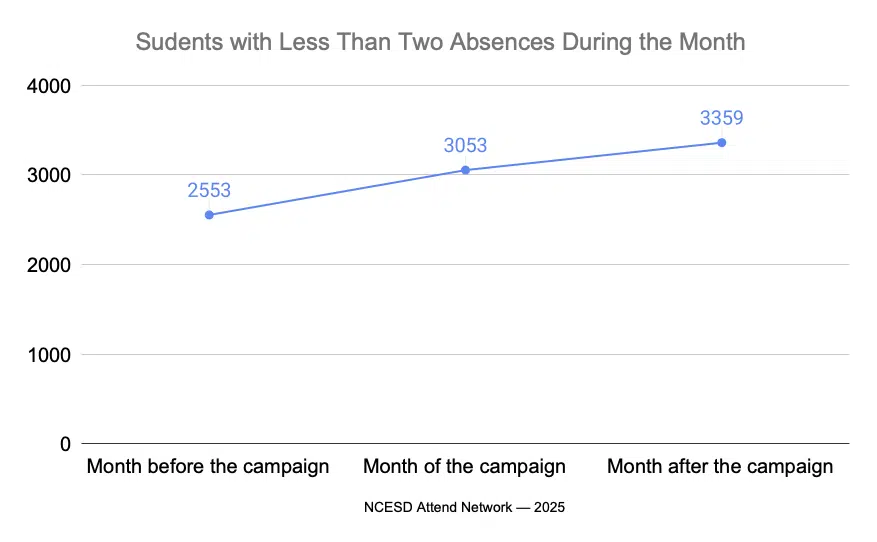
As a Meta Network member, our regional attendance network designed a sequenced communication cadence that rolls out in three waves: a “Start Strong” attendance campaign in the fall, followed by winter and spring campaigns. Early evidence suggests that such campaigns positively impact attendance not only during the campaign but continue to produce positive impacts for a short time afterwards. Across the network, the number of students with fewer than two absences during the month rose from 2,553 before the campaign to 3,053 during the campaign and continued to stay elevated during the month after campaign completion (see Figure 1).
Figure 1: Students with fewer than two absences during the month (Source: NCESD Attend Network (2025))
Each campaign focuses on educating the school community about the value of attendance. To achieve this, the campaigns sent out an informational blitz about the importance of attendance—which included universal messaging designed to shift norms—and the use of an incentive system for positive attendance. Following each campaign, teams deploy “nudge letters”—personalized, non-punitive messages—targeted at students and families whose attendance data indicates they are at risk of becoming chronically absent. These nudges are personalized and include the student’s name, specific information about their absences, and are typically sent via post to homes. This sequence allows schools to ride the wave of awareness generated by campaigns and extend their impact through strategic, data-informed touchpoints.
Experience across our regional network demonstrates that short-term communication surges can improve attendance in measurable ways, especially when reinforced with timely data and consistent follow-up like nudge letters.
Targeted campaigns and nudge letters can function as effective individual strategies for helping schools interrupt attendance declines before patterns become entrenched. However, our data suggests that nudge letters and campaigns used in combination with other strategies and completed using a specific cadence amplifies impact. The North Central Education Service District (NCESD) Attendance Network implemented a seven-component attendance change package designed to support schools in building coherent, proactive systems. A clear pattern emerged: schools that implemented more components of the change package experienced lower chronic absence rates. Specifically:
This pattern reinforces a critical insight: Attendance improvement is not driven by a single strategy, but by the strength and consistency of the system supporting it. The seven indicators—when implemented together—create reinforcing conditions that normalize attendance, promote early action, and sustain improvement over time. Among these seven components was a focus on using the strategies in a specific cadence.
Our regional network organizes attendance communications into three strategic waves:
Start strong (early fall) to establish expectations and norms.
Mid-year reinforcement (early winter) to counter emerging attendance drift.
Spring persistence (early spring) to prevent late-year disengagement.
Early network findings indicate that these short, focused communication surges produce attendance gains that persist for several weeks beyond the messaging window, allowing schools to ride the wave of awareness and reinforce positive behavior with timely, personalized outreach.
Embedding a cadenced communication strategy within broader systems ensures that families hear from schools early, often, and in ways that build momentum rather than fatigue.
We encourage schools to reflect on how and when they currently communicate with families about attendance. Are the messages personalized? Are they framed with empathy? Are they delivered early enough to change behavior before patterns become entrenched?
Chronic absenteeism is a multi-faceted issue requiring multi-level solutions. While communications and campaigns are essential tools, they are most effective when embedded in broader systems and carefully cadenced. Schools that establish attendance teams, meet regularly to review real-time data, and implement supportive interventions—not just enforcement measures—are best positioned to make sustainable improvements.
Ad Council Research Institute (2024). Back to the Classroom: How to Overcome Chronic Absenteeism and Encourage Parents to Send Kids to School Consistently. https://www.adcouncil.org/learn-with-us/ad-council-research-institute/chronic-student-absenteeism.
Attendance Works (2023). Chronic Absence Remained a Significant Challenge in 2022–23. https://www.attendanceworks.org/chronic-absence-remained-a-significant-challenge-in-2022-23/
EveryDay Labs (2025). Spring Slide 2025 Webinar Materials. https://www.attendanceworks.org/resources/spring-attendance-slump/.
Mervosh, S., and Paris, F. (2024, March). Why School Absences Have “Exploded” Almost Everywhere. New York Times. . https://www.nytimes.com/interactive/2024/03/29/us/chronic-absences.html.
U.S. Department of Education (2023). Chronic Absenteeism Data Story. https://www2.ed.gov/datastory/chronicabsenteeism.html.