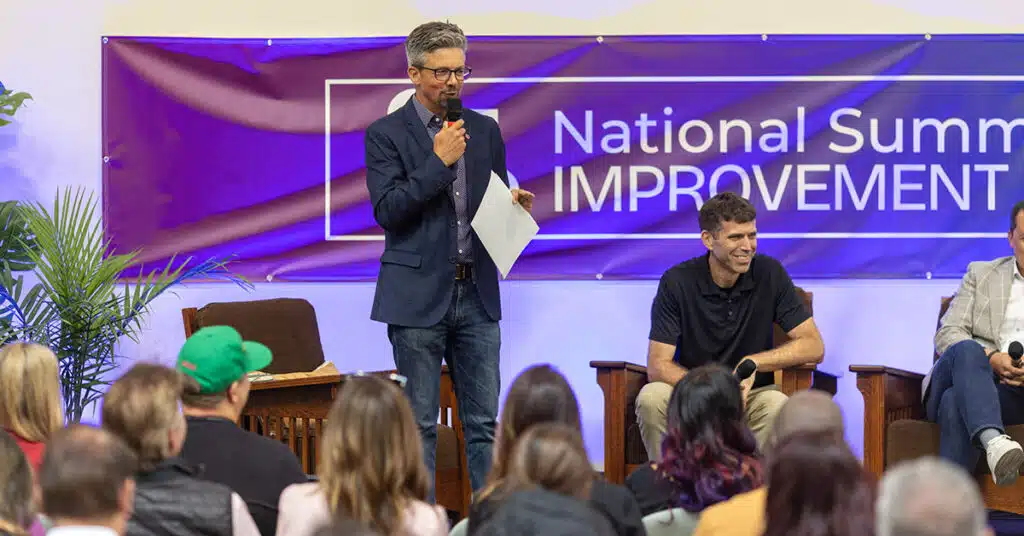
In April, I had the great pleasure of moderating a “crossover” panel that spanned the Deeper Learning Conference and the National Summit on Improvement in Education.
The title of the panel was “Continuous Improvement or Deeper Learning: Why Not Both?” and on the panel were Hewlett Foundation education director Ash Vasudeva, New Tech Network CEO Jim May, and High Tech High GSE president Ben Daley.
I keep returning to the conversation (and you can too—we released it on the High Tech High Unboxed podcast here) and there are an absurd number of passages I want to share with you, but I’m just going to share one. It comes from Jim May—he was talking about how continuous improvement can serve the cause of deeper learning:
You need a method for constructing shared meaning. And shared meaning (even if it’s coming from a set of values and ideas that I believe in deeply, like deeper learning) can’t be a set of normative practices that I hand down as the formal leader of the organization—shared meaning has to be cultivated communally over time.
Continuous Improvement gives you a set of tools to do that right, whether it is a fishbone diagram or a driver diagram, or a PDSA cycle or a run chart. Those tools are not a substitute for judgment, but they create the conditions within which collective wisdom can emerge.
There’s so much here, but I want to point out one thing: the idea that “shared meaning has to be cultivated communally over time, is the central premise of constructivism, the educational philosophy that underpins “deeper learning” as a concept.
When an attempt at constructivist pedagogy fails to lead to deeper learning, it’s normally because a teacher expected learning to emerge without enabling structures. So although Jim is talking about continuous improvement when he describes tools “that are not a substitute for judgment […] but create the conditions within collective wisdom can emerge,” he could just as well be talking about deeper learning.
In other words, continuous improvement is an enabling structure for deeper learning.
I think this is a helpful frame for experiencing the articles in this issue.
We start with Jim May himself on “what deeper learning and continuous improvement owe one another,” followed by Ben Daley on what deeper learning can get from continuous improvement, then Jeff Boxill reflects on coming to improvement as a skeptic.
Next we have two articles on student “belonging”: Chandler Patton Miranda draws on her extensive research into the work of New York’s International High School on supporting immigrant students, and Michellea Millis Rucker provides insights from an improvement project on building belonging for multilingual learners.
We also have three articles about continuous improvement and deeper learning internationally: Milena Carmona and Ingrid Puche tell the story of a co-designed first grade project in Brazil, Eduardo Lomba relates what happened when a Portuguese school district took student voice seriously, and Ramiro Séré shares how a school district in Argentina has created an international professional learning community.
Want help with chronic absenteeism? We’ve got you. Learn about the “butterfly strategy” from Jon Green, find out how to design a full year cadence of family communication from Ashley Goetz and Bill Eagle, and let Amanda Meyer and Sofi Frankowski challenge your assumptions about the role of “incentives” in attendance.
And finally, we have a tried-and-true strategy for managing classroom noise levels, and a second article from Ben Daley: this one, appropriately, about why it’s important to make senior leadership a little uncomfortable in improvement reviews.
Stay curious, my friends
Alec Patton
Editor, Unboxed