Let me begin personally. To gauge the significance of my work, I occasionally pause, close my eyes, and think of a student connected to that work. Let’s consider Luísa, a seventh grader at one of the Oeiras schools involved in the ongoing school redesign movement I’ll discuss here. I bring her to mind, feel the affection, and let emotion sharpen my clarity, focus, and sense of purpose. Then I ask myself: “Is this work truly learner-centered? Will it influence Luísa’s learning and growth in any meaningful way—even indirectly?” If not, I reconsider what I’m doing. Sometimes we lose focus—or are forced to—spending valuable time on work that does not meaningfully impact students’ lives and learning.
Schooling is among the world’s greatest collective enterprises and has driven profound social transformation. With vast investments, countless regulations, and an army of teachers, it is one of the organized human activities that involves the largest number of people on a daily basis across the planet. The world would be worse off without it, yet the recipients of this tremendous collective effort often do not experience the impact on their learning, development, and identity that they otherwise might. For nearly two centuries, millions of children have remained passive, silent, and overlooked, unable to express their unique identities through their learning journeys. We may debate what best serves students, but although schools exist for them, it is clear that the prevailing school model is not, in many respects, student-centered. Rather, it is teacher-centered, curriculum-centered, test-centered, grades-centered.
Across Portugal and in Oeiras—a municipality in the Lisbon metropolitan area with the country’s highest literacy rate, and strong business, scientific, and technological development—many school leaders are acutely aware that the traditional model perpetuates practices that are ineffective for many students. It fails to develop essential skills, and coexists with—and resigns itself to— high levels of student dissatisfaction and disengagement.
These leaders recognize that the prevailing model is characterized by the isolation of teachers and students, rather than collaboration and cooperative construction; by inaction, listening, and passivity, rather than dialogue and creative action; and by the disconnection of schools from local learning opportunities, rather than meaningful engagement with the surrounding communities. They know this model is more about prioritizing testing, memorization, replication, grading, and ranking students, and less about deep, higher-order learning that fosters inquisitive and engaged minds and a lasting connection with knowledge. They are also acutely aware that this model is transforming motivated and creative professionals into worn-out, mechanical replicators and evaluators.
Worldwide, a growing number of schools are rethinking their educational approaches (Lomba, Alves & Cabral, 2022), and a consensus is emerging: We must move beyond the old industrial, mechanized, impersonal, one-size-fits-all model. We need more personalized, humanized, relational schools; vibrant and joyful learner-centered environments that foster authentic work, deep knowledge, and support students in shaping their own lives with identity and purpose.
The progressive and collective deepening of understanding about the obsolescence of the traditional school model, alongside the possibilities for improvement, sparked a desire for transformation that gave rise to the community-rooted school redesign movement in Oeiras’ public schools. With the strong support of the Oeiras Municipal Department of Education, it began with three courageous women—Rita Rolo, Isabel Marques, and Alice Simões—visionary principals of three school clusters encompassing 11 schools and more than 4,500 K-12 students, within a broader municipal educational system of ten school clusters, 46 schools, and approximately 20,000 K-12 students. This movement is now advised by the Center for Love & Justice at High Tech High Graduate School of Education (HTH GSE) and the Learner-Centered Collaborative.
I asked Rita if there was a particular moment that convinced her she needed to make a radical change. Here’s what she said:
There wasn’t a moment of sudden revelation, but rather an accumulation of experiences, questions, and small frustrations that made it impossible to continue doing “more of the same.” Seeking to transform the educational model was, above all, an act of responsibility and hope in the potential of students and teachers.
Isabel adds:
After so many years of hearing about putting the student at the center and about pedagogical differentiation, the realization that these principles have yet to translate into effective pedagogical and classroom changes demands the audacity to seek and embrace challenges that allow us to fulfill these objectives. We will only achieve this when we have the courage to change practices, giving professionals the necessary tools so that they feel comfortable implementing a true transformation of education.
And Alice observes:
This desire for transformation was not triggered by a single moment of inspiration, but by a continuous process of questioning and listening. As we recognized the gap between the school we have and the school our students need, it became clear that it was necessary to act with courage and imagine new ways to learn, teach, and lead.
The educational community of Oeiras aims to transform more than just a few schools. They want to build a vibrant, student-centered learning ecosystem across the municipality—one capable of inspiring communities throughout Portugal and beyond. Political leaders in Oeiras strongly support this vision.
Following discovery visits in March, the HTH GSE and the Learner-Centered Collaborative—organizations with which I now collaborate in implementing this vision—carefully designed a project spanning the next two years, framed within a long-term perspective. The project is contextualized to the local reality and envisions a sustained and progressive transformation. It begins on a small scale, with the hope of being extended to the entire municipal educational system, and with the vision of creating a community-based, learner-centered ecosystem in Oeiras.
After a Leadership Summit in July that brought together 28 teachers and three municipal leaders, we began working in November with the three school clusters led by Alice, Isabel, and Rita. These three school leaders trust one another, embody love- and learner-centered leadership, and share a bold vision for collective community transformation. During our visits, dozens of students passed by—students they knew personally, along with their stories, joys, and challenges. In every school we visited, there was a group of changemakers with a strong collaborative spirit already engaged. There is a clear opportunity to accelerate what’s already underway.
The Center for Love & Justice and the Learner-Centered Collaborative crafted experiences to center student voices, strengthen community ties, and develop leadership capacity. In a community gathering, parents, principals, teachers, the education councilor and his team came together to reflect on how a learner-centered vision for schools could be fostered. By valuing parents’ insights, this moment marked a first step in building the trust between schools and families that is essential for transformation.
Teachers, coordinators, and the three principals who make up the change-leadership teams began developing leadership capacity, a shared vision, and the systemic conditions needed for lasting change. While envisioning a learner-centered school with more connected teachers, they explored project-based learning as a pathway to deeper learning.
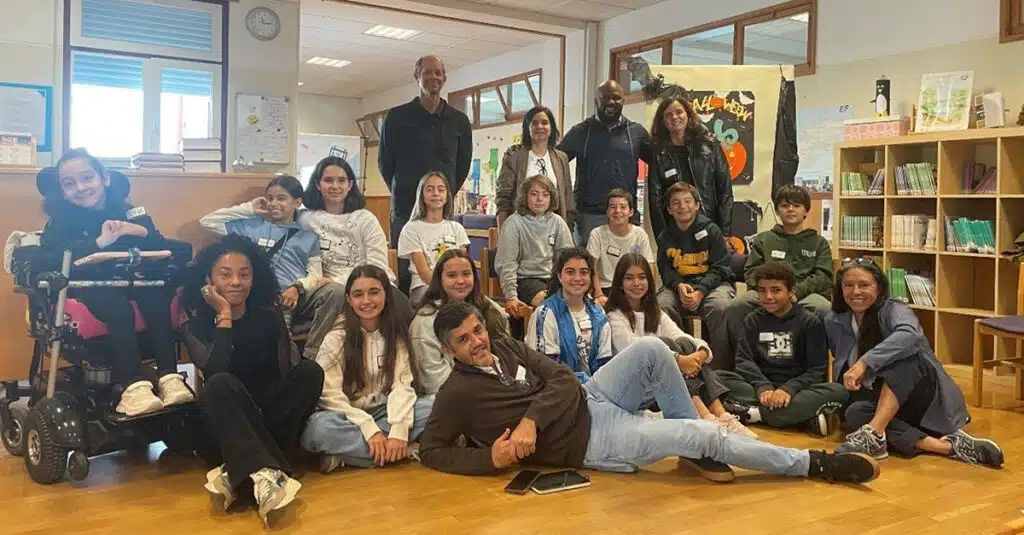
In November, we brought students into the work—40 of them, from grades five to ten—placing their voices at the heart of the process and later sharing their ideas with parents and teachers. One guiding question shaped our work: How might we listen to and empower students to actively participate in reshaping the way we do school? Their eyes shone with anticipation, filled with hope for richer and more engaging school days.
The students’ message was clear and resounding: They want to be co-designers, to have a say in how their learning and school life unfold. They want to learn deeply, in new and meaningful ways. They want their individuality and identities to be acknowledged, along with their interests. They shared dozens of personal interests that they may never have voiced at school before, interests we now hold dear and cherish. They want projects, authentic work, and opportunities to actively engage with the world, putting their ideas into practice. They seek more creation, more exploration, hands-on learning, experimentation, and field trips. They long for greater agency, deeper collaboration, richer relationships, and a stronger sense of purpose and meaning throughout their school journeys.
Among the many insightful comments shared by students, a few stood out for being strikingly direct:
We did not frame the discussion as a call for change, nor did we dwell on the shortcomings of the traditional school model. Yet on the very first day, Luísa penned this note on a Post-it:
“I wonder… is the broken school system actually going to fix itself for us? :(”
What more compelling plea could there be than Luísa’s question? And now? Now, Luísa, as you can see, the community of Oeiras has a plan to transform your school. For you, for your classmates, for your entire community. For this, we need your help, and that of your peers. Our work will not be finished until your school journey, and that of your classmates, is truly transformed for the better—with you, your learning, your growth, your identity, at the very heart of everything we do.
Lomba, E. A., Alves, J. M., & Cabral, I. (2022). Systematic Literature Review of Innovative Schools: A Map and a Characterization from Which We Learn. Education Sciences, 12(10), 700. https://doi.org/10.3390/educsci12100700