Jon Green is a member of the National Attendance & Engagement Meta Network
Dawn Berry was the new kid. She had just transferred to a small high school in the Bronx. Don’t even ask about her experience at her former school. But here she was, in the hallway between periods, meeting with Assistant Principal (AP) Ian, who was carrying some official looking document. “Dawn Berry?” asked Ian. “Yup that’s me,” Dawn said.
Ian handed her the document. On the front was a sea of red colored tables and numbers documenting Dawn’s spectacularly poor attendance since starting high school in Brooklyn a year and a half ago. “Let’s talk about your attendance,” said Ian. “Were you absent last Thursday?” Dawn flipped the document over to reveal a calendar with each month of the school year and all her absences highlighted with a little red x. “Wait, I was here last Thursday,” Dawn said, suddenly remembering. Ian thanked her, circled the date, and told her that once corroborated, her absence would be reversed.
So began a weekly meet up, usually in the hallway, between Dawn and AP Ian. Ian always had the piece of paper and was always surprisingly curious about Dawn, eager to help her improve her attendance. Dawn started to notice she looked forward to these check-ins. No one at any of her former schools had ever seemed to notice her.
The Bronx school of 320 students where Dawn and Ian have their check-ins is part of a New Visions Network pilot implementing the “butterfly strategy.” At the heart of this strategy is a consistent, weekly, 1:1 attendance meeting between a chronically absent student and their attendance point person.
Using this strategy, New Visions for Public Schools, based in New York City, has lowered chronic absenteeism for a subset of students who have contributed to the increase in absenteeism since the pandemic. These students, known as “butterflies,” accrue at least 1 absence per week for the majority of any 10-week period. In the fall of 2023, an attendance team in the Bronx discovered that these students responded surprisingly well to weekly, data-driven, 1:1 check-ins with the same adult. The learning from this team spread to 4 sister schools, and by the fall of 2024, 12 pilot schools signed up to implement the strategy.
In 2025 the project scaled to 25 schools, representing 12,388 students across 4 boroughs. In 2024 the strategy yielded promising results, which included:
The 1:1 check-ins work because they ground a conversation about absenteeism in data. The discourse is localized, specific, and tethered to the reality of weekly changes in attendance. Moreover, the act of sitting with a student weekly and analyzing their recurrent patterns unlocks the stories behind their absenteeism. In this structure, any agreement or intervention is responsive to a shared understanding of the root problem.
In many schools, attendance incentives like pizza parties are based on assumptions about why students are not coming to school. These assumptions, however well-intended, are often not grounded in the observational insights gleaned from a weekly conversation with a student about their attendance struggles.
Dawn Berry presents a good case study. When Dawn entered her current school in March 2025, she had a 35% attendance average and only a few summer school credits to her name. Now, she is an “off-track” 11th grader who is hovering around an 85% attendance average. That is, by January 30, 2026, she had missed 13 days of school out of a total of 89.
Dawn’s current and former attendance rate put her in the category of “chronically absent.” To get out of this category, she would need 90% attendance. Prioritized outreach is typically based on these blanket designations (e.g., chronically absent = < 90% YTD), and these designations typically group students like Dawn into intervention lanes (e.g., letters home, incentives, family conferences) that focus on re-engagement. But here’s the thing: Dawn does not have an engagement problem. She has an extremely tenuous home situation that is not going to get less complicated. A pizza party is not going to work.
Dawn continues to exhibit chronically absent behavior, but underneath this bleak designation is a student who has turned a corner academically and found belonging at her new school. Initial high school years, marked by extreme levels of absenteeism, relegated Dawn to a cycle of multi-term failure and non-matriculation. Last year, Dawn’s absences interrupted 19 or more of the school’s 37 instructional weeks. This year, her absences have affected fewer than 9 of the 18 instructional weeks that have transpired to date. That means Dawn is banking more complete weeks of instruction this year. These blocks of week-on-week uninterrupted learning have helped Dawn achieve her most successful high school term to date.
Using an established routine, New Visions coaches pull all active students’ data within a criteria band prior to each interval. The criteria is somewhat situational. For example, New York City experienced a massive snow storm that spiked chronic absenteeism rates the week of February 23, 2026. The weather event required coaches to adjust the criteria in order to rule out students who were suddenly deemed chronically absent because of the storm.
Spring 2026 data pull criteria look like this:
Students within the 8–13 year-to-date (YTD) absence band who also have 1 or more absences in 5 of the last 9 school weeks. These absences occurred within the 9 significant weeks of instruction from 12/01–02/23, excluding a week of testing in January and the two-day week before Christmas break.
These students are the butterflies.
The check-in happens no later than the end of day Tuesday. Timing this conversation early in the week increases the likelihood that the student will attend all days that week. The check-in focuses on the concrete unit of a week (e.g., last week, this week, next week) rather than the more abstract improvement in a YTD percentage or moving out of an external designation like “chronically absent.” The adult, or attendance point person, is typically either a teacher committed to a small caseload of students (2-5 max), or a school social worker, counselor, aid, or administrator with capacity to commit to a larger caseload. A caseload ceiling is around 12 students. Everyone involved in this effort sits on an attendance team and meets weekly to make plans and monitor actions.
AP Ian became Dawn’s point person because he was charged with adding late admitted chronically absent students to his caseload that spring. The logic of assignments is governed by the school site. Many pilot schools assign the adult closest to the student in terms of role (e.g., their section teacher, their grade’s school aide, their school counselor, etc). Typically the admin picks up the slack and takes butterfly students like Dawn who aren’t obviously connected to an attendance point person.
The attendance point person prints out a weekly attendance snapshot from the New Visions portal. The snapshot displays attendance trends in 5, 10, and 20-day intervals, patterns of absences by day of week, a table showing historical monthly averages that reaches back to middle school, and a highly visible monthly calendar graphic with red X marks for dates absent and yellow slash lines for dates with lateness.
This is what the “weekly attendance snapshot” looks like:
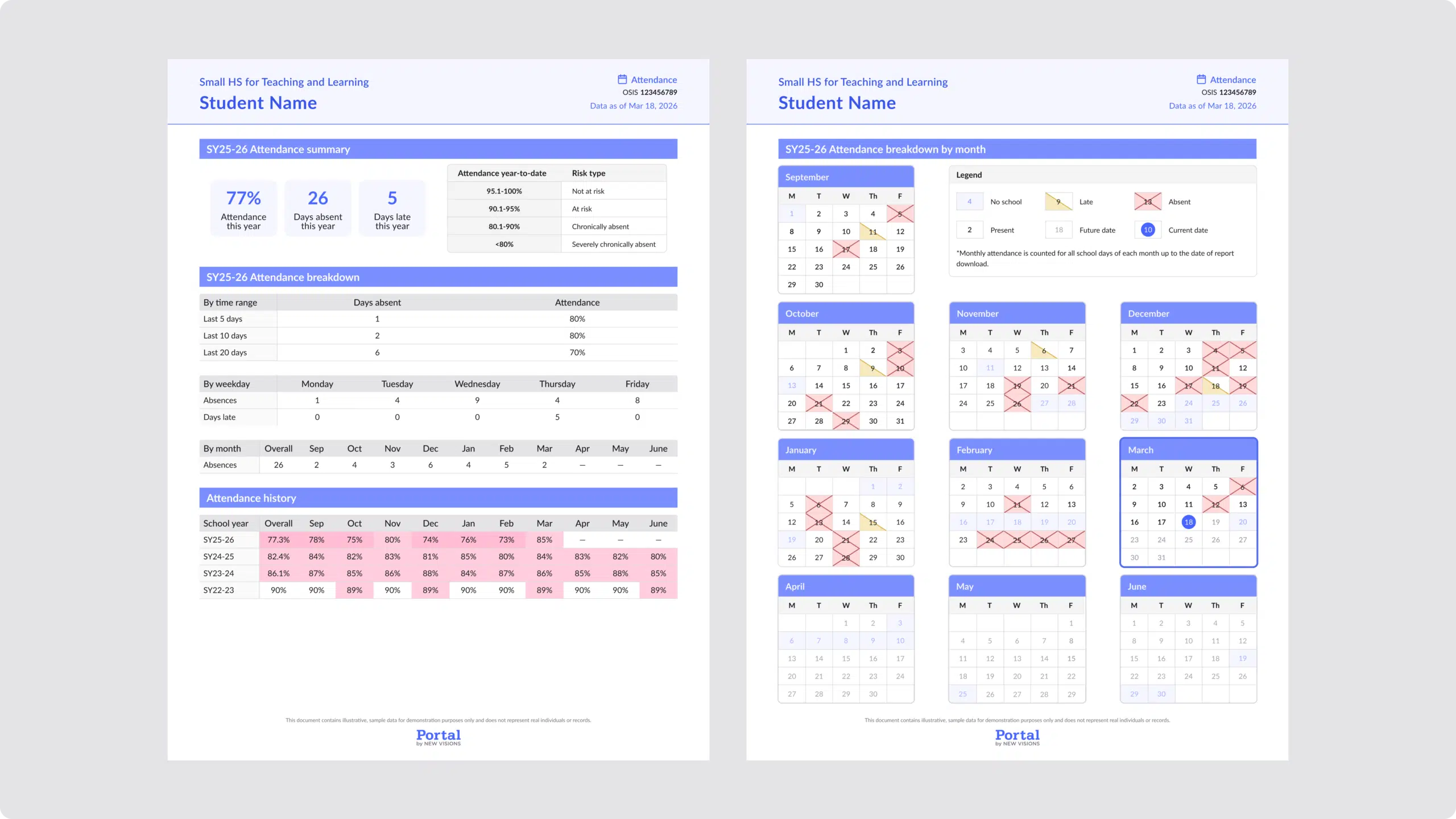
The adult reviews the data before meeting the student, noting areas to celebrate (how many absences, marginal comparative gains), and patterns to investigate. For example, the attendance point person might jot down a note to ask the student: “Your absence last Thursday, does this have anything to do with what you were dealing with in November when you (x, y, or z)? Do we need a new solution or is the old plan working?”
Data pulls, completed by the New Visions School Support Team coaches, allow school teams to set goals against a baseline and prioritize check-ins for students who are sliding away from this end of the interval goal. Coaches track 0, 1, 2, or 3+ absences over multiple 10-day blocks within the interval so the point person has sightlines into where they need to focus efforts for the coming week.
Equipped with these notes, the point person checks to see if the student has been marked present that morning. If yes, the point person also checks the student’s bell schedule and finds the student in between classes or during a free period. Meeting the student where they are makes this exchange less officious and increases the likelihood the conversation happens.
If the point person’s prep work reveals that the student’s attendance is excellent, the check-in can happen in the hallway. On the other hand, if a student is struggling with absenteeism, the butterfly check-in will require a private office, classroom, or empty stairwell space.
The following guidelines for a butterfly check-in are based on observing shared strategies employed by the most effective point people in the pilot last year. These point people held a caseload of 10–15 students under the threshold of 18 total absences by the end of the school year.
Check-ins work like this: The student holds the attendance snapshot and reviews the data while the point person asks the student to check its accuracy, acknowledging that sometimes it can be fallible. Being open to the record being wrong is an excellent way to build trust. It is also helpful for the point person to resist letting the conversation get bogged down by discrepancies. Otherwise, students can get stuck on the inaccuracies and fail to see the bigger picture. Then the point person opens the conversation with a caring, asset-based prompt that is grounded in data from the attendance snapshot (“You didn’t miss any school last week!”). There is always a silver lining to be found in attendance data. This could look like acknowledging the student’s history of strong attendance from middle school, or that they were absent fewer Fridays this month than last.
Next, the point person leads a dialogue. They verify accuracy (“Were you absent last Tuesday or is this a mistake?”), probe root causes (“Is the headache that made you absent a one-time thing or a recurring problem?”), and forecast the week ahead (“Remember, you have a mid-term exam on Friday, and it might be extremely cold that morning. So wear a coat because you usually don’t come to school when it’s this cold.”). They summarize a concrete plan, which the student restates to confirm their commitment (“Yup, I will remember a coat for Friday.”). Intentionally shifting agency to the student during the conversation is a throughline of the practice.
Below is a pacing guide that helps direct the initial series of check-ins. The sequence is designed to develop trust over time. Veteran point people combine many of the steps below into a single check-in.
| Week | Topic | Action Goal | Communication Goal |
| 1 | Check for Accuracy | Student reviews the data and identifies any inaccuracies in the attendance record | We take you seriously. We want to correct the record and identify our errors. The data we review weekly needs to be a true and trusted record. |
| 2 | Uncover Reasons for Absence | Point person elevates patterns of absenteeism in the data, and asks probing questions that arise from the data.
Student identifies specific barrier/s that get in the way of school |
We are concerned about these absences and want to start whatever plan we develop from a shared understanding of the problem. |
| 3 | Forecast | Point person and student anticipate potential pitfalls in a calendar review of the coming week of school (ex. doc appts, weather, trips, responsibilities, etc) | We take your challenges (however small) seriously and want to make a detailed plan that is transparent, specific, and realistically trusted. |
| 4 | Mitigate & Monitor | Student and point person engage in a curious shared interrogation of why absences did or didn’t happen the week prior. Absences are puzzles to be solved and non-absences need to be equally understood and championed. | We want to solve (not judge) for the setbacks and champion the hard won gains when a week, and then a set of weeks. are completed without absence. Regardless, we want to understand the story behind the data and support you in building on small gains. |
Step 5: Documentation
Documenting the essential elements of a 1:1 check-in is a key part of the process but comes with its own set of challenges. The good news is that attendance point people sit on attendance teams that convene weekly for 30–45 mins. The first 10 minutes of these meetings is spent jotting notes into the New Visions Portal so that the check-in data is organized by date under the student’s name and ID. Caseloads vary but point people typically have between 2 and 12 students max. Students are assigned to point people based on a range of criteria, including relationship and schedule.
There are two 8–10 week interval windows, and several rationales for this. First, it takes 4–6 weeks of attendance data to spot the weekly trends needed to select the right students. Second, constant check-ins are too hard for pilot schools to sustain for more than 8–10 weeks, and morale is critical to the success of this model. Finally, having two intervals allows schools to adjust which students receive the intervention, based on the changing nature of need across the school year.
Pilot schools strategically situate the intervals to coincide with the most critical part of the term academically, when there is still time to correct sliding performance before final grades. Therefore, the two intervals take place from mid-November through January and then again from mid-March through June. When you factor in the holidays, these two windows amount to roughly 8–10 instructional weeks, one in the fall and the other in the spring.
Pro tip: It is almost impossible to launch a sustained 1:1 check-in if your school is carrying dozens of non-attending active students on register. These students need to be addressed early in the year to free up space for the 1:1 check-ins to flourish. This is yet another reason to delay the fall interval until mid-November.
It’s also worth prioritizing students in the middle of the spectrum, rather than those who are long-term absent. Doing so leads to more sustainable action. Staff can get deflated trying to do check-ins with students who are severely or persistently absent, which can undermine the whole initiative.
Only a subset of chronically absent students are responsive to weekly 1:1 check-ins. Any chronically absent data set includes both acutely and consistently absent students. Acutely absent students are out periodically but do not need a weekly check-in to address the suspension, illness, or holiday that kept them out of school. Also in this group are a small subset of students who are commonly referred to as school-phobic or avoidant. School-phobic students do not benefit from weekly check-ins because, as they themselves report, they do not want to be at their current school. These students often need a different set of support conversations to re-engage with school or find a new school setting.
But it is the consistently absent students—those who are absent at least once per week for the majority of any 10-week period—that are more receptive to this intervention. They are the “right fit” candidate for this intervention, or what the Attendance Playbook identifies as students with “minor barriers.” These students are not opposed to school, but forces outside of school consistently undermine their ability to bank a week of uninterrupted learning.
1:1 check-ins offer a space to forge a supportive relationship with an adult that holds high expectations and follows up consistently and supportively. Baked into this structure are layers of sustained attention, accountability, and relational caring. For students like Dawn, the 1:1 check-in is a shocking revelation. Or, as AP Ian shared, “It never occurred to Dawn that someone cared that much if she came to school or not.”
The butterfly approach is not a neutral clerical effort of inputs and tallied outreach logs, but rather an approach that communicates a stance about attendance. It sends the following messages:
Week after week, Dawn sees the relationship between her solid weeks of attendance with her higher credit earn rate and likelihood for on-time graduation. When students like Dawn receive interventions rooted in specificity and observation, they are met with the targeted support necessary to address the true barriers to their attendance, which improves their presence in school and enables them to learn and thrive.