A few years ago, I went to a meeting at my kids’ school about the future of its dual language immersion program. The point of the meeting was to create a set of recommendations from parents and get consensus on them.1
When I walked into the school’s multipurpose room, the first thing I noticed was it was perfectly segregated: native English speakers on one side, native Spanish speakers on the other. The division was stark, but I don’t think it was especially meaningful, and I certainly don’t think anyone was trying to draw “battle lines”. Parents had just come in and sat with people they already knew, and this was the predictable result.
After a district representative arrived to facilitate, the meeting unfolded equally predictably. By the end, battle lines had been drawn. The facilitator gave up on reaching consensus on anything. By the time we went home, the only thing we all shared was frustration.
One way to interpret this was that the community was hopelessly divided, but I don’t think that was the case. I think every problem in that meeting came from the fact that the facilitator didn’t shuffle up the group at the start.
I don’t know what was going on in that facilitator’s head, but the facilitators I work with know two fundamental truths:
This means that if you come into a room full of people you don’t know, and try to have a rich conversation with them, you’ll probably want to get them to shuffle themselves before you do anything else. With this in mind, here are four methods that work equally well with kids and adults:
This is the simplest way to shuffle a group: Just point to everybody one at a time and have them say either “one” or “two”. Then send ones to one side of the room, and twos to the other.
This is the technique I would have used if I were facilitating that parent meeting. The risk is that people won’t actually move, but you can mitigate that by explaining to people why you want them to shuffle up—that is, it’s your experience that groups tend to have more productive conversations when they shuffle themselves.
I learned this technique from Kurt Wootton and Marimar Patrón Vásquez at the Habla Institute in Mérida, Mexico (you can learn more of their community-building techniques in this article). Here is the explanation of the Human Atom from that article:
[Participants] move around in a large, open space—on a stage or in a classroom with the chairs and desks cleared. Each person walks to the center, then to the edge of the space, and then back to the center. They continue this movement—to the center, then to the edge—repeatedly, while you coach them with various instructions. Ask them to walk silently, focusing their thoughts internally, without giving one another eye contact or touching. When the “atom” is well established, ask them to freeze in place and high-five the person next to them, who becomes their partner for one of the following activities.
It also helps to play music (Ernest Ranglin’s album Below the Bassline works well) and stop the music when you want people to freeze.
I once taught a group of tenth grade boys with an uncanny ability to end up in groups together. I’d count off the group, and in under a second they arranged themselves to all get the same number. Honestly, it was impressive!
I found that the best way to break up the group was to play the groups game, because while they all wanted to stay together as a group, they each wanted to avoid “losing” even more.
This groups game is incredibly simple. You just tell everyone to get into groups of a certain number (let’s say “groups of five” but it doesn’t matter what you start with).
A few people will be left out of the groups. There’s no penalty for being left out, they will just try to join groups in the next round. To start the next round, just shout another number (say, “seven”). You can go higher or lower, it doesn’t matter! At some point, say the size of group you’re actually trying to form. Once those groups have been formed, say “OK, this is your group for the next activity.”
Almost always, everyone gets so caught up in the game (and not wanting to be left out) that they stop worrying about staying in their cliques, and you end up with beautifully mixed groups.
This requires some advance preparation and access to some magazine covers (if you ask people for donations, you will likely get more than you know what to do with).
Take the magazine covers off the magazines and cut them into quarters (you can use a standard straight paper cutter for this). Then laminate the pieces. You should end up with a bunch of pieces that look like this:
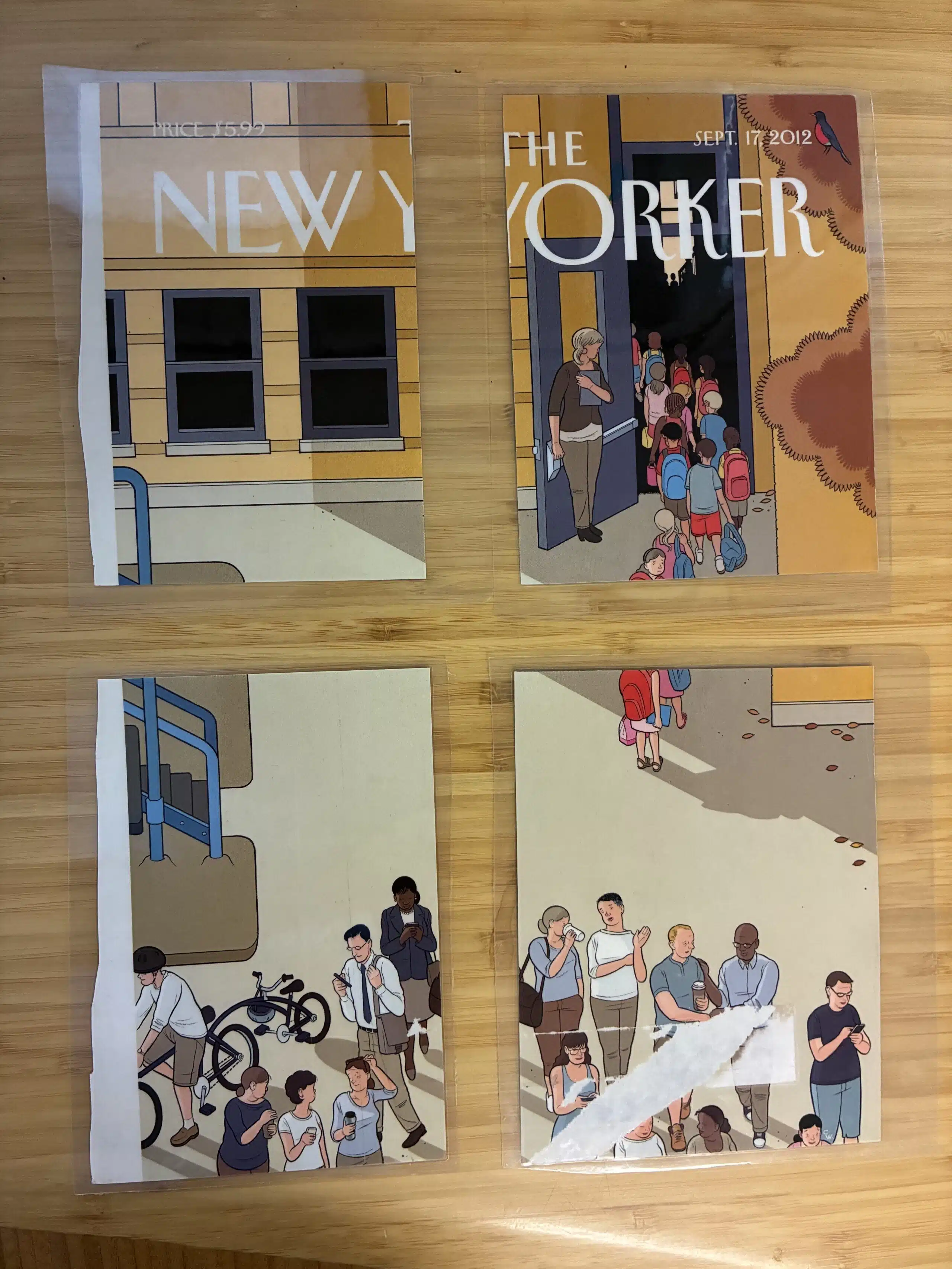
Take enough “quarters” to give one to each participant, and shuffle them. To make groups, hand one of the laminated “quarters” to everybody. They then need to find the people with the other pieces of their magazine cover. That is their group.
If you’re trying these out for the first time and they feel awkward, don’t worry! The more you use them, the easier they will become for you (and, if you are working with the same group regularly, everyone will become familiar with them).
As you use them, you will discover which ones you prefer to use in particular circumstances, and customize them to meet your own needs. Have fun!