published
Listen us AT any platform
Share this
By
Every other week, we publish a newsletter with great resources like this one, sign up for it here!
Listen to our podcast miniseries about Cheltenham High School’s PBL program here
0:01
Was everybody really this dialed in? Or were there some kids who were like, Yeah, I don’t know about this. This isn’t this isn’t so cool.
0:08
I think there were a few that were like, for some parts that were more tedious, when we were at a process, when we were just planning and planting, some kids weren’t excited. But then when it came to like cleaning up and like washing dishes, while other people were, like working with wax and like heating up water to get the wax off dishes, other kids piped up. And they were like, This is my task. I’m ready for it.
0:32
Wow. The secret, the secret to student engagement, dish washing,
0:36
dish washing. Who to thunk it? Right? Yeah, that’s far out.
0:42
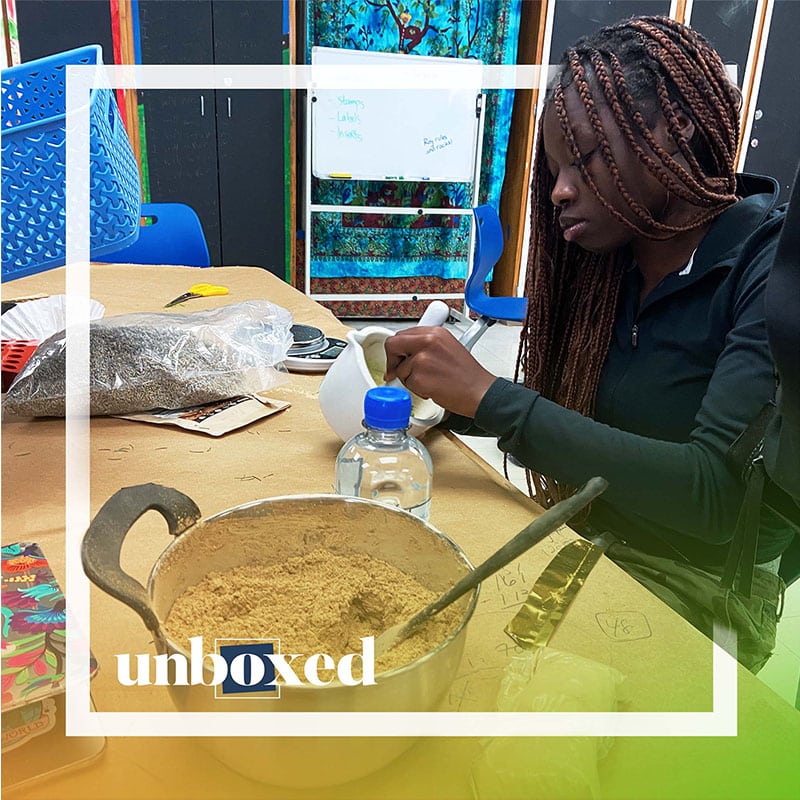
This is high tech, high unboxed. I’m Alec Patton, and I need to set the scene for this episode by telling you about something that happened to us last spring. A box of cosmetics arrived at the unboxed office. This had never happened before. There was solid perfume, lip balm, moisturizer, a sugar scrub, all organic and all made by students at Cheltenham high school in Pennsylvania. We’ve talked about cheltenham’s PBL program before on this podcast. You can find links to those episodes in the show notes, and when we got this box, we knew we had to talk to the folks at Cheltenham again. So I interviewed the people whose voices you just heard. Karen shaffren, a 12th grade teacher at Cheltenham, and alegria Vargas, a 12th grade student. We talked about the project that led to that box of cosmetics arriving at the unboxed office. They call it PBL pharmacy. That’s pharmacy spelled with an F instead of a pH. Karen, who goes by shaft at school and her students are able to do projects like this because they are part of a self contained PBL program at Cheltenham high school that started six years ago. Here’s what that means. In practice, the school operates on a block schedule where students attend four blocks each day. Students in the PBL program spend two of their four blocks doing PBL, which incorporates English, social studies and science. For the other two blocks, they take math and any other required courses or electives. And I want to be clear about something. Cheltenham High School is a public high school with about 1500 students, and it’s been around since 1884 in short, it’s not the kind of place most people think of when they picture a radical innovator in project based learning. Now you’ve got all the context you need. Let’s talk about PBL pharmacy. Where did the idea for this project first come from?
2:19
When we first started playing around with the idea of introducing PBL at the high school. We had some workshops facilitated by a Philadelphia area project based high school called the workshop school, and they had us develop our dream project. And that was my dream project, was to have a students grow hydroponically and come up with a product line. So that’s what I sort of dreamed my way into a project design, then stuck it in my back pocket. It was probably three or four years before we actually got to the point where I was teaching PBL. And then it took me another year or two to really get the resources together in order to be able to make this happen. Fairly expensive startup as projects go. So I wrote some grants, and so we had funding to purchase all of the equipment to make it happen. Where’d you get the grants from the Pennsylvania Department of Agriculture? Was a big grant. We did a partner grant with another school in the region, and then we also have a school district foundation that gives small grants to teachers for projects. So cobbled together money from both sources and then project based learning has a budget for projects. So some money came from the school district as well.
3:36
Where did all this hydroponic equipment go?
3:39
In the dedicated area in our STEM lab is once a storage space, and we changed it, made a whole sign that goes in the door that says hydroponics lab and everything
3:52
sweet and is it just like packed.
3:55
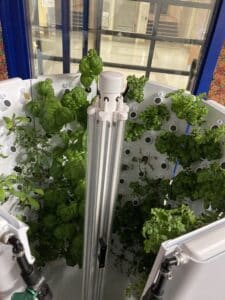
It’s pretty full. We have a vertical tower. It’s a really high efficiency tower called a flex farm. Then we have tables with other sort of bucket systems and other kinds of growth systems, and obviously a lot of storage.
4:10
And Karen was your dream project. Originally, kids grow stuff, or specifically, kids grow stuff hydroponically.
4:19
Because of where we live in Pennsylvania, the growing season doesn’t really align with the school year. So in order to grow stuff that we could use in a product line, we had to go hydroponic.
4:29
Right? Alegria, when did you first become aware that you were going to be growing plants hydroponically for class?
4:38
Definitely, somewhere around junior year, because my friend, his internship, had something to do with building the hydroponics lab. So he was telling me all about it and how he really enjoyed it and how he hoped we would continue to use the hydroponics labs for PBL through the years. Oh,
4:54
cool. So this has been going for a while, second year, all right, I am curious to know. What was your biggest mistake in your what? And Karen,
5:03
we made more than we needed of some products and not enough of others. We had really no way to know what we’re going to be our big sellers Sure, we ended up with a fair amount of overstock with some products and sold out quickly of others. What
5:18
turned out to not be as big a seller as you expected.
5:21
We made so much lip balm because it’s it’s one of the easier things to make, and obviously it’s packaged in a relatively small package compared to some of the other products. Well, a little went a long way got it. A lot of leftover lip balm. The first year, we spent a lot of time on the candles. It’s not as easy as you would think. The first year, we actually had a partnership with a really cool business in Philly that recycles glass containers and sterilizes them and then sells them back to artisanal businesses in the area. And so we really were trying to source everything as sustainably as possible. We went down to their headquarters and volunteered for the day cleaning jars, and then used their containers, which were really cool, and we dried botanicals and attached them to the outside and made the jars look really cute, but they didn’t have lids, so that made it very challenging to to store and distribute. So as much as we enjoyed the experience of working with them, and like their philosophy, a lot, we ended up getting jars with Liz the second year. But to keep it as sustainable as possible, everything’s packaged in reusable containers.
6:35
So this is the second year alegria. You’re you’re coming to 12th grade, you’re thinking, you know, the hydroponics lab is there in the converted storage area. How did this project launch?
6:47
It originally launched for my grade when shaft asked us if we would be willing and wanted to continue PDL pharmacy and our class came to a collective that we were actually really excited to have the opportunity to it just kind of went from there. And we pitched our ideas on what we wanted to make, what we would need, and chef made the boards where we could volunteer for what assignments we wanted
7:20
to do. I will say we had very organized thoughts when we started about who was going to do what. And then once we got rolling and making products, it ended up being all hands on deck for the fabrication stages, because once we get going with a particular product, there’s sort of an urgency about getting things poured or whatever the process was. We, you know, we only have an hour and a half together every day, so it required all of us to make batches of things on the days that we were fabricating. So while it looked really organized on the tiller board, in terms of it was doing what? More days than not everybody was helping with everything. All
7:57
right, so what were you going to do if the students decided that they didn’t want to keep doing PBL pharmacy.
8:05
I had some other ideas, but because this is sort of their first go round, at student directed projects, we were really open in terms of what could come out of it. And I was obviously very glad, since we made the investment, both financially and in terms of developing expertise. I was prepared to Duke and go in any way they wanted to go. But it’s it’s a really like great community service, and I think that they saw the value in that people really love the products. We get all kinds of great feedback, both online, from people that in the community that have purchased the products. We open it up with a digital ordering form to everybody in Cheltenham. Get quite a few orders from outside of the school. And we like very much to be outward facing here in PBL so I think that was a big hook for everybody. Plus it really is the kind of project that is something for everyone. You know, the people that want to do the science e growing stuff get a chance to do that. People are more into design. Could work with the packaging and labels, and then people that like to, you know, get dirty, which, luckily there were plenty of got to mix and stir and fabricate and be chemists and measure. And there was, as I said, something to keep everybody engaged. So long answer to a short question. I was pretty sure they’d go for it. I was very glad they did, but we had lots of other ways we could have gone if they didn’t. It would
9:26
have been more surprising if we didn’t go for it, because when PBL pharmacy first opened, shaft let us have as PBL 11 kids first pick to buy what we wanted before they fully launched, and we almost sold them out in one day. We all grabbed our wallets and all the products were so good that I think some of us even asked if we would be able to do it while in 12th grade.
9:52
So yeah, that makes sense. Okay, so what subjects were involved in this project was it. Just science.
10:01
The senior design course is not tied to a content area. It’s really a Design Thinking course. The kids get stem credit for it, sort of general stem credit that they can apply wherever they need it. So it’s not required that it fits any standards for any course, but we try to get as much content in as possible. So it’s definitely science heavy, since that’s my thing. But there’s also business and the PR and marketing piece, there’s an opportunity for them to do community outreach, because we have social media presence, and then just working together and collaborating. You know, that’s the most important skill. I feel like we’re sending them out in the world with and project management, because they really took it around with it. And it was a swirl around me, especially on the fabrication days, like people just worked like machines. You know, they knew what they had to do. They had things that they like to do. There’s even a couple of kids, thank the Lord that like to wash up afterwards and keep the equipment clean. So more than specific academic content, it was, you know, the quote, unquote, soft skills of PBL that this project really refines.
11:13
Gardening and Farming projects always stress me out, because of the built in time delay of like, you plant stuff, and then it’s like, well, what do we do now? We got a few weeks to fill at the very least. How did you handle
11:31
that? We had a lot of inventorying, labeling and getting the recipes, but also we had other projects going on at the same time. So it wasn’t the only thing happening.
11:42
Alec agreed, you garden. Had you been doing that in your life?
11:45
I garden every year with my mom, we always have a huge crop season and flowers and everything. So I came into this knowing I had a green thumb, which isn’t always as helpful with hydroponics, but for germinating and planting, it was,
12:03
Yeah, how’d you find how did you find the shift to hydroponics?
12:06
So the shift of hydroponics occurred while I was absent due to being sick. But one of my classmates, he really took on the lead with the hydroponics. He like, learned how to do everything. And every day he would go up to the hydroponics lab and, like, check the water, check the pH levels. And he really took complete lead on that, because it’s what he really enjoyed the most about the projects that’s actually
12:35
turned into his internship. I think I mentioned also the senior second half of the year, going on internship to explore a career or college major they’re interested in, and he’s focusing his internship on hydroponics. Oh, that’s
12:48
so rad. It sounds like almost hard to believe how like dialed in everybody is, the way you’re describing it, like, Was everybody really this dialed in? Or were there some kids who are like, Yeah, I don’t know about this. This isn’t this isn’t so cool. What do you think?
13:03
I think there were a few that were like, uh, for some parts that were more tedious, but as soon as something that they volunteered for and that they were excited for came around, then they, like, hyped up, and then they were ready to do their own part. It really just depends on which part of the process we were in at the time, like, when we were at a process, when we were just planning and planting, some kids weren’t excited, but then when it came to, like cleaning up and like washing dishes, while other people were, like, working with wax and like heating up water to get the wax off dishes, other kids piped up. And they were like, This is my task. I’m ready for it.
13:41
Wow. The secret, the secret to student engagement, dish washing.
13:45
Dish washing. Who to thunk it? Right? Yeah. Far out. You know, one of the things that I learned at high tech, high maybe the thing that has resonated with me the most I was the first time that I visited you guys, was I heard a bunch of people say, the more you trust teenagers, the more trustworthy they become. And I have found it to be so true. It’s something about saying, go off, not under supervision, and do something. And I trust you to do it. Well, even if it’s washing dishes, it’s it is the secret sauce.
14:19
So the concept here, with this project is that you’re making wellness products that use, not exclusively, but that use as some of their ingredients, plants that are grown hydroponically. Yes. How did you decide which plants to
14:37
grow? Right? So the planning phase, they pitched what they wanted to make. I had said three they ended up with six different products that they felt like that we could pull off, which we did. And then researched ingredients, and then we use that for our planning list things that we knew we wanted to utilize in the products we made, the things that we use them the most for that actually sold off the fastest were our teas.
14:59
So. All right, I guess I mean, stuff also isn’t ready at the same time when you’re growing things,
15:04
right? Yeah, that’s true. So, and also, we needed different parts of the plan for different products. So things that we needed leaves for, we were able to harvest sooner than things we needed to wait till they went to flower
15:15
for, right? So there’s, like, a lot the coordination part of this is substantial, yeah, and who, yeah, who’s kind of in charge of that? Who is, who’s keeping track of, like, oh, it’s flower time this week. So we know that we’re going to have to have such and such in in order to make it into the such and such thing.
15:33
I would have like a to do list every week, main list going of what was happening, but I would just call off the test, and it became pretty automated in terms of students knowing what their roles were.
15:46
Was there a point where it just felt like this is never going to work? We’re in over our heads.
15:52
We had a hard time figuring out well, we made the sugar scrub, which is what I think leaked in you in your package. It
15:59
did, but my kids love it, so it’s all good. It
16:02
solidified. We didn’t use enough oil, so I think we might have gone a little in the other direction with hence the leakage. So we had to sort of start over again. That was very, sort of physically difficult, because it was hard to mix a lot of trial and a lot of trial and errors. I think that was the one product we had that we really just got wrong completely. The first time we ended up doing a second fabrication of the Shea, we actually got feedback from clientele who had purchased it from us last year that thought that our batch this year wasn’t with enough. So we got a new recipe, and we’ll probably, you know, if the next year’s class wants to do it, we’ll probably try another recipe or another set of products, but it’s a lot of chemistry.
16:44
So let’s go through, I want to go through the products that you made, and I want to know, like, what was that? What was growing that went into it? So was there a hydroponic thing in the shea butter?
16:53
Well, an earlier batch, we had made oil that we use petals from last year to infuse the oil with but we didn’t use anything that we grew this year.
17:05
Got it candles.
17:07
Yeah, we use dried flowers in the candles. And then last year, as I said, we actually use them to decorate the outside of the jars. I can send you a picture. They came out. Really cute. Sugar Scrub, lemon balm, yeah, that was my didn’t we
17:23
do a lens, yeah, that makes sense. And then the solid perfume,
17:25
no, those were essential oils. Those essential oils, to make them strong enough for perfume, you need to have a distiller, which we don’t have. Get
17:32
them another grant, get them that distiller, all right? And the soap, yes,
17:37
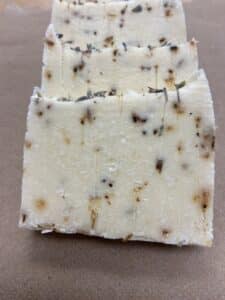
yeah, we pressed flowers in the soap. They came out really pretty. They sold out
17:41
immediately. And then the tea. What was it? What was going the tea? We did two recipes.
17:45
One was a like a feminine cramps and stomach tea that had fever. Few, I think in it lemon balm. I don’t remember the recipe off the top of my head. So, yeah, that had the most botanicals in it.
17:59
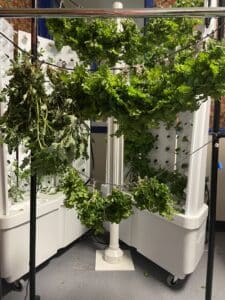
Got it cool. And how are you, were you just drying them by, like, hanging them up? Or are you using, like, a dehydrator,
18:07
no, hanging them up. I send you pictures of that. Too, awesome. Old school.
18:11
What was like the most fun thing, Alec, agree, it to make,
18:16
definitely the whip shea butter. Just because it was really funny, trying to whip the shea butter constantly and then piping it out was like, growing difficult. We had to, like, switch on and off. And then there was sometimes, like, with the mixer, we would accidentally get it all over the place, or all over our clothes. We were very oily for a while. We were very oily for a while. And at one point we had, like, a significant amount of extra that we were, like, going around the school with free samples, and I was just covered in shea butter because it was the middle of winter and I didn’t want to be ashy, so I was just covered in shea butter walking around passing out free shea butter.
18:53
Nice. It’s good way to build clientele, too. It is free samples. Everyone loves free everyone loves free samples. So obviously there’s like, like, critique is, like, deeply built into this project and and iteration. Were you doing that formally, or was it kind of just happening, like, Oh, this isn’t, we know, we have to do something here. Let’s, let’s figure it out.
19:17
Yeah, it was definitely baked into the nature of the project. If it didn’t come out right? That was the critique. And also, like I said, we did get feedback from customers. We would research different recipes, talk about what we wanted to make, whether we thought things would sell, or if we could source the ingredients. So the budget process was part of that, what we could afford. But I would say the critique was in how the products came out and how our audience responded to them.
19:45
In PBL, there’s kind of a continuum where like on one extreme is like, this basically feels like school, but there’s some cool stuff. It’s basically like, you’re in the classroom, you’ve got assignments, you’re you’re like. You’re doing your assignments, and there’s some critique and some other stuff, and you’re like, working towards an exhibition, and then there’s kind of like, we’re basically all just doing a business together, and it happens to be happening in a school building, but it really doesn’t feel like school. This feels like it tilts very far towards like we’ve all just, like, started a B Corporation, the socially conscious business, and it just happens to be happening in a school. Am I right about that?
20:28
Yeah, you’re pretty spot on with that. That’s awesome.
20:31
So let’s talk about exhibition. Obviously, you’re selling this stuff. Did you have a, like, culminating party? Was there a official launch. What? What happened?
20:42
The school district did sort of a social media blitz for us when we were ready to launch.
20:48
Was that cool or was that stressful? Was it like guys, maybe don’t go too hard on this, or where were you at?
20:53
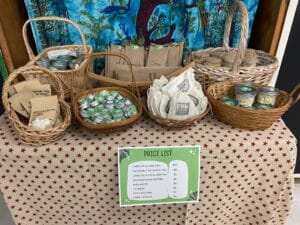
We were feeling pretty confident. Yeah, you had good stuff. We knew we had good stuff. We knew it looked cute. We liked our packaging a lot. So No, we weren’t, we weren’t stressed out about it, then we actually had enough to do an in person sale at like a choir concert that happened at the school, which gets a really good turnout, which was a mad rush. That was actually the more challenging thing, the online sales. You know, we get the sales the next day. We package everything up. People come and pick it up. It’s kind of a nice ebb and flow of PACE live sales was was a little nuts. Yeah, it sounds a little crazy.
21:25
Lifestyle was way harder because everything was on display, and we had to package it right there. And then there’d be people sort of crowding just a little bit, but at the same time, it’s like, then they’re trying to get into the choir concert and then stop and buy something, and they’re like, Well, can I buy it after? We’re like, um, it’s gonna be a bigger rush after. So I’d say, Buy it now and then make it the choir kids gift for doing so good. That’s
21:53
a good pitch. Well, you know, I already appreciated getting this stuff, but now that I realized, like, how much of a serious commodity it was, I really appreciate, yeah, you sending it limited edition. Yeah. I mean, as I say, I love it. Like I both I didn’t know how it was gonna go over. But, like, both of my kids, like, took baths, were, like, using the scrub. And they were, they were all
22:13
about it, the work that went into it, I should hope so I missed for like, three days straight. I would
22:19
say now that I’m thinking one of the like, sort of lessons learned, sort of need to figure this out. Part is, because our supplies and equipment were grant funded, we were able to set things at a pretty low price point, if and when we need to be self funding that thing we need to revisit.
22:38
Yes, that makes a lot of sense. That
22:40
was one of our pitches, was affordable, financial friendly, pricing.
22:45
Yeah, we wanted to make it so that, you know, students could afford for the products too. And I think, you know, we were encouraged, actually, as a program, to think about projects that generated revenue. Because, as I’m sure you know, we can be expensive, yep. So the goal would be for this to be self funded. Got it
23:06
all right. So I absolutely don’t want you to take this the wrong way. People who are listening to this episode are not going to be able to fathom how much of a normal high school Cheltenham is, it’s, it’s incredibly old. It’s 1500 students. Like, yes, I feel like, people, you know, people have the same sense of, like, oh yeah, High Tech High. Like, you can do that project at a High Tech High, but, you know, you never be able to do that at my school. And like, I just want people to understand that, like, Cheltenham High School is, like, if you were making a movie about an American high school and you were just like, looking for sites to do something where everyone in the world would go, Oh, yeah, that’s an American high school like Cheltenham would be on like, your like, your like, top 10
23:53
list any town USA, we have lots of challenges. We have no running water in my classroom or in the hydroponic lab, we have very helpful and kind facility staff that do what they can to make us give us access to what we need. We’re running, you know, regular extension cords all over the
24:16
place, driving carts up and down a hall. Yeah.
24:19
I mean, it is a challenge. It is a challenge. And, you know, it takes a dedicated group of students to make it happen. It’s a lot of cleanup. I have a regular class before and after it the next morning, so the classroom has to go back to not a fabrication studio pretty quickly. So it’s really challenging.
24:38
Chef, I forgot that you all like, don’t just do PBL this blows my mind. Yeah. So, so what else? What else are you teaching?
24:45
I teach what I call Normie environmental science class. So
24:50
you teach Normie environmental science class and you participate in running a socially conscious wellness products
24:58
company, right? So I teach 11. Grade environmental science as a project based learning course, and that’s our interdisciplinary Social Studies science and English cohort. I teach Normie Enviro class, and I do this senior course, this Design Thinking course, slash I run the internship program,
25:16
so you run two separate environmental science classes, right? And you help run a business? Well, I realize they help run a business is because I don’t want to like it’s clear that you and the students are really working in collaboration here. Jeff, that’s crazy.
25:32
Come visit. When are you going to come visit us? We miss you.
25:36
Last time we were going to come visit, there was a global pandemic, but we do have to come visit.
25:42
All right, so wait, hold on, there’s another thing. Yeah, I direct the musical.
25:48
That is true.
25:49
You direct Wayne, you you stayed quiet about that. That’s incredible. That’s astonishing. Hats off to you. All right, so for a school, I mean, this might be for leaders. This might be for teachers. This might be for, I mean, probably not for students, because they didn’t know the ones really have the power in the situation. But I’d be curious to know for somebody who’s listening to this, who’s like, boy, I would love to do that, but it’ll never happen at my school. What’s the first step? Like, what could they do to to get on the road towards this. If
26:22
this is something that’s exciting and interesting to you, and you’d like your students to have the experience of running a business, I highly recommend starting with candles. What’s that? It’s reasonably inexpensive in terms of the equipment that’s needed and the and the materials. There is a learning curve, but not super steep learning curve to do it well. Everybody loves candles, Alec and high profit margin
26:49
depending what wax should we be using? We use soy wax. This, unfortunately,
26:54
was not an experience this year seniors got to have. But last year I there’s a Philadelphia beekeepers Guild, and we went to somebody’s hives and sourced beeswax from him and made beeswax candles and lip balm had beeswax in it from the bees that we met, which was very cool, but it’s expensive. They don’t make that much.
27:15
Got it? Yeah, I feel like asking your students would also be a good thing, because especially if it’s a public high school, everyone’s selling something, whether it be snacks, binders, homemade bracelets, almost all of us have some type of marketing experience.
27:34
There’s a lot of entrepreneurial spirit, and amongst young people,
27:38
especially in a public high school, we got to make money somehow.
27:43
Got it all right. Is there any, any final things we should know about, any, any final thoughts we haven’t covered here.
27:50
What do you think? What do you like? A takeaway from your now fourth year as a PBL student that you want to share with my fourth year is my six year. Oh, that’s right, we had a brief foray into PBL at the middle school. Alec was part of the cohort that got to start in seventh grade. Wait,
28:06
were you at Cedar Brook? I was oh, yeah, Brooks, PBL, all through covid, which was insane, the way I heard about PBL, is I was on the cedar Brook like tour to figure out what the heck I was supposed to do in middle school, because who knows. And the kid giving the tour was like, and this is the PBL wing with all the PBL classes. And my mom was like, What on earth is a PBL? And then they explained it. They’re like, it’s a class. It stands for project based learning. And my mom just kind of looked at me. She’s like, you’d probably like that, and then transferred me into it, and I just kind of stuck with it the next six years because I really enjoyed it and it brought joy back to learning for me. So I just stuck with what I liked, awesome.
28:54
Thank you both so much. This has been an absolute delight.
28:57
Love and cherish our relationship with you, and miss the back and forth. So thanks for staying in touch with us.
29:03
Oh, of course, of course, you all are the best. Yeah, I’d love, I’d love to come out. That would be, that would be super cool.
29:09
We’d love to have you anytime.
29:12
High tech. High unboxed is hosted by me, Alec Patton, with editing by Yesenia Moreno. Our theme music is by brother Herschel. Huge thanks to Karen Shaffer and Alec Graha Vargas for this conversation, we’ve got links to a bunch of awesome photos from this project in the show notes. Thanks for listening. You.
Transcribed by https://otter.ai