published
Listen us AT any platform
Share this
By
Every other week, the High Tech High Graduate School of Education publishes a newsletter with great resources like this one, sign up for it here!
Amanda is going to be talking about her work on ninth-grade on track in Oakland at the National Summit for Improvement in Education. It’ll be like experiencing this podcast episode in 3D! Book now so you don’t miss out!
Resources mentioned in the episode:
0:00
I want grades to reflect learning. I want students to be able to say, Oh, I know what I need to do. I know what learning I need to show my teacher to be successful in this class, as opposed to what fistful of paper can I turn in right now to get my grade to A, B.
0:18
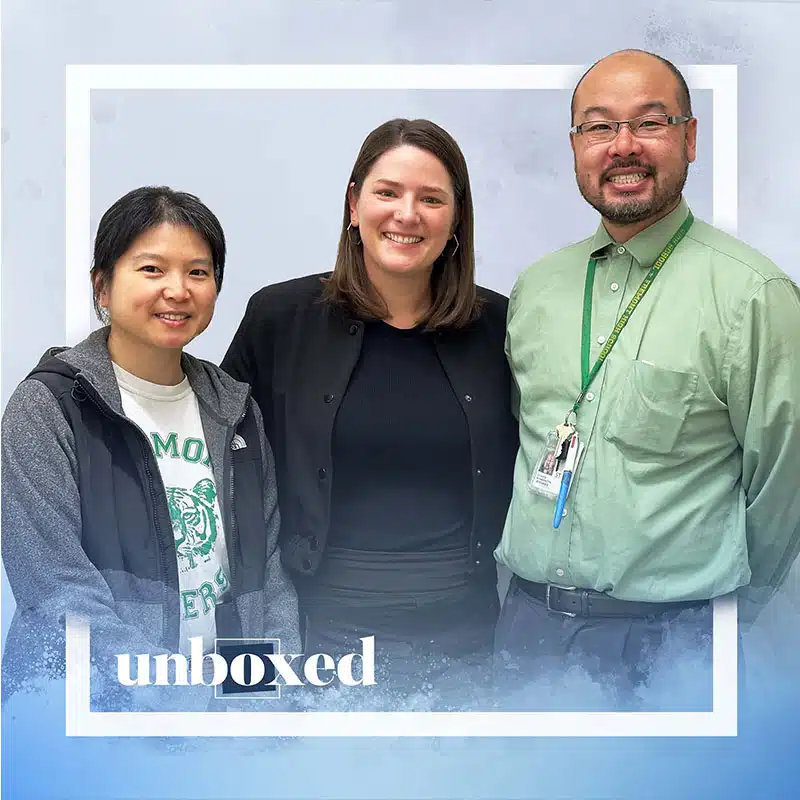
This is high tech, high unboxed. I’m Alec Patton, and that was the voice of sunny Chan, a math teacher at Fremont High School in Oakland, California. I spoke to sunny along with Sandy Tu, who also teaches math at Fremont, and Amanda Meyer, who’s a ninth grade on track and improvement coach in the breakthrough success community. The breakthrough success community is a 45 School Improvement Network focused on improving ninth grade on track across California, Fremont has been a part of the breakthrough success community since it launched in 2019 I wanted to talk to sunny Sandy and Amanda, because since 2019 Fremont High School has been very successful at improving ninth grade on track rates. You’re going to hear two remarkable statistics in just a moment, but first, a special announcement we’re talking today about how a school is using continuous improvement to make a tangible difference in the lives of their students. If you want to connect with people from across the country who are doing cool stuff like this, there’s only one place you want to be from March 30 to April 1 2026 and that is San Diego, California, for the National Summit on improvement in education. In fact, Amanda Meyer, from this very episode, is going to be there talking about breakthrough success community’s work on ninth grade on track in Oakland. Book your spot today while you still can. We’ve got a link in the show notes. Now it’s time for statistics. Are you ready? Here they are. We’ll start with a percentage of ninth graders on track to graduate high school and be college. Ready in 2018 only 44% of ninth graders at Fremont were on track last year. That percentage was up to 61% that is a 39% increase one of the ways that Fremont helped more kids get on track was by focusing on one famously challenging class, algebra in 2018 the D and F rate for ninth graders in algebra was a whopping 50% that’s right, half the kids were failing algebra last year, it was down to 26% so how Did Fremont cut their algebra D and F rate nearly in half? Well, Sunny already told you the short version right at the top of the episode, the teachers changed their grading so that it reflected learning. But the story of how they got there is where it gets interesting to begin. Let’s set the baseline. Here’s how sunny and Sandy were doing grading back in 2018 before Fremont High School, joined the breakthrough success community.
2:44
Typically, every every week, I would have some assignments, they would do their assignments, turn it in and that that would be 100 points for the week. And then every week we’d have a quiz. They would do the quiz, they would turn it into me, I graded out of 100, and I would give it back to them. So in one week, they would have 200 points, 100 points from the work and 100 points from the quiz, and that would be their
3:03
gain. And Sandy, is that how you’re doing it too?
3:05
I think back in 2018 I was still doing some weighting, and I was trying to make assessment weight like 60% and assignments weight 40% and yet the assessments didn’t come as regularly as the percent suggests, I kind of wait for the right opportunity, maybe, like at the end of a unit, to do an assessment. And so in the grade book, The kids just didn’t see it, didn’t get what’s going on with it.
3:36
So that’s how grading and algebra happened at Fremont High School in the before times, then in 2019 the breakthrough success community kicked off by inviting all the schools to a two day launch event at a Waterfront Hotel in Oakland. But Fremont High School couldn’t get sub coverage for the teachers, so they couldn’t come until day two after the school day was over. That is Sandy and her colleagues showed up for the end of day two of a two day launch event. As you can imagine, this was not an ideal way to start this collaboration. Here’s Sandy.
4:10
We just joined in after we’ve been teaching all day, been teaching for six hours. And when we joined in, I think they were doing an activity that transitioned to another topic. And I think that was just a really bad first impression, like it was, we’re just tired already, and now you’re having us do this silly activity that is not like substantive yet.
4:33
We’re playing a PDSA game. I think, I think we were playing Mr. Potato Head.
4:38
Yeah. I mean, first of all, they had somebody dressed as Mr. Potato Head, and just like, peeked in from a window or something, and then somebody said, Okay, so now we’re gonna build Mr. Potato and let’s see how you do with the time constraint. And this is after us, like, do. Prompted to bring our ninth grade picture to share with each other. So just a lot of like, okay, getting to know each other. But again, we’ve had a long day. We came in maybe expecting some strategy that we could try the next day, and this is
5:15
what we got. So that’s your first impression. I
5:18
feel like that’s a really accurate first impression that probably many folks have when they join an improvement network, because they think that they’re coming to a training, they think they’re going to get a program that they can take back and implement. And I think one of the things that really was an adjustment for our collaboration was that we’re not necessarily giving you things that we think should be done. We’re here to help you figure out how to improve your own work in your own school. And I think sometimes at the beginning that can be really unsatisfying for people.
5:53
I don’t know if we told you this before, Amanda, but after that we I mean, we weren’t over it clearly, because there was a group chat saying, What was that about? Why did we do this thing? Why did we waste our time
6:06
so half the kids taking algebra were failing at this point,
6:12
D’s or F’s, right? It wasn’t just F
6:15
Yeah, D’s or F’s. Was that something that was like weighing on you? Or did that feel like, well, that’s just what algebra is.
6:23
I would think so, like we were using the Jupiter Grades, great online grade book, and what they have on there is a bar graph at the bottom, and it shows us bars for each grade. And it was just ugly to see, just it’s being skewed right? You know where the F and Ds are. And I just wonder, like, does it always have to be that way? Like, kids don’t like math and kids also don’t know how to do math. Sunny, how are you
6:51
thinking about it at that point? I mean,
6:53
I think if you think too hard about it, it’s really depressing. But I think what teachers do is they say, Oh, look, half my kids are failing, but I’m really giving them every opportunity is on them. The ball’s in their court. They need to do this, and they need to do this. So as a teacher, sometimes we default to that.
7:07
Amanda, how were you thinking about it when you saw the numbers at Fremont?
7:12
As an on track coach and improvement coach, I’m always looking at the data, and I’m thinking about where we’re seeing variation and where we might be able to make an impact. So kind of from the beginning, as soon as we had access to the data from O USD and from Fremont, I was looking for patterns and seeing where were students struggling, which students were struggling. And it was really clear to me that algebra was a pain point for this community, and you know, it was something that I knew we might take some time to to work on. It wasn’t something we were going to tackle right at the outset. But, you know, I remember pretty early on, we were in a ninth grade team meeting, and Sandy and Jane, the other ninth grade team lead, were bringing some grading strategies to the team, just some initial, kind of early things that they might try. And I remember that Sonny was sitting in the back of the room, kind of on his laptop, multitasking, you know, getting things done. And when we started talking about these grading strategies, he kind of lifted his head up and started paying attention. And it turned out he had very strong opinions about how grading should be done. And that launched the beginning of a really awesome conversation where we started exchanging resources. He offered to show me how he was grading. He was really passionate about his 200 points a week system. And there was a lot of really logical benefits to it. So he was showing me how that worked. I shared with him some resources around grading, and it was just kind of like as we saw each other. From time to time, we would have little conversations. And I was really excited by his enthusiasm, because I knew in the back of my mind that algebra was a gatekeeper course in a lot of ways for students at Fremont, it was a place where more students struggled than many other core content courses. So if we could really start to collaborate around student success in algebra, it would be amazing and have a really big impact on students. And I knew that sunny would be a critical person to have in the conversation. So seeing him really step into leadership around grading, I think has been an incredible part of Fremont story.
9:28
We’re going to get to sunny in a minute, but you really like glossed over a thing that I want to bring out here, which is that we suddenly went from Sandy being sarcastic on the group chat to Sandy bringing grading strategies to the ninth grade team meeting. Sandy, what happened?
9:45
I really appreciate Amanda being persistent with us, because I value persistence myself, and some of the strategies that core has brought was grade book review. Grade Book Review. View was one of the things we did in our ninth grade team, just to try it out. And of course, we Fremont. We’re not just going to try out the way we want to try it out. We are going to look through it and find ways to enhance it or to revise the protocol.
10:15
And what is a grade book review? It’s a way for teachers to look at every student who currently has a D or an F in their class. What is the primary root cause for that? Is it that they failed assessments? Is it that they’re missing some assignments? Is that they haven’t done homework? And by kind of looking for patterns in the root causes of why students are struggling, we not only come up with some ideas for how we might support those students, but it also ideally makes us reflect on what we’re grading and why. So I’m pretty sure Fremont started with that grade book review, and some of the strategies that the breakthrough success community was recommending at the time were things like, Well, if you’re having students with a lot of D’s and F’s, you might consider doing a 50% floor or minimum grading where you set the bottom of your grading scale at 50 rather than 0% as a way to make the grading scale more proportionate instead of being disproportionately weighted towards failure. So I think we started with 50% floor. We probably talked about having makeup days, where we make space during class time to guide students to complete some of their missing work. Those are some of the early ideas that I’m pretty sure Sandy and Jane were bringing to the Fremont team when Sunny was sitting in the back of the room with an eyebrow up.
11:40
Do you remember this, sonny, do you remember this meeting?
11:42
No, but it sounds like what I would do. It tracks, I mean, generally, the the team brought back strategies and I did not like them. So I would complain a lot. I’m a complainer in general. So I would complain to Amanda, I would complain to Sandy, whoever would listen, that I did not like these strategies and explain why. And over time, we just had more and more conversations about why I did not like them, why didn’t you like them, specifically the minimum grading. It’s really the communication that we that provides to the student. What does that tell the student? If I were a student and I saw an assignment, I got a 50, 50% I would say, Oh, I did that. I didn’t do well, but I did it. And I think that parents would think the same, oh, you tried, but you didn’t do very well. But in reality, the student didn’t do it. And I think that communicates the wrong thing. What do you mean? They didn’t do it? So with minimum grading, if a student does not do an assignment, they automatically get a
12:33
50% Oh, I see you mean, yeah, okay, I got it.
12:37
So a student who does really poorly on an assignment gets the same score as a student who did not even do the assignment, which is the 50% but
12:44
the theory, the theory behind minimum grading, is right now, if we’re giving zeros for everything that student hasn’t turned in yet, we are letting them dig a very big hole that becomes mathematically very difficult to get out of Because of how so much of the grading scale is an F. So by adjusting the grading scale to make it more proportional, we make it mathematically easier for students to get within striking distance of passing, which makes so much sense. But you know, practically speaking, the 50% floor model does push up against some, you know, challenges with communication and kind of the mental models that people hold about what grades mean. How do you feel
13:29
about the 50% minimum now? Sonny, oh, I still don’t like it. Yeah, I was picking up on that. All right, so you start having these discussions. You’re complaining to anyone who listened, as you put it, yes. And so what happened?
13:41
And so I kept complaining. Amanda gave me books to read, and I read some of them, and then they asked me to join the team. And I was like, what? Why would you do this? So I joined the team. Then they had a conference somewhere where they flew us out and had a hotel. It was really nice. I was really surprised. And I went to this conference. I’m like, I’m gonna find somebody to convince convince me that minimum grading is good. That’s what I was looking for when I went to that conference. And so at the conference, I listened, I listened to ask questions, and nobody convinced me, and I was, like, even more determined in my thought that this is not going to work for me.
14:14
So whatever got, whatever got, the DNF rate from 50% to 26% it was not sunny, getting stoked about minimum grading.
14:23
It was sunny, getting unstoaked about minimum grading. So I was started looking at student grade books from the student point of view, where advisory we have advisory in our school. So it’s basically like, we help students navigate their grades and their school, especially in ninth grade, is really important. A lot of times when I would look at the student grade books, I’d be like, Hey, Bobby, let’s look at your grades, and I would try to help them figure out what they need to improve. It was often really difficult to figure out what to improve, because the grade books were all over the place. It was really hard to provide any feedback to the students, other than go complete your work. And so I was like, Is this really common or. Are all students experiencing this? So what I did was I went in a lot of grade books with the lens of, is a 50% floor going to help this? If we made everybody do a 50% floor, would these grades improve? And when I looked at it as I know it, wouldn’t. There’s other issues other than minimum grading that’s gonna that we need to solve first. And what were those issues grade books? A lot of them just didn’t make sense. Some teachers don’t update their grade books on time. So some some kids, I’m like, I don’t know what you need to do because there’s nothing there. And then sometimes it’s the things are vague, and sometimes the assignments are listed very quote, unquote, clearly. But I asked the student, and they’re like, I don’t know what that is. I don’t know where to find it. And then some assignments were like this, you just got credit for turning this in. And then we had tests that they bombed that brought their grades down. I’m like, I don’t know how to advise students to fix that. And it was just overall confusing, even though minimum grade would make some of the math easier, the a lot of the math in the grade book was just confusing.
15:58
It’s almost like an empathy interview, like you’re sitting now with a student, and you’re looking at it from the student perspective. You’re talking to the student about it, you’re getting the student to share with you, and you’re going like, man, well, I’m you’re confused. I’m confused. Sandy, were you feeling this way too?
16:14
Well, I just, as I mentioned before, when we did, like the waiting, it just felt really lost at it like what’s on the grade book and what the students are experiencing. I’m pretty sure it’s not me, just me, but like other teachers who have, for example, like a 60 to 80% weight on an assessment, and yet sometimes that assessment just comes once in the marking period. So as what Sunny said, you know when, when you advise a student and you have, like, this long list of assignments that, for example, have all A’s on it, and yet, with 1f on the assessment like that, just tanked your grade. Now your overall grade is a C or a D, and it’s just, wow. That’s the only assessment that that mattered at that point,
17:01
one thing I’d love to highlight about what sunny and Sandy just shared is that I think that we found at Fremont and at other schools doing ninth grade on track work in our community is that when teachers become consumers of their own grade book data, it can be really powerful by looking at The outputs of grade books from the perspective of an advisor trying to help a student make sense of their performance and decide what they might need to do to improve their grades. It really helps teachers create, I think having like, like you said, Alec, much greater empathy for students and families and to really reveal like, how confusing some of our grade books can be if we’re trying to use that as an effective communication tool and learning tool for students. And I think a lot of the grading work that Sonny has done, and he’s designed all of these different activities and discussion prompts and exercises that he’s done with his team to kind of reveal this variation, it really stems from a place of like, our grade books are not just for our students or for their families to receive updates. Our grade books are for us too to be able to make decisions about how we’re supporting students as advisors, but also students in our own classrooms.
18:13
So tell me about that. Tell me about how you what you did.
18:18
So I designed an activity where I took screenshots of student grades. I took one student, I took screenshots of the grades, blocked out the grades, and had the teachers talk about, What grade do you think this student has? So we were guessing the student grades. And the second question was, what would you do to advise this student? And sort of the third question is, what’s confusing about this? And when we looked at the grades, when teachers got together and looked at the grades, there was a lot of confusion. There was like, what does this mean? What does this mean? And to spoil it a little bit, the sixth grades we looked at were all DS, but they all look really different, and so it’s really hard to understand it when all the grades look so different from
19:00
teacher to teacher, that’s super smart as an activity. Yeah, I share with everybody I can what was the mood of the teacher team coming out of that? I think
19:09
the teachers were confronted with a puzzle like this is confusing. This happens, and I understand it, but I don’t know what to do about it. I think that was the mood that came out a teacher told me, after I did this activity that was like the most we’ve ever talked about grading. And I always tell people we had allotted a certain amount of time for that, and we went, like, 45 minutes over, but nobody complained, like teachers hate. PD, but we went over and nobody complained, and people were still engaged. So I was really happy about that, that people were making sense, or trying to make sense, of these grade books.
19:37
Sandy, were you there for that? Yeah, I was there for that. It was a Saturday, what? Yeah, we work on Saturdays. Wow, again, like, Sunny said we, we were just allotting, like, a certain amount of time for it. And we definitely went over and as you were, like, explain, like, telling that story, sunny, I was thinking about that quote you got. Bought from, like, the Ministry of time by Kelly Anne Bradley. Do you still remember it? Yeah, what is it
20:08
ideas have to cause problems before they cause solutions. And I think,
20:11
like during this, like Saturday session, people were, you know, what got put in front of them was, you know, something that is causing problems. And so it really got us to thinking about it. And I’m really glad that we did it. And I think sunny probably done it a few more times, with different subgroups coming out of that we were. I think the next thing we said was, let’s, let’s bring this to the entire team, not just the people who wanted to show up on a Saturday.
20:42
So, so you your ideas cause problems? Oh, yeah, how’d you get to solutions?
20:48
That’s a great question. So based on the grade books that I had presented, I had some suggestions. I was like, You should do this. You should do this. Clarify your assignment titles, like, don’t use weighted grading or make them more consistent. Now, now that I think about those things, I was trying to Band Aid things. Those were little things to fix, little things to make it easier for advisors to understand it, but now I know that it requires more change. Like you said earlier, it’s a multitude of things. It’s not just this thing or this thing is this thing. It’s a really big shift in thinking about how you’re how you’re grading,
21:20
and I don’t remember if our third math teacher was there at that meeting. She was also part of the ninth grade team, but it was really helpful that all three algebra one teacher was in the ninth grade team. And at some point after that Saturday meeting, we got together again with another fellow math teacher to examine our grade books even more, and I think that’s what kind of led to the changes that we’ve made in our grade books.
21:49
I think one framework that’s really helpful for thinking about the kinds of changes that the Fremont team has implemented in their grading is the one posed by Joe Feldman in his work on equitable grading, there’s lots of different ways to think about it, but one framework is that if we want grades to be more meaningful reflections of student learning, we need to make them more accurate, more motivational and more bias resistant. So I think a lot of the things that the Fremont team has implemented address one of those areas. We want to make sure that grades are actually showing accurate depictions of what students know and are able to do, not just their compliance or their ability to turn into a worksheet. We want to make sure that the grades are motivational, that they’re set up in a way that makes students feel like their hard work will pay off and that that they can still catch up, even if they fall behind, and then also bias resistant. So we really look hard at if we’re grading things like homework and participation, which are really more measures of other aspects of a student’s life than what they know and are able to do in our content area. So yeah, thinking about like, how can we make our grading system more accurate, motivational and bias resistant? A lot of the things that Fremont team has tried fit in one of those categories and sunny.
23:13
It sounds like you thought you had the answer and you didn’t to begin with.
23:18
For sure, I thought I had some first steps to how we could improve grade books, but some of them didn’t take and then when I saw some teachers do the changes I like, this is not producing the result that I had intended. And as I looked at more grade books, I just was, like, frustrated, because I was like, what exactly is it that I want? And over, over, time. It’s just that’s been changing, and I’ve been trying to figure it out what exactly, what change do I want?
23:46
What change do you want?
23:50
I want grades to reflect learning, and I want to be an advisor, advisory teacher who can be like, hey, you need to go learn this. I want students to be able to say I know what learning I need to show my teacher to be successful in this class, as opposed to what fistful of paper can I turn in right now to get my grade to A, B?
24:09
Yeah, I’ve often said, like, grading is a thing that happens at the same time as assessment but it’s often not an assessment tool. It’s an accountability tool. It’s a way of like kids going, Oh, this grade is bad, so you need to do this work or turn this thing in in order to get that but it’s not as you say. It’s not telling you, oh, there’s a certain number of concepts that you really need to understand in algebra in order to achieve the level of mastery. That lets us know that you can go to the next class and I can see that you’re missing this concept, this concept, this concept, right? So how did you start redesigning grading so that it was an indicator of learning.
24:43
So for me personally, like I said earlier, my quizzes were the 100 points. And students got a quiz. They got 87 whatever that means. They got a 63 whatever that means. So from that I shifted. I still had a quiz a week, but the quiz would be broken down into three parts, the three things that I really. Wanted the kids to, like, take away from that week, and each would get an individual grade, but it’s not 100 to zero anymore. It’s just a, b, c, d, f, so that the kids would understand, oh, look, I’m at this level. I’m at this level. Don’t worry about the numbers. So, yeah, basically, my quizzes were broken down into learning targets, so that in any particular week a student can go, oh, I learned that this week, or I did not learn that this week. That’s what I need to work on.
25:25
Were other people adopting that? Or is this just a you thing?
25:28
So like Sandy said, the algebra one team was really solid. I don’t know how we manage that, but we really worked together when we all agreed. So every week to give some kind of quizzes where we had learning targets and the students would know what they learned, and
25:42
did you see a shift?
25:44
It’s hard to say what shift we saw in the students right away, but I definitely felt a shift for me, and I think it helped us in planning, because we were like, what did the kids really need to know this week? What does my grade really reflect this week? And it makes us think, Oh, the kids learn this, or they did not learn this, not Oh, the kids did not turn this in. The kids are late with this. It’s did the kids learn this thing?
26:08
What does grading look like now in ninth grade algebra,
26:12
so grading has really de emphasized the daily work. We still ask students to do it. They still practice. We still provide a little bit of feedback on it, but it doesn’t have a huge impact on the grade, if any. Depending on the class, a lot of the grades depends on the mastery checks or the quizzes that we give at the end of the week. And the key part of that is that kids, if they are not successful, if they don’t do as well as they want to the first time, they can always retake it later and improve their grade that way.
26:45
Ted Cuevas, another teacher who we had on the podcast, talks about grading like they do it in scouts. It’s like getting a badge. And the point is that you’re demonstrating your mastery of it. And when that happens is when that happens, all right, so you have so you have the retakes. Retakes are one of those things that I think sound really, really good, but anybody who’s taught has this fear of like, well, is every single student just going to be trying to do retakes in the last three days of the semester?
27:15
So retakes are one of the big pushback points whenever I suggest, like, this grading system, this grading reform, to people, teachers often push back with, how am I going to do all these retakes? I think the structure of the retakes, the structure of the assessments, is a big part of it. But a lot of teachers are used to doing a big unit test with like, 50 questions and all these different kinds of questions at the end of the marking period, and then you’re like, how do you retake that? And I agree that’s really difficult, so one way you manage that is to create your assessment so that they’re shorter and more manageable for you and the students, so that it’s not as big of a lift for you or the students when they want to improve a particular aspect of their learning. And then to your question, do students do this? Yes, there are always students who will wait till the last minute, but the goal is for all our on the fence kids to realize this is a lot of work. If I wait till the last minute and try to learn everything last minute, it’s going to be really difficult. So over time, eventually, hopefully they’ll say to themselves, I should skip this right the first time. I should do it the best I can right now so that I don’t have to worry about it later.
28:23
Okay, but Sandy and sunny, I want you to level with me. Are you doing more work as teachers now that you’ve added retakes?
28:31
I’d say I am doing definitely doing more work. I’m grading twice as many depending on the test, like if it’s a particularly tough unit or tough few lessons that I’m testing on, then yes, there’s going to be a lot of kids that want to do retakes, and I have time during the class to do retakes, so there’s going to be more students that would want to take the opportunity to do it, as opposed to, if I say come at lunch or come after school. To do it, I get fewer students. But for the retakes, I’m not asking them to retake the entire page. So each page for me has like three different skills. For example, like this past week it was, the first skill was to identify Y intercepts in different representations, and the second skill is identify slopes in different representations. So if students are able to score well on identifying Y intercepts, then when they’re retaking they’re just retaking identifying slope. And so that that second time I’m grading goes a lot faster because the students are just focusing on the skills that they’re weak in and that they’re getting better at.
29:48
Got it. I would also say that it may be more work, but I think it’s much more effective work, whereas before we’re using a lot of time to grade completion work that doesn’t actually tell the kids whether. They learned or not. Now we’re spending more time grading work that actually communicates learning to the students. So while it is more work, I think it’s more effective and more valuable for the students to understand this, rather than to see if they completed an assignment and turned it on the time. Also, another complaint about retakes is that, like you said, students will come in at the last minute and try to do everything. I often tell teachers to put a hurdle in there, put an obstacle, put a checkpoint. So yes, kids will come in and try to take a test again and then again and again without any further preparation. And of course, they’re going to do poorly. So what we need to do is set some kind of barrier, like show me that you practice, or tell me what you’ve learned, so that when they come and take this retake, they’re actually prepared for it, and that’s just coming in cold again, so they can do well this time.
30:45
I think sunny and Sandy, there’s another aspect of what you’re doing differently now, and I think that’s how you’re naming assignments and using grade books as a way to communicate. You said that was one of the pain points that got you into this work. How do your grade books look differently now? And how are you using them as communication tools for students, families and for colleagues?
31:07
So if we use the scout example again, you don’t get a merit badge for I participated in the third session of camp. You don’t do that, but we do it all the time. As teachers, we put assignments in like I participated in this, or I turned this on time. So now that our assignments are like merit badges is like, I can solve two step equations, or I can use the distributive property that makes it more accessible for the students, the advocates, the parents, other teachers, to be like, Oh, this is what you need to work on. Let’s work on this. As opposed to, I don’t know what this assignment is. You just need to turn it in. You just need to go to go to class. So we can be very specific and targeted in our interventions for improvement.
31:48
One of the entry points to this work was a practice that we called Grade Book Settings audit, where we looked across the back end of everybody’s grade books in the gradebook software, and took an inventory of what settings people had in place. And so some of the types of settings that sunny and Sandy and I looked at were things that related to like, how many categories did they have in their grade book? Were they using weighting? Did it look like folks were grading homework or participation, what percentage of the grade was composed of assessments. And so by making visible that variation, we were able to see some of what might be patterns that we could address in conversation with folks on the team. So I’m curious, Sunny and Sandy like, what were some of the things that you remember when we first took that peek behind the curtain, looking at the system of grading through the grade book audit?
32:48
What I’ve noticed was that if you have seven different teachers, seven different classes, you will probably have seven different grading systems. Every teacher does it differently, and this can be really overwhelming for everybody involved, it’s very hard to figure out what the impact of a single assignment is, even if the grading software says a certain thing. So that was one of my focuses, that everybody should simplify their grade book, whatever that means to you. Simplify it so that you understand what’s happening, and the students can understand what’s happening. And that’s one of the drives that we use when we fixed our algebra one grade books, or improved our algebra one grade books is to simplify and make it more meaningful for the students.
33:27
How does algebra class feel different? Now I would say
33:31
that like since I’ve changed the way I list assignments in grade books, or I list assessments or learning goals in grade books, and really not count the assignment for anything. It’s really like a whole practice shift. Like, I use these grades not only to like direct students on what to practice, but also on how I arrange the seating chart, for example, because I really hate making seating charts, but now I click on the grade so that it’s sort by grade. And I would really put all the students with their low grades in front of me, in front of the classroom, so that I could be closer to them, be able to access them faster and check their work faster. When a student asked for certain help, I go, have you asked your classmates? Because during our retakes in class, I point out which student did well on which skill or which topic. And I would ask the students to well go to this person, to ask them how they do it, because I’m only one, and there’s 30 of you, so they know what to do, you should really get them to help you out. And I say the same thing to the people who know what to do, like, you know what to do. Help somebody else that’s not on that list that would need your help.
34:52
One of the shifts I wanted when I started was kids come at the end, they’re like, What can I pull out of my backpack to get my grade for? From this F to A, C or B, and that was really irritating. I wanted to change the question from what can I do to what learning can I show you it’s still in progress, but I feel like some students understand that better. They’re like, okay, it’s not about the papers I turn in. It’s about, can I show him that I know this and then I can improve my grade. So ultimately, eventually, students in my class will be like, I want to get a B. This means I need to show proficiency in most of the things in this class. It’s not about the paper. I turn in final
35:31
question for a school that’s hearing this and thinking, I want to change our grading practices. I want grading to feel like it is an indication of learning and a tool for learning. What should they do to get started?
35:45
I will look for opportunities to create a coalition of the willing. I know Amanda has used that term before. If there’s somebody else, even like one other teacher that’s like, huh, I have questions about this. I don’t like what I’m doing. I think that’s a chance for you guys to try something together.
36:08
I’ve thought about this question a lot, and this does not answer the entire question, because there are so many supports that go with it. But basically, do more assessments. I think if teachers do more regular, shorter assignments, then a lot of questions will come up, like, how do I make this effective? Or how do I show this in the grade book? But all those questions are answerable once you start doing assessments, if you want to look at your grade book and think to yourself, is this effective? Is this reflect learning? Ask yourself that, does this assignment reflect learning? Can I see that the student learned in this assignment, or is it just a reflection of whether they turned it in on time? So overall, I would say, do more assessments so the students, and you know what they’re learning and when you put things in the grade book, think about, is this helpful from a learning perspective? Is this going to help them learn this content better, or is it just to let them know that they complied with your request?
36:58
I think those are great tips for folks getting started working on their own grading. And I think that’s awesome from an improvement perspective, trying to think about how can we catalyze some change across an entire team or an entire school? I think some lessons to draw from sunny and Sandy’s story are, you know how helpful it was at the beginning to make that variation visible, and how folks are using their grade books through either the grade book audits that we talked about looking at the back end settings, or through Sunny’s activity of putting up anonymous progress reports and having people dissect and analyze them and guess the grade, making that variability visible for folks is seemed to be an incredible entry point to conversations on the team, and sometimes even just making the variation visible was a call to action for teachers to change something. And I think another thing that we discovered is that using the electronic grade book, there’s a lot of barriers, like technological barriers. Sometimes people think that their grade book is set up one way, but they’ve clicked some settings or chosen to do a certain weighting or certain categories, and their intentions aren’t really reflected in the final math. And so sometimes what we think someone might be trying to do intentionally with their grading. That isn’t the case at all. They just need some support and learning how to use the electronic Grade Book Settings and really make those settings reflect their intentions. So those are a few things that I think are really important lessons to draw from this story. And of course, Sandy and sunny like you all start with yourselves. First. That’s one of the things that I admire so much about you. Like you’ve been at this for a really long time, two decades in the classroom, is incredibly admirable, but you’re like, changing things up every day. You’re doing it first in your classroom, you’re learning what works, and then you share that impact with your colleagues. And I think that’s just such an incredible testament to teacher leadership and the role that it can play in improvement work.
39:06
When I ask people to do things, when I have conversations with people, I try not to be like you need to do this because this is the right way to do it. You need to do this because the literature says to do this. I’m saying you should consider doing this because it will improve student learning. Like I just want to help students learn better. I want you to be able to help students learn better, and I want to support that. So my goal is never like to impose anything. It’s to improve student learning. I think that if you’re going to go into this work, that’s what your focus has to be. Sunny.
39:37
Wouldn’t say it. So we can say it. I think a really big tip for doing this work is to find the right champion. And I think in sunny we found quite a champion of someone who’s always curious, who’s always thinking about how to make things better, who has a bit of an independent streak like I could figure that out. I could find a better way to do that, and who isn’t, you know, afraid? To roll up his sleeves and get into some really tough conversations with folks. So find that champion. You know what? Help folks ignite that fire? Because that’s how we’re going to learn the things that we need to learn.
40:11
There’s one other thing, and I don’t know how you might incorporate it, or at all, but Sunny has made some has used AI to make some music that has to do with grading and learning as well.
40:23
The grading song has taken on a life of its own in our network. I don’t know if sunny even knows this. People love it, but it really has made an impact in kind of spreading the key point, the key message that grading grades should reflect learning.
40:40
Yep. Awesome. Thank you all so much, and we will play out this episode with Sunny’s grading song.
40:50
Teachers, when thinking about grading, remember this one thing, grade your reflect learning. Grade show, reflect learning. Does the assignment show student understanding. Can you see the student’s mastery? Would you bet money they are making teachers, when thinking about grading, remember one thing, grade should reflect learning. Grade should reflect learning. If the assignment only shows you if they practiced or if they completed the assignment, or if they participated in the discussion. Maybe don’t use it. Teachers, when thinking about grading, remember this one thing, grade your reflect learning. Grade should reflect learning. Teachers, when thinking hot
41:46
High Tech High Unboxed is hosted and edited by me Alec Patton. Our team music is by brother Herschel, though the music you’re hearing right now was composed by Sunny chan with the help of some AI. Huge thanks to sunny Sandy and Amanda for this conversation. You can find information about the breakthrough success community and the National Summit for improvement in education in our show notes. Thanks for listening. You.