This article is an edited excerpt from an episode of the High Tech High Unboxed podcast. You can listen to the full episode here.
In this excerpt, Andy Sprakes, co-founder and chief academic officer at the XP School Trust in Britain tells Unboxed editor Alec Patton about the mistake he has never forgotten from his first-ever project, and how that mistake shaped the school’s entire culture.
Andy Sprakes:
My cofounder Gwyn ap Harri and I opened XP school as a secondary school in Doncaster, in the north of England. Our school actually shares its school building with the Doncaster Rovers football club. Anybody could apply who lived in Doncaster and we selected 50 students randomly to be the inaugural class.
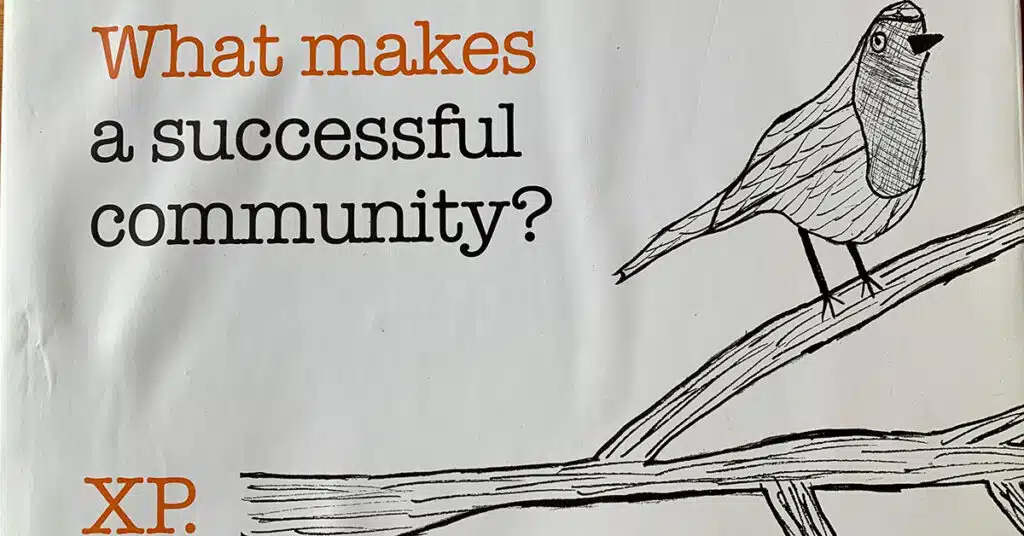
We thought, “We’re opening a new school, and building community is the most important thing.” So for the first project—or, as we call it, “expedition”—we had the guiding question, “What makes a successful community?”
Our anchor text was The Giver so we looked at dystopian community, and what happens when communities break down. We looked at some science through the animal kingdom: Why do geese fly in a certain formation? Why do penguins huddle together, and then move out, and move in?
We looked at the London riots, as well, and what people do when things go wrong, and how communities work together to put that right—because that’s invariably where the answer comes from, it ends up being back with the community and the community leaders, and schools, and nurseries, and care homes, that actually make up successful communities.
The students each wrote quite a lengthy essay about what made communities successful, and they did some line drawings, to express what they felt made a successful community.
Then we took an extract from their essay, and we printed a book. And we were all really pleased with the outcome of our first product.
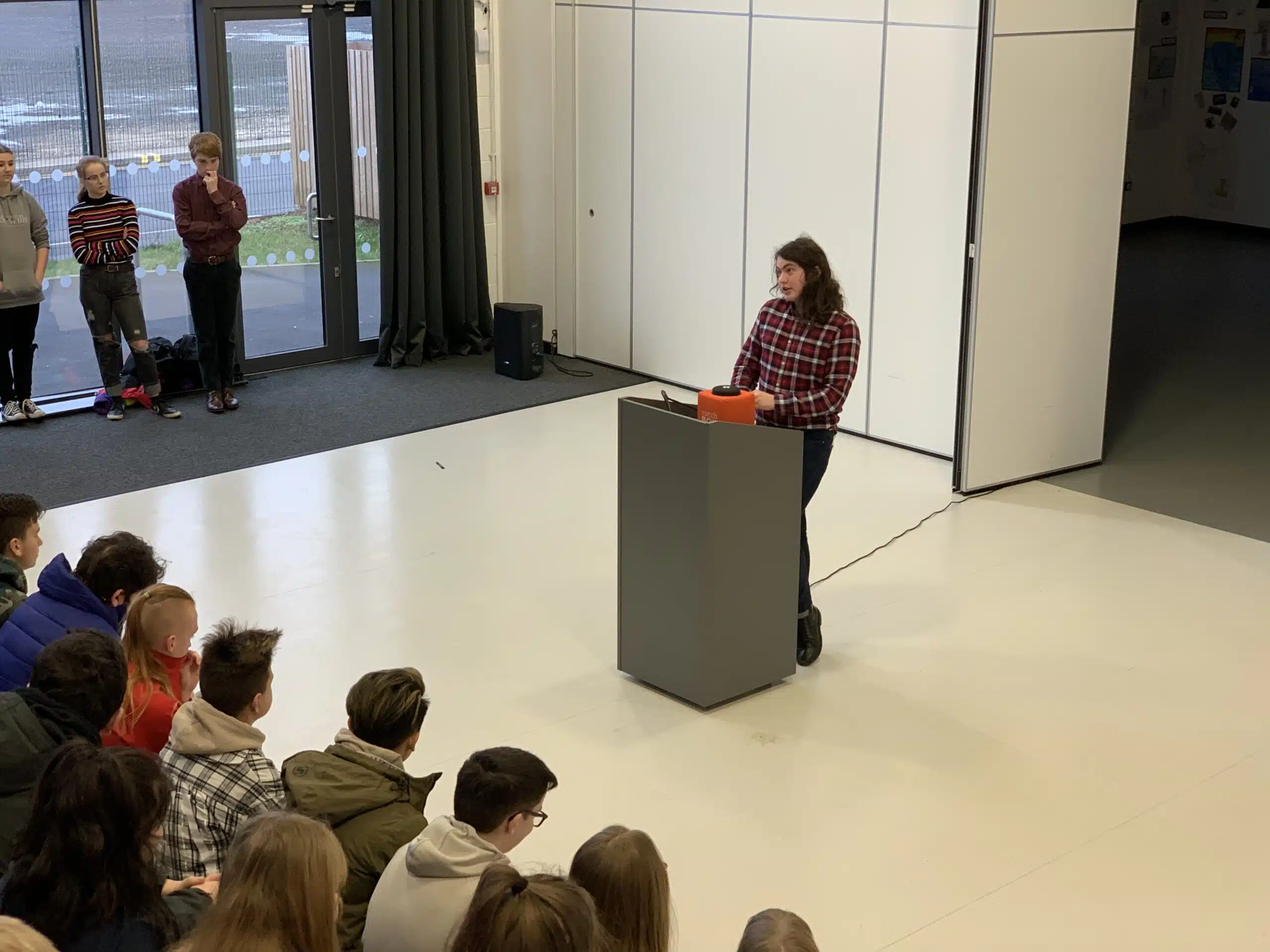
We invited all of our parents to the Doncaster Rovers stadium. The kids had put together a book launch group, who’d made a film about how the book had been made, the guiding question, the standards that we’d covered.
The books arrived on the day of the book launch, which was a bit tight, but they looked great! The students were running the whole show—everybody was contributing successfully as a community, which was rather satisfying.
We gave the books out, and we had cups of tea and biscuits, like we do in England, to celebrate. And it was great. Everybody was really pleased.
And then, one parent, Mel, came up to me and said, “Andy, Toby’s work isn’t in the book.” Toby was her son, of course.
I said, “No, you’re wrong, Mel. It’s got to be. We’ve checked it, double checked.”
“It’s not.”
“It’s impossible, it can’t be.”
Toby had been instrumental in putting the book launch together. He’d written this beautiful piece of work. He’d stood upon the stage, talking about how proud he was to be featured in this book. So it was unconscionable that he wouldn’t be in it. He was going to be in it.
I said, “Give me a book, Mel.” So I flicked through the book, and it’s like, “Okay, he’s in here somewhere, Mel. Don’t worry, Toby.”
Toby’s there, ashen faced.
“Don’t worry, you’re in here. I’ve checked it, I know.”
I checked through. Couldn’t find him. Checked through again. And the panic set in. It’d been missed out.
It was like, “Oh my God, this is a disaster. What are we going to do?” We’d already spent so much on the book. We couldn’t afford to reprint it.
Toby’s really upset, Mel’s upset. I said, “Don’t worry. We’ll sort it. If we have to reprint all the books, we will.”
As soon as I said that, I thought, “I shouldn’t have said that, it’s going to cost us thousands of pounds to do this. We have to recall all the books.”
We were struggling to think what to do, and I was absolutely devastated. The first product, we’d missed one of our kids out.
Later I was talking to my wife, Nicola, about it, and I said, “We’ve got to reprint them.” And she said, “Well, why don’t you create a dust cover for the book?”
I said, “What do you mean?”
She said, “Well, a cover that you wrap around the book, would that be cheaper than reprinting them all?”
So that’s what we decided to do.I can remember going to see Toby the next day, and I said, “Toby, I’m really sorry.”
“Oh, it’s okay.”
“No, it’s not okay. It’s quite terrible. But what we’re going to do is, we’re going to create a dust cover, and we’re going to put your work on the cover. Everybody will see your work. It’ll have your artwork on the cover, and we’ll put your work inside, on the leaf inside.”
He was like, “Oh, my God, really? I’m going to be on the cover?” So that’s what we did.
Andy Sprakes:
We managed to include Toby’s work, but we realized that we’d not been thorough enough in checking the work, and that stuck with us.
So Gwyn and I sat down, and said, “Look, this can never happen again. We’ll have to have a law. So we’ll call it Toby’s Law, after Toby, because it was his work that was left out.”
I went to see Toby, and said, “We’re going to create a law, Toby, which means that what happened to you will never happen to a student ever again.” He went, “What? You’re going to create a law? I’m going to have a law?”
So Toby came out of it really well in the end, and I’m pleased to say he was very successful in his time at XP, as well. And we thought it was really important to show that we were fallible, and that even as adults and educators, sometimes we make really big mistakes.
So this is Toby’s Law, and so this is, it’s on the inside cover of the book:
Inexplicably, despite hours and hours spent proof-reading the final product, not to mention all the hard work by every student not just to get the book done, but all the preparations for the Celebration of Learning, we discovered during the Book Launch that one of our student’s pages had not been included.
That student was Toby Williamson. To say we were all devastated would be an understatement. Toby was part of the Book Launch team! How would we fix this? It would cost us thousands to get all the books printed again?
At XP, we learn through experience. The shared narrative of these experiences is an important part of creating memories, not just remembering facts. Instead of hiding our mistake, we decided to make it part of our narrative, so no-one will forget.
We are making a stand for Craftsmanship and Quality, and have pledged never again to allow any product we create to not include all the work by all our students. This will never happen again. This is called, ‘Toby’s Law’.
That has stuck with us for the last 10 years.
Alec Patton:
As I understand it, there are two parts to Toby’s law. First, there’s a checklist that says an expedition is not done until the following have been completed. What has to happen for an expedition to qualify as done?
Andy Sprakes:
All expeditions have to culminate with a celebration or a presentation of learning. So the work has to be made public, and the kids have to present their learning.
So an expedition is not done until that’s happened. It won’t be signed off. You can’t start your next expedition, until you’ve finished. Also, portfolios need to be completed, so assessments need to be done. The kids’ work that they’ve done, that’s associated with the product is in there, so all of the assessments need to be done, all of the work needs to be completed. The expedition has to be curated for public display.
They’re really the core things that we expect people to complete, before we say an expedition is done. “Done” is a sacred word at XP.
Then at the end of every expedition we sit down formally, review it, and revise it for the next time we do the expedition.
Alec Patton:
And what are your safeguards to ensure that no student’s work gets left out?
Andy Sprakes:
What has to happen now is that all of the work is proofread, and the final product is checked and checked again, by the teaching team. Then we have another layer: our school has a communications team and they check the work as well.
Finally, Ricky Elderkin, who’s our lead on design, will put together the book digitally, and then, that’s shared again for another check, before it goes to print. So we have layers now of backstopping.
So we have systems now, where we just rigorously check, much more rigorously than we did, obviously, on the first product. I suppose, in some ways, even though it was disappointing and upsetting, I’m glad it happened, because it made us much, much tighter.
And that’s remained, on ensuring that all of our kids’ work is included in final products, in final presentations, in the curation of work, so that none of that work is lost.