Luz walked into an International High School (IHS) in New York City in October 2001, at the age of 16. She spoke no English, had no high school record, and badly needed a winter coat.
Milagros had crossed the border near Reynosa, Mexico, to outside McAllen, Texas, in the summer of 2014. She was taken to a detention center and eventually relocated with an abusive uncle in New York City. She had finished fourth grade in Guatemala, but the secondary school was too far from her rural village to attend. She enrolled at IHS as a 16-year-old ninth grader in the fall of 2014.
Gonzalo came to the U.S. from the Dominican Republic in the sixth grade, but told me that the only English he had learned was curse words. He had watched knife fights in his middle school bathroom, and was not sure school was for him. He also enrolled in IHS in 2012 as a ninth grader.
Luz, Milagros, and Gonzalo would not be considered high-achieving students, and none of them graduated in four years. Luz was labeled as a student who was over-age and under-credited. Milagros was a student with interrupted formal education (SIFE), and Gonzalo was a long-term English learner (EL) who also received special education services (SPED).
The three of them had the good fortune to come to International High School, which changed their life. It changed mine as well: When I first walked into IHS in 2015 as a doctoral student at New York University (NYU), I knew, as a novice educational anthropologist, that I had found a unique setting in which to conduct my research. After teaching high school science for seven years, first in San Benito, Texas, and then in Barranquilla and Bogota, Colombia, I had questions about leadership, school design, and how my students were crossing borders for educational purposes. When I walked into IHS, I felt something I’d never experienced as an educator and couldn’t quite put my finger on.
IHS is one of sixteen schools in the International Network for Public Schools in New York City. I have continued to study the network year after year because these schools are epicenters of educational innovation, deeper learning, and whole-child educational approaches that center on love, care, deep learning, linguistic and cultural affirmation, and what I have come to think of as “radical welcoming.”
I have written extensively about my research on International Network schools for academic journals, as well as in my 2025 book, Sanctuary School: Innovating to Empower Immigrant Youth. In it, I take a deep dive into one school’s culture to tangibly impart the feeling of radical welcome to educators and help them imagine a truly welcoming and empowering school for their most marginalized students. This school, like others in the network, only serves recently arrived newcomer immigrant youth, all of whom are classified as English learners. As such, these schools have been forced to maneuver and adapt as immigrant communities navigate the nation’s ever-changing sociopolitical landscape. While they are a unique network of schools, understanding how they have evolved, their current practices, and how they are preparing for the future can be instructive to all educators who want to better serve their most marginalized students.
I’ve written this four-part series to explore the four radical mindset shifts I have identified in my research, which educators and school leaders can adopt in order to create radically welcoming schools. They are:
Drawing from Sanctuary School, each article focuses on one mindset shift and translates it into practical strategies for educators, leaders, and innovators. Through reflection, questioning, and leadership actions, the series will support practitioners who are already engaged in the work of building radically welcoming schools where students can thrive. This article focuses on rethinking the roles immigrant students play in schools.
In many schools, students like Luz, Milagros, and Gonzalo often face social and academic isolation. For example, in a recent study conducted by one of my doctoral students, third graders described how, from their perspective, the “Spanish kids” in their classroom sat alone in a corner and had special teachers who told them the answers. Teachers in the study described not speaking English as a “disability” that they were not equipped to navigate. Research shows that this type of isolation is common for recently arrived immigrant students in classrooms where immigrant youth are seen as needing help, remediation, or rescue. Structures and practices in classrooms that limit engagement and inclusion of students who are learning English may be one reason that only 29 to 58 percent of ELs who arrived in the United States during grades 10–12 will graduate from high school within four or five years, although this data is hard to come by since we have no nationally accepted definition or designation for newcomer students.
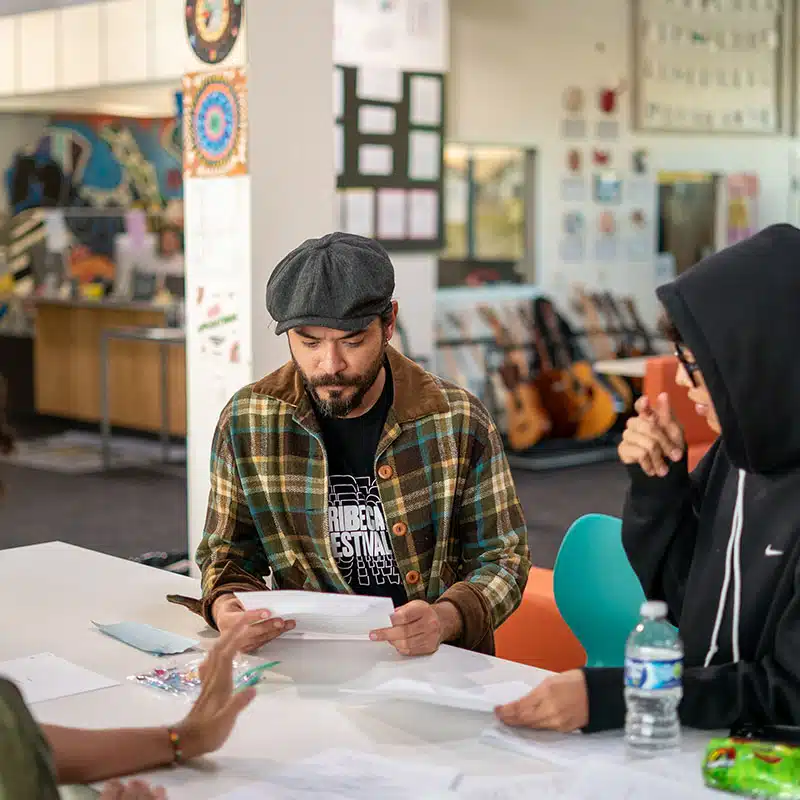
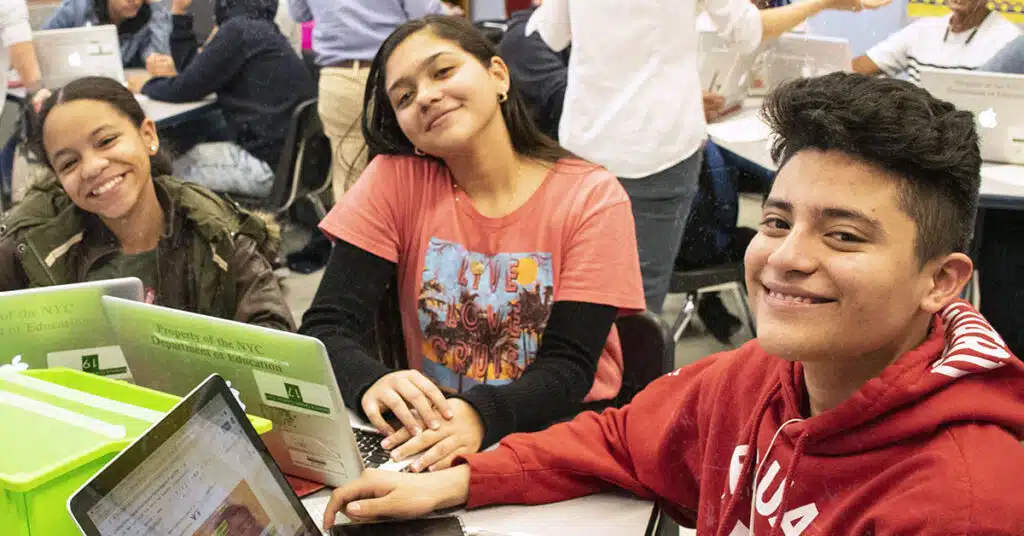
Fortunately, Luz, Milagros, and Gonzalo had a very different experience at IHS. From the first day, students were placed in small ninth and tenth-grade cohorts with whom they attended every class. They spent their first two years of high school with the same interdisciplinary team of teachers who learned about their lives and migration stories, and who designed projects that drew on their full range of experiences, languages, and expertise. Classrooms were project-based, multilingual, and collaborative, with teachers circulating to facilitate learning rather than instructing from the front of the classroom. A typical day involves interdisciplinary project work, presentations, and small-group support. The instructional model also makes time and space for an advisory focused on social-emotional learning, one-on-one mentorship on an academic project, oral defenses of work, and opportunities to engage in an internship outside of school, earn college credit, or gain work experience.
Because of these intentional practices, Luz, Milagros, and Gonzalo learned complex content in rigorous classes, where they drew on all their language skills and modalities. Nevertheless, none of them were ready to graduate high school after four years. After her fourth year, Luz’s teachers asked her to stay an additional year instead of joining the Army, and created an internship for her to work alongside the assistant principal. When she graduated after five years, her teachers dropped her off at college and helped her decorate her dorm room. After graduating from college, Luz became a math teacher at IHS and is now an assistant principal. When Milagros needed to start working after attending school for four years, the school created a modified schedule that allowed her to work while she completed her education. After a little more than seven years, she graduated in 2019; she now has an associate’s degree and is pursuing a degree in social work. After becoming frustrated with school and not graduating with his cousin, Gonzalo returned to the Dominican Republic. Despite weeks of effort, the school was unable to reach him to ask him to return for a fifth year. The assistant principal began asking his friends to text him and encourage him to come back. He eventually returned to the U.S. and to school, graduating in 2019 after five years, and has built a life in Pennsylvania.
My research at IHS provided me with enough insights about teaching and learning to fill a book (literally), but there are three elements of this mindset shift that any educator can introduce at their school right away:
I’ll go into each of these in more detail, as well as share some advice about barriers that derail efforts to improve the schooling experience for immigrant youth.
Rethinking the roles immigrant students play in schools is not about adding another program or initiative. It’s a mindset shift; a deliberate move away from seeing such students as burdens and toward seeing them as essential contributors and experts, in both their own learning needs and the particular skills and knowledge they have gained from their lives so far.
To illustrate what this looks like in practice, consider a project that Luz created when she became a math teacher at IHS. She tasked her students with determining the fairest place to build a hospital in their home country. To achieve this, they needed to employ a system of linear equations while also addressing larger moral, ethical, and political questions, beginning with, “How do we determine what is fair?” and, “Is equality always fair?”
The project begins with students text-coding and analyzing the following prompt:
There are three non-collinear towns in your home country. There is a plan to build a [students choose a needed resource] somewhere in the area of these three towns. The mayor of one town says that the [resource] should be located in their town because it is the shortest distance from the other two towns. As an active citizen, you disagree, stating that another place might be better. The mayor responds by saying, “You MUST prove it!”
This project engaged ninth- and tenth-graders to solve a real-world civic problem—determining the most fair location for a shared community resource—by applying core algebraic and geometric concepts such as distance, midpoints, slope, systems of equations, and triangle centers. Under Luz’s guidance, students moved beyond abstract exercises and created maps, generated equations, tested hypotheses, and justified their reasoning through multiple solution methods. The project gave students agency by encouraging them to situate their project in a geographic region they had personally lived in and select a public resource (such as a hospital, water station, grocery store, or bank) that they felt was most important, based on their own experience in that place.
The project’s culminating performance-based assessment required students to synthesize their mathematical work in a structured essay that integrated calculations, diagrams, and evidence-based arguments, strengthening both their mathematical fluency and communication skills. At the same time, the project situated mathematics within broader questions of fairness and equity, inviting students to consider whether equal distance was always just and how different models of fairness could privilege or disadvantage particular communities. By choosing what kind of resource to build and defending their own position against the mayor’s claim, students took on the role of active citizens, exercising agency in shaping both the problem and its solution. In this way, the project connected rigorous math learning with social justice inquiry, empowering students to see mathematics as a tool for critical thinking, decision-making, and civic participation. Luz honored students’ knowledge by asking them to share their expertise about their home country, a community in which they lived, and a public resource they believed would have improved the quality of life of their family, neighbors, and friends. Weaving students’ knowledge and experiences into the project gave them agency and ownership over their learning, positioning them as experts about where they are from, yet still requiring them to engage in rigorous math learning and performance assessment.
This project illustrates how student voices and lived experiences keep the curriculum dynamic and meaningful. When students bring their own knowledge, cultures, and perspectives into the classroom, the work itself becomes more dynamic and engaging. The projects evolve because they are shaped by students’ realities, creating space for authentic exploration, inclusion, and dialogue.
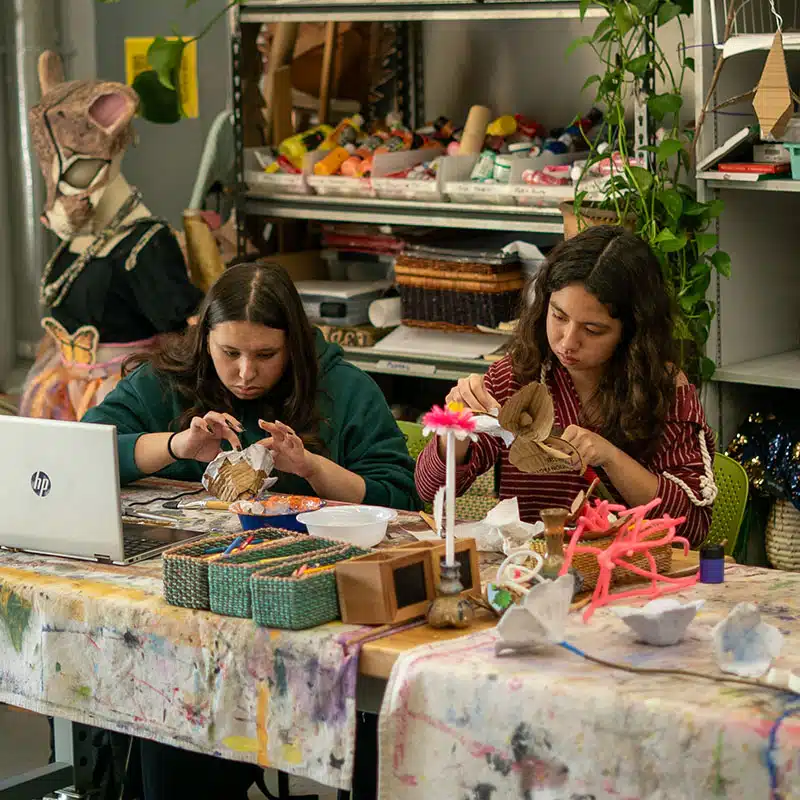
In another project, “American Dream, American Reality,” students examined what the American Dream meant to them before they arrived and how their understanding of it has changed over time. In a social movement project, students determined which movement should be honored with a federal holiday, grounding their choices in their values and experiences. A Model UN project allowed them to advocate from the perspective of their home countries. Other projects invited personal and cultural expression, such as designing a dream home through scale modeling, creating identity boxes, publishing magazines with articles about revolutions, painting parable murals, or producing a folk tale puppet show. In each case, students’ cultural knowledge was central, making the curriculum rigorous, culturally relevant, and personally meaningful.
Collaboration is at the heart of how IHS educators recognize and honor the contributions of immigrant students to their school and the broader community. Their skills as cultural brokers, translators, and peer supporters allow them to share knowledge in ways that extend far beyond individual achievement. In classrooms, this collaboration is explicitly taught and valued. For example, sentence stems posted on desks encouraged students to ask their peers clarifying questions (“What do you mean by ________? Can you explain more?”); support one another (“Can I help you with anything?”); and build on peers’ ideas (“I have a similar idea. I think…” or “I have a different idea. I think…”). These structures positioned students not only as learners but also as collaborators whose contributions sustained the collective learning environment.
As an observer in the school, I continually saw students translating for peers and teachers, explaining assignments in multiple languages, and bridging cultural differences through shared meals or group projects. Portfolio-based assessments reinforced this communal approach by asking students to defend their ideas before authentic audiences, respond to questions, and teach others through their work. Rather than seeing knowledge as something individuals hold privately, these practices affirm that learning is built together through dialogue, questioning, and mutual support.
Students are given multiple avenues to exercise leadership in school life, with opportunities structured to highlight their cultural knowledge and experiences. For example, in Peer Group Connections, students are paired with newer classmates to act as youth leaders, helping them adjust academically and socially. Others serve as bridge coaches or provide support for graduating seniors, including through a fifth-year senior panel and alumni panel, where they offer guidance and encouragement to students who might not graduate in four years on why they should stay in school. These leadership structures affirm that immigrant and multilingual youth are not passive recipients of support, but active leaders and guides within the school community.
In eleventh grade, students apply what they have learned to the professional world via the school’s internship program. In the spring, students spend three days a week at an internship site of their choice or area of their professional interest. In their on-campus internship seminar, students keep vocabulary logs and observation journals that push them to notice the subtleties of workplace culture.
Teachers describe the internship year as transformative. Students navigate language differences, adapt to new environments, and contribute in ways that matter to their sites, such as translating for colleagues, assisting with technology, or sharing cultural insights. Seminars provide a space for students to process these experiences together and connect them to academic content. In this way, leadership is reframed as contribution: Rather than holding formal titles, students demonstrate their capacity through observation, support, and participation. They are not only preparing for future careers but also giving back to their host organizations in the present.
Expanding opportunities for leadership beyond the school makes the internship a powerful extension of project-based learning. Just as classroom projects have students apply academic skills to civic and cultural contexts, internships require them to utilize their multilingualism, cultural knowledge, and interpersonal skills to contribute to the workplaces they joined.
Leadership opportunities also extend into external programs that expand students’ horizons and professional identities. For example, the Women in STEM Leadership program at the New York Hall of Science, and NYU’s ARISE program, give students access to hands-on lab experiences, research mentorship, and leadership development in STEM fields. The NYC Summer Youth Employment Program and Leaders for Ladders emphasize financial literacy, career exploration, and professional development, allowing students to apply their cultural knowledge and creativity to public-facing roles.
These layered opportunities reinforce the idea that leadership is not dependent on English proficiency or familiarity with U.S. school norms. Students are invited to lead through multimodal forms, including mentorship, art, civic dialogue, research, and translation that honors their strengths. This approach shifts the mindset from viewing immigrant students as “not ready” to recognizing that they are already leading, contributing, and shaping the school’s culture in profound ways.
One thing I often see in my research is that when educators are new to working with newcomer and immigrant students, they often feel an urgency to teach them English first and quickly, because English fluency is often treated as a prerequisite for learning, participation, or leadership. In some cases, teachers avoid getting to know students deeply—where they come from, how they arrived, what their lives are like outside of the classroom, what they love, and who they miss—because they feel pressed for time, uncertain about how to connect across cultural differences, or uneasy without seamless communication. These barriers create distance and inadvertently reinforce exclusion, limiting opportunities for immigrant youth to be seen as leaders, knowledge holders, and contributors within the school community.
The most impactful educators I have observed at International High School all share an intentional reflective practice in which they continually question their assumptions, instructional strategies, and classroom structures. I’ve learned from countless interviews with teachers that this process requires asking oneself critical questions, such as:
Such reflection helps uncover deficit-based thinking and structural inequities that may be otherwise invisible to educators. By asking these questions honestly, educators begin to reframe immigrant youth not as passive recipients of support but as active contributors with valuable knowledge and leadership potential.
The educators I write about in my book all share similar mindsets and believe they have a responsibility to get to know their immigrant students deeply. They believe they can learn alongside their immigrant students, and welcome negotiation in the curriculum so that together, educators and students can collaboratively decide on the focus of their learning. For example, instead of assuming that students must be fluent in English to learn or lead, teachers create projects and choose texts that honor immigrant experiences, provide avenues for immigrant students to contribute transnational knowledge in meaningful ways, and draw on students’ experiences and expertise. Teachers in these schools commit to learning from their students, inviting them to be co-creators of knowledge in the classroom.
My research shows that schools can become more welcoming places for immigrant students by acknowledging their immigrant community in school documents and communications and rethinking their intake process to ensure it is culturally appropriate, welcoming, and appropriately acknowledges lived experiences and knowledge. This can involve facilitating clubs, starting a culturally relevant sports team, or opening peer support roles that center on the voices of newcomers. The International High Schools I write about also find ways to provide stipends or credits to compensate students for their leadership, acknowledging that it is a form of labor and addressing potential barriers to participation in extracurricular activities. These seemingly small shifts in mindsets and practices signal to recently arrived immigrant students that belonging is not language-dependent; that their cultural knowledge enriches the classroom; and that schools become more just and inclusive when all immigrant students are recognized as having the full rights and responsibilities of all other community members.
Part of what I felt that first day at International High School was what I have started calling “sanctuary schooling.” This is a culture of shared leadership and reciprocal learning that blurs the lines between experts and newcomers, as well as between teachers and students. International High School offers a school model grounded in trust and collaboration, where immigrant students and their teachers truly belong and thrive. Rethinking the roles immigrant students play in schools is part of the mindset shift that educators at this school have embodied. In the upcoming articles in this series, I will explore the remaining three mindset shifts I discuss in my book and believe are essential in sanctuary schools, or any school serving marginalized youth. These include valuing stability over urgency, centering knowing and caring for students, and recognizing flaws in the social contract and failures of the state.