In May 2024, David Price died of cancer. David was a musician, a co-founder (with Paul McCartney, among others) of the Liverpool Institute of the Performing Arts, the creator of “Musical Futures”, which upended how music was taught in secondary schools across the UK, and the head of the follow-up, Learning Futures, which applied those insights across the curriculum.
It was in Learning Futures that I met David, as an intern assigned to the project at the Innovation Unit. It’s neither an exaggeration, nor at all unusual, to say that I loved David from the moment I met him. He was warm, kind, curious, and incredibly funny, and he taught me a huge amount not just about education, but about how change happens in organizations—which is to say, through meaningful relationships grounded in compassion, respect, and understanding.
Since Learning Futures, David wrote two books: Open: How We’ll Work, Live, and Learn in the Future and The Power of Us: How We Connect, Act, and Innovate Together.
The article we are sharing below, first published on David’s Medium site, was informed by The Power of Us as well as his lifetime of work on education. The British spelling and punctuation has been preserved.
You can read the eulogy that David’s friend and frequent collaborator Valerie Hannon gave at his funeral here.
-Alec Patton
“You know how you can tell you’re in a happy school within 30 seconds of walking through the front door?” This is a statement/question that I’ve experienced on countless occasions during a lifetime spent in education. It has a ring of truth to it and we’ve all felt it as visitors or (worse) inspectors.
But what does that actually mean? Until recently I’d nod my head and pretend that this essence of excellence was somehow an immutable truth. And then I started to question what was meant by what was said. It’s a bit like describing colours — how do I know that what I understand to be ‘blue’ has the same qualities as what you see?
So, I started asking people to be more specific. What were the signals that indicated it was a good or a happy school? Answers varied in their specificity: “There’s just a vibe about the place”. “Kids seem happy to see you”. And so on.
About 4 years ago, I had the revelation. What people were describing, in vague and imprecise terms, was something that is crucially important. It separates the wheat from the chaff, and it is the precursor to high-performing organisations. It’s so important — yet so opaque — that most schools and colleges make no attempt to name it, measure it, or define it. They are assisted in this wilful neglect by the powers that be — inspections agencies, regulatory bodies and the like — who collude in the ‘first 30 seconds’ syndrome, without ever digging deeper.
The sales equivalent of the ‘first 30 seconds’ syndrome is the ‘3-second sell’. This theory maintains that a buyer decides within 3 seconds of meeting a salesperson if they’re going to buy from them. As if good salespeople had a mysterious ‘X factor’ that the rest of us schmucks could only dream of acquiring….
This is just lazy thinking. The salesperson gives an impression and exudes authenticity through a whole range of techniques: body language, physical appearance, initial greeting, etc. All attainable by mere mortals like you and I and all measurable. So it is with schools and other organisations. Those initial impressions are informed by a wide range of observed interactions, behaviours, values and beliefs that, together, constitute ‘how we do things around here’.
What lies beneath is a really simple, yet much misunderstood, concept: culture.
It’s culture that is being made manifest when people have those staffroom conversations, or when they describe what it’s like to work there. And culture — as this TES article argues — is the key determinant in staff retention rates. It tells you whether people feel recognition for their work, how much autonomy they have, and whether they are trusted by, and trust in others. When people feel a sense of fulfilment in the work they do, two-thirds of that is down to the culture within the organisation (the other one-third is purpose). The little rituals that shape the working week, the nicknames people acquire (with or without their knowledge), the ‘hidden hierarchy’ of voices being raised and voices being heard….. All of these so-called ‘inconsequential’ facets of organisational life determine the culture of the organisation.
I can say this with some conviction because, from the publication day of my book “The Power Of Us”, I have been working with colleagues at The Power Of Us Agency to help organisations measure and develop their culture. We’ve worked with iconic brands, leading global NGOs — and quite a number of schools and colleges. It continues to shock me that so few leaders have a clear understanding of their culture. This is reflected in the paucity of language to describe any given culture. If the Inuit people have over 40 different words to describe snow, almost everyone has but a single word to describe a culture gone bad: toxic. And, in reality, it’s far more nuanced than that: even in those cultures where leaders foster a ‘divide and rule’ culture, there are still good people, trying to remain positive and supportive of others.
During the past academic year, The Power Of Us have measured the orgnisational culture of nearly 40 schools. We involve everyone in completing our ‘audit’ and the results frequently surprise leaders. In a recent high-profile example, craft brewer BrewDog’s CEO, James Watt, was humbled to discover that the culture he imagined to be present was entirely at odds with the views of a sizeable minority of staff. We have seen similar experiences in schools — balanced by many cases where the audit confirmed and affirmed the Principal’s and MAT CEO’s belief that they’d co-created a dynamic, autonomous, positive environment.
Part of the reason why leaders struggle to see the actual ‘lived’ culture of their schools is the all-pervasive nature of it. Mark Moorhouse, CEO of The Watergrove Trust likens it to the goldfish in the bowl: “When the goldfish is asked how to make the bowl better, they’ll talk about the gravel, they’ll talk about moving that stone arch. They won’t talk about the water, because they can’t see it — because they’re in it!”
One of the fascinating aspects of culture that we’re discovering in working with schools, is the correlation with external key performance indicators and assessments by regulatory bodies. This should surprise no-one, after all, if your people are feeling recognised, being treated fairly, and involved in decision-making, the chances are that they’ll work harder than others who don’t enjoy these cultural benefits.
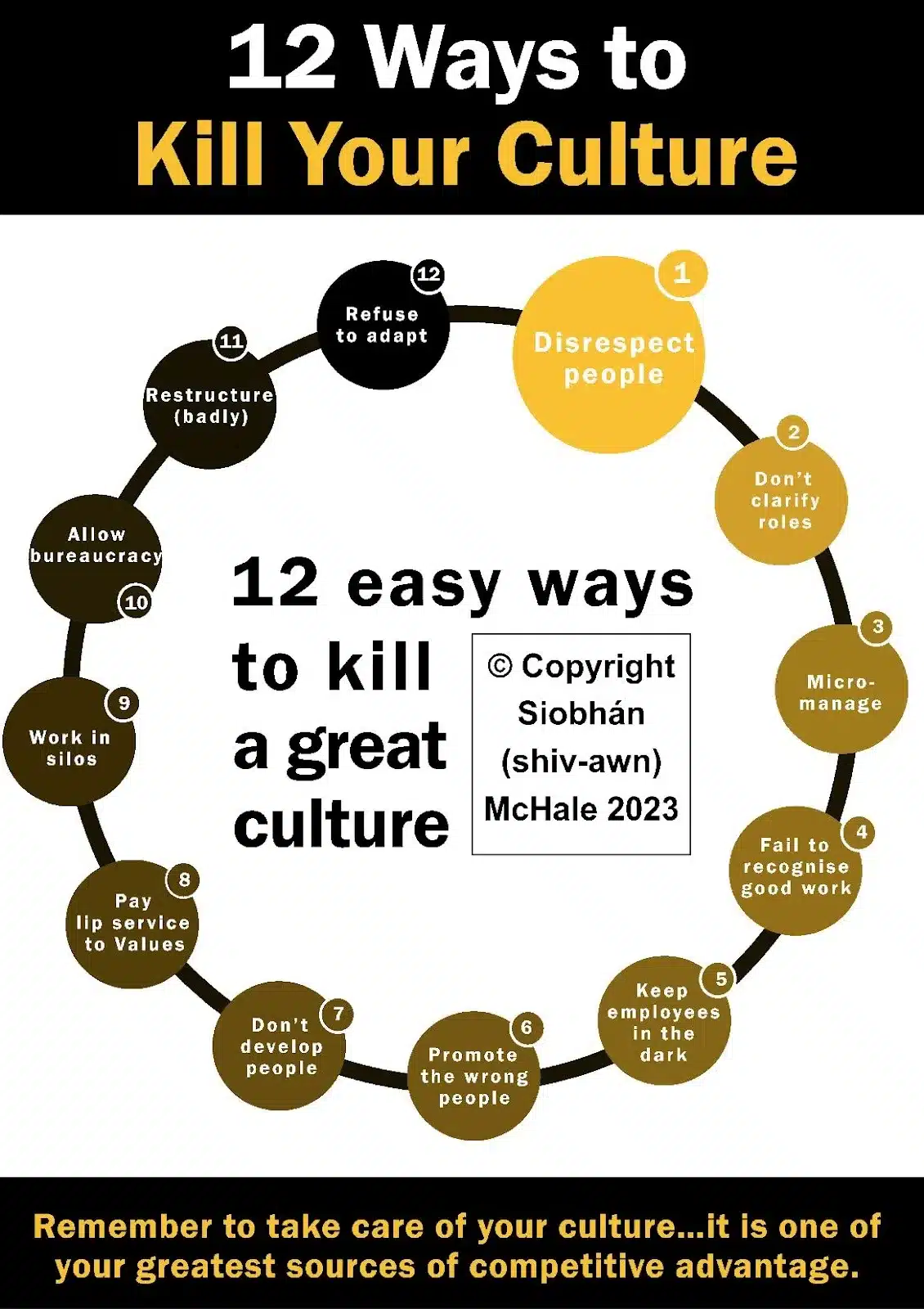
Another frustrating aspect of culture is that it can take years to create a positive, fulfilling culture — and moments to break it. This is why, at the agency, we refuse to buy into the myth of ‘cultural transformation’. Instead we talk about cultural development, as it’s a process that requires a long-term commitment, humility, and widespread ownership and accountability. It also demands constant vigilance and renewal, because potential cultural ‘derailers’ are everywhere, as this recent graphic from Siobhán McHale outlines:
If all of this seems too daunting remember that leadership has changed significantly after the triple-whammy of Hybrid Working, The Resignation Wave and the arrival of A.I. Leaders can no longer be the ‘hero CEO’, who tells people how things will be and then expect everyone to follow his/her vision. Instead, it’s their job to be ‘cultural architects’ and everyone else to be ‘culture creators’.
Despite all of the reasons for investing in culture, it’s disappointing to see so many leaders who avoid the subject. Of course, if OFSTED1 asked to see evidence of their cultural ‘ranking’ (we provide a numerical score, but stress that it should be used as a basis for discussion and whole-school strategy) every school would take cultural development far more seriously. Instead, too many pay lip service to an annual employee engagement survey or student satisfaction polls. It’s not that there’s anything wrong with such yardsticks, but they only provide a partial picture. We look at 8 cultural elements: Trust, Transparency, Engagement, Equity, Autonomy, Agency, Mastery and Meaning. It gives a more comprehensive picture of what it’s like to work in any given organisation.
So, instead of chasing the latest management fad, ask your school leaders, and your support workers to sum up the culture as they experience it in a few words. Check for alignment with your public pronouncements. And if people can’t describe the culture, then perhaps you need to find a way to measure it. Stop viewing organisational culture as a nice-to-have-but-not-essential and accept (as most of the schools we’ve worked with have done) that, if your culture becomes a co-created, bottom-up endeavour, then everything else — the performance indicators, recruitment and retention, HR issues, and above all, the classroom culture — will follow.
Lou Gerstner, the person credited with saving IBM from collapse summed up his key learning like this:
I always viewed culture as one of those things you talked about, like marketing and advertising. It was one of the tools that a manager had at his or her disposal when you think about an enterprise. The thing I have learned at IBM is that culture is everything.
1. OFSTED, whose full name is “