I was recently talking to a teacher who is new to PBL, and was feeling stuck because they wanted to design a “big ambitious project” (their words) but didn’t know how to cut wood, weld, or do much of anything with raw physical materials.
When they told me this, I realized they were making a basic but extremely common mistake: They assumed that what makes a project (or a PBL unit) feel “big and ambitious” is the product that students make. But this is not usually the case. Much more often, a project feels big and ambitious to students because of the audience they’re showing the product to and the venue in which they share it.
Here’s an example: If students write a poem and turn it in for a grade, that does not feel like a big ambitious project.
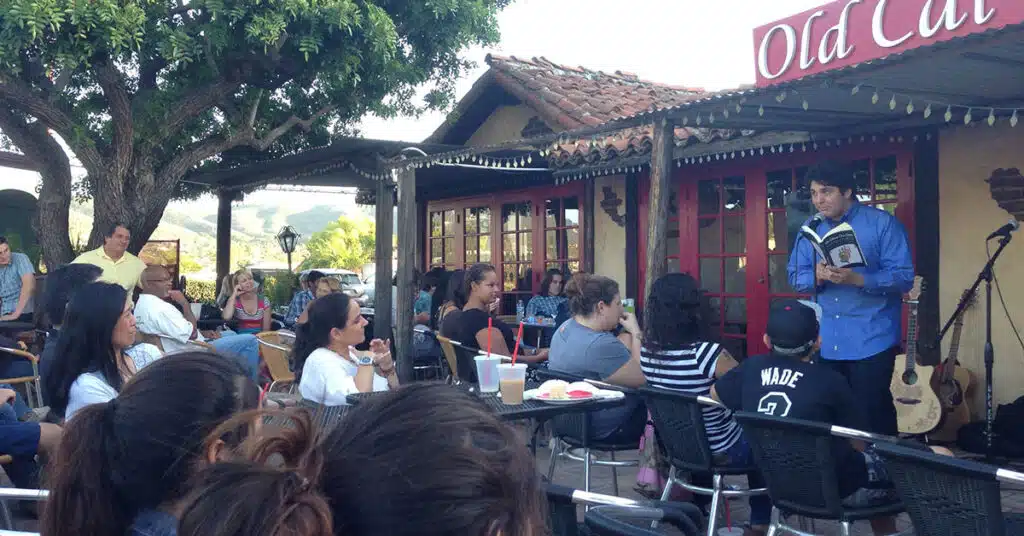
On the other hand, if they write a poem and read it into a microphone in front of a packed coffee house at 7:00 at night, that will feel big and ambitious!
The product stays the same; all that changes are the audience and the venue. But now, it’s a totally different project. In fact, adding a compelling audience and venue can be all you need to change an “assignment” into a project.
This is the secret, and it’s so simple: Hold an exhibition in a venue that’s off school grounds, during a time that is outside school hours.
I once held such a poetry reading in a coffee house. The first project I ever designed was called the Poet Laureate project. I commissioned my students to be Poet Laureates for different periods in American history.
Each student chose an event from their time period to commemorate in poetry, a perspective from which to view the event, and a form for their poem. They also wrote an essay providing historical context for their poem and explaining their creative decisions, and gave a presentation to their peers about their historical event.
While I love this project, I’ll admit that writing poetry in an English class is hardly revolutionary. What made the project “big and ambitious” was the poetry reading, which took place at night, at a coffee shop down the street from school. Students dressed up, stood in front of a crowd, spoke into a microphone, and we hung all the poems from cords around the performance space. The coffee shop even had outdoor firepits, which added a lot to the atmosphere.
For my next project, Absolutely True Comics, I found out that a local community college had recently acquired a new exhibition space and were interested in using it to display work from high school students. I designed the project with this venue in mind. Students read Sherman Alexie’s The Absolutely True Diary of a Part-Time Indian and, inspired by the book’s graphics, made comics illustrating events from Native American history. As I wrote in the project description, “Unlike the comics in the book, our comics aren’t about the narrator’s life; they’re about the historical reasons the narrator’s life is the way it is.”
We printed out the comics on high-quality paper and held a gallery opening in the college’s new exhibition space. We served refreshments and a few students brought musical instruments. The event ended in an impromptu jam session and it was among the rare times I’ve been unable to get students to leave at the end of an exhibition.
Whenever possible, I made sure my projects ended with an exhibition somewhere exciting.
When biology teacher Mackenzie King and I collaborated on a science fiction project, we launched a collection of science fiction short stories at the Mysterious Galaxy Bookstore. A theater near our school was “dark” on Mondays through Wednesdays (that is, there were no performances), so when students wrote short plays about wrongful incarceration, they premiered them on that stage. We used that theater again when students recorded podcast episodes about California propositions—we played the podcast episodes over the theater’s sound system, and the creators held a Q&A on the stage.
Most of these projects could have been assignments in almost any English class. When I was in high school I was asked to write a poem, draw a comic, write a short story, and develop a short scene to perform with my friends, and I did not go to a project-based school.
It wasn’t the products that made these projects big and ambitious;. it was how we shared them with the world.
Looking for more?