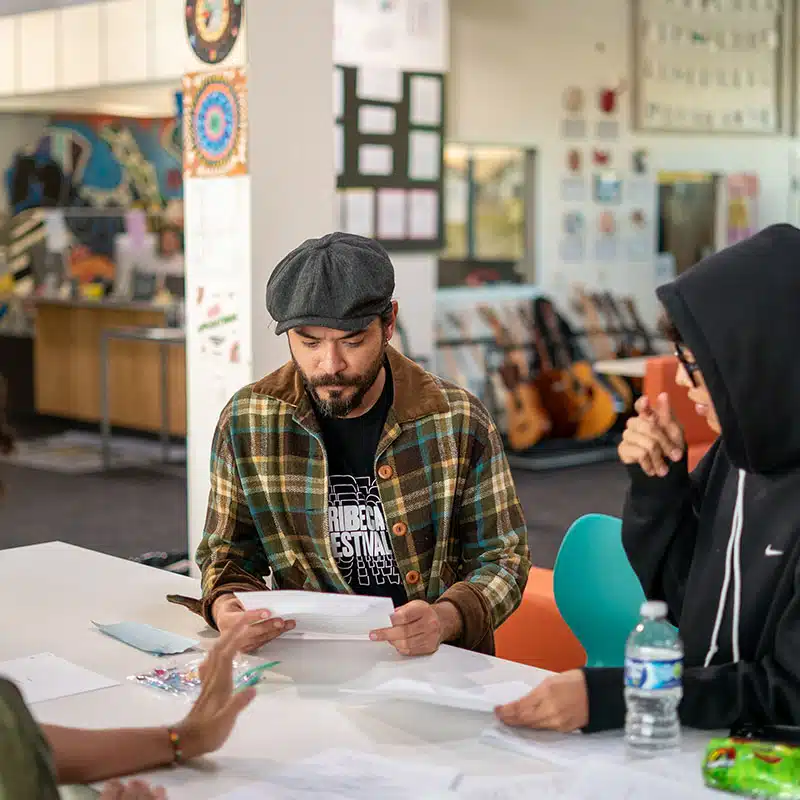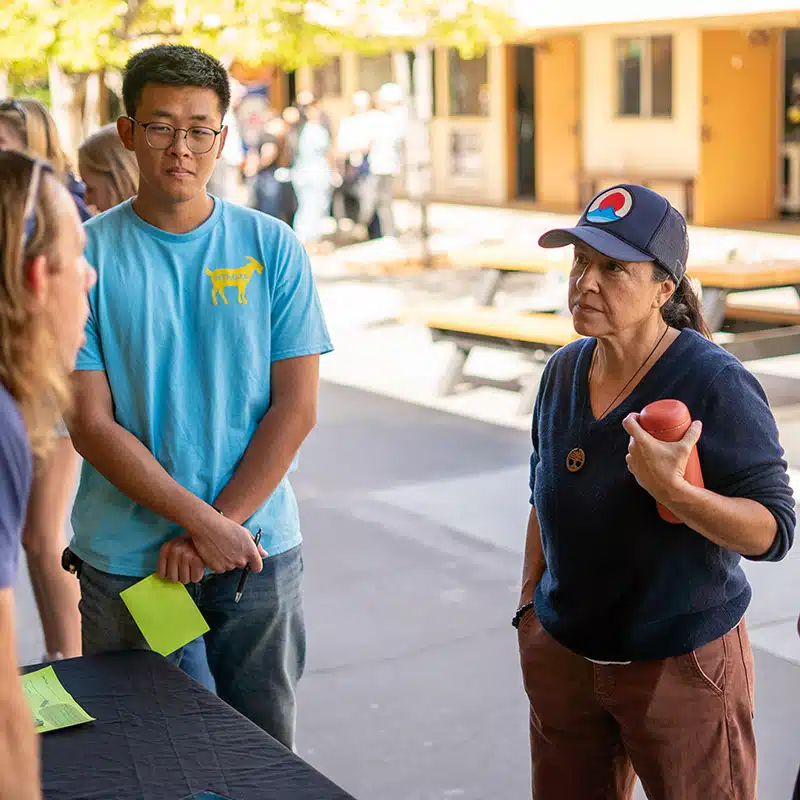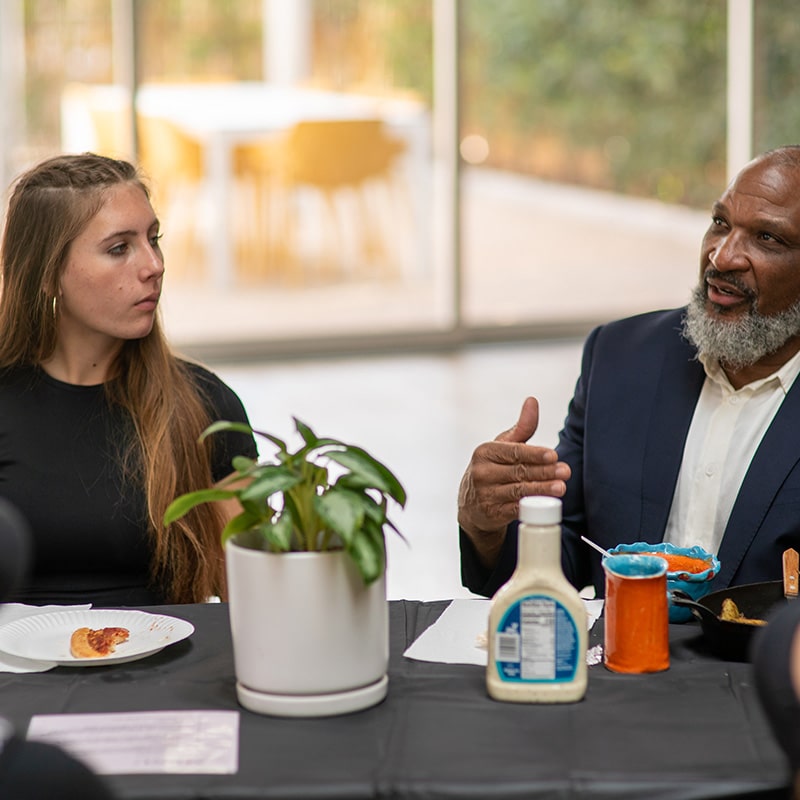
The questions asked by the teachers were probing to the point where [my son] had to go on an internal journey of self discovery so that he could see where his own thoughts were coming from.
—Gitu Daryanani, parent
A recent study sponsored by the Social Science Research Council found that 45% of college students make no progress in critical thinking, complex reasoning, or writing during their first two years of college. Perhaps even more unsettling, another study claims that approximately half of the students who start BA programs never finish and only 30% of those who enter community college leave with a degree (Grafton, 2011).
These studies are should not be viewed as the definitive word on the effectiveness of post-secondary education. However, they raise important questions for the K-12 level: What does college prep mean, especially in non-traditional schools with progressive forms of assessment? Should these recent studies influence how we define academic rigor in secondary schools?
While there is a wide range of opinions on how to prepare students for college and how to define rigor, there is a general consensus that critical thinking is an essential skill for high school and college graduates. State boards of education, educators spanning the collegiate and K-12 spectrum, and business leaders all claim that thinking critically is necessary for the intellectual development of individuals and the economic competitiveness of countries (Arum, 2011).
Presentations of Learning (POLs) and other types of performance assessment lend themselves to the teaching of critical thinking, but they are often overlooked for this purpose. Depending on the priorities of teaching teams or faculties, POLs typically fall within a spectrum between two poles, neither of which allows for demonstrating the analytical skills involved in critical thinking.
On one extreme is a content-based presentation where students are asked questions about facts. On the other extreme is a reflective presentation where students are asked to evaluate their academic development. The former has been criticized for promoting drill-and-kill at the expense of reflection or skills; the latter has been criticized for lacking rigor.
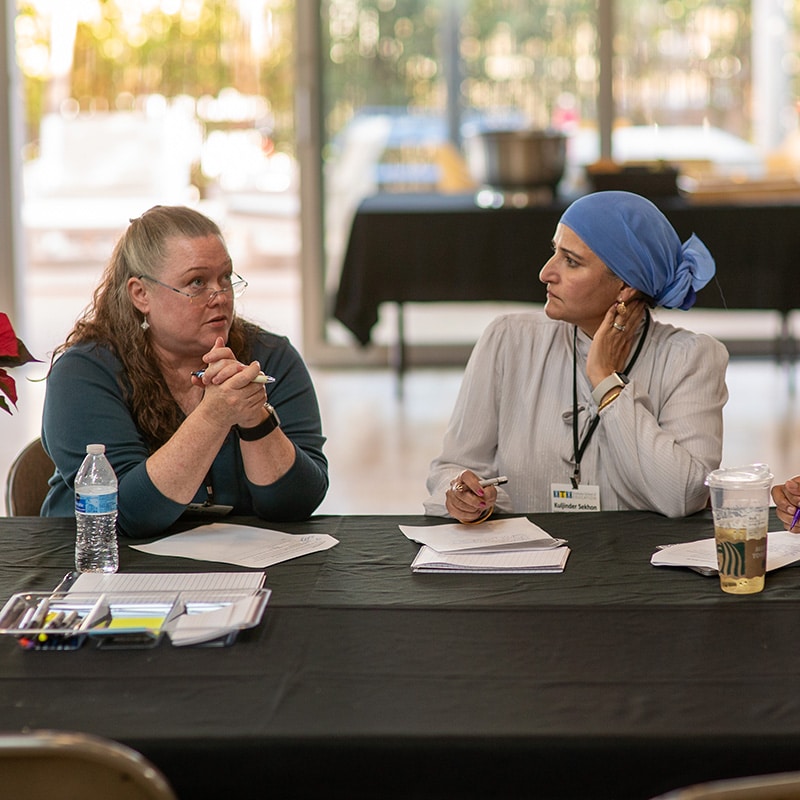
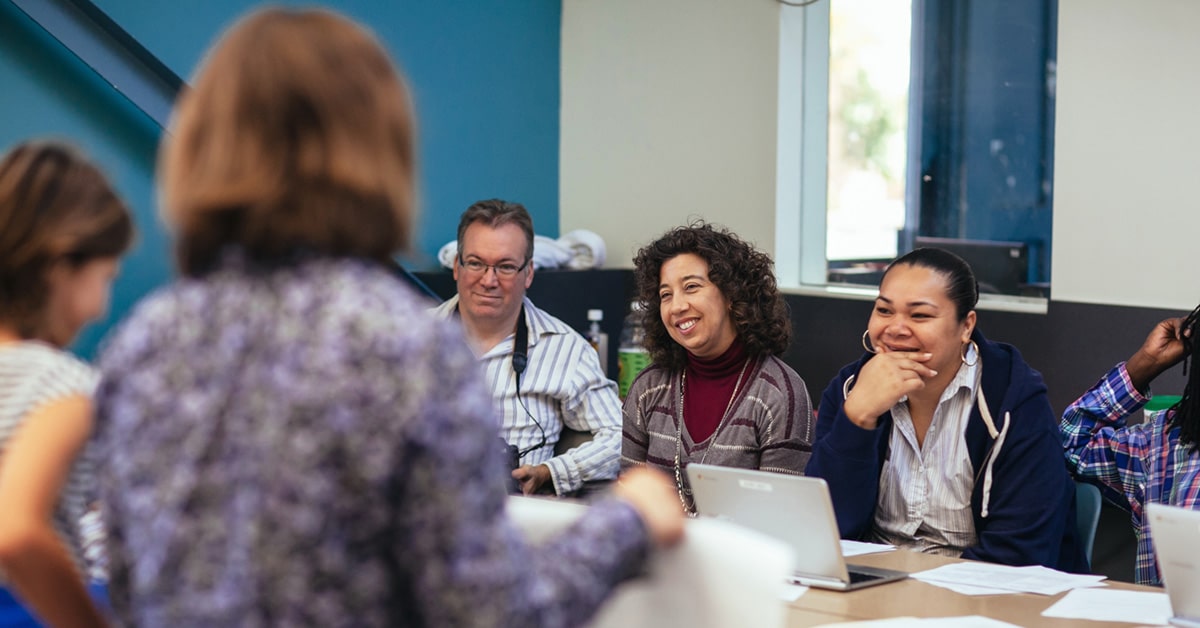
The authors’ critical-thinking POLs lean toward the content side of this scale, but by making them a public performance where students are asked to analyze problems, we strive to avoid the pitfalls of the purely content-based POL. Additionally, our discussion-centered approach allows teachers to ask reflective questions when appropriate. Our critical-thinking POLs comprise a small group of student-panelists, teachers, and parents. They include presentations, Q&A, Socratic questioning, open discussion, and a debrief.
Critical-thinking POLs are based on the following principles:
Critical-thinking POLs follow a four-step process:
Panelists take turns giving short 3–4 minute presentations. Teachers should be specific about the content parameters and encourage students to keep their presentations as short as possible. Students typically make claims or venture a hypothesis related to the class project. Unlike other POLs, our critical-thinking POLs do not involve students displaying portfolios or products related to the project. We save that for the public exhibition of learning.
After the presentation, teachers spend approximately 15 minutes asking questions. This period of time is divided into two different sections, which often overlap: Q&A, and teacher Socratic questioning.
The Q&A consists of clarifying questions and fact-based questions. Questions often follow up assertions made during the students’ presentation. At this point the questioning is straightforward, such as “How does the average Haitian acquire clean water?” or “What positive control did you use for your experiment?” This type of questioning only lasts a few minutes; it does not necessarily reinforce critical thinking skills, and unless limited it can bog down into a monotonous regurgitation of facts.
In Socratic questioning, the teacher asks a series of questions that force the student to defend a claim. This essential step ensures that the POL involves critical thinking. It is inspired by the dialectical method in Plato’s dialogues. The teacher opens with a question, the student responds, and the teacher asks another question based on that response. This back and forth continues until the student realizes that his reasoning is flawed, or not.
This process resembles the tying and unraveling of a knot. Prodded by the teacher’s questioning, the student will sometimes get stuck, unable to defend her reasoning. The teacher then helps the student unravel the knot by asking another series of questions, or by assigning a follow-up writing assignment that modifies the argument or rethinks the claim entirely.
In the following example, a student defends his claim that egalitarianism is the most just social philosophy. The teacher asks a question about an area of interest for the student—sports—in order to make connections with ideas studied in class.
Teacher: Do you believe the salaries of professional athletes are morally justified?
Student: Albert Pujols just signed that big contract with the Angels and he takes up 1/10 of the MLB paycheck. I don’t think you need 300 million dollars, or whatever it is. They don’t need as much as they get. I’d be fine playing for a million.
Teacher: Okay, so, what’s an idea that can be used to make an argument that they shouldn’t be paid that much?
Student: They don’t deserve it. They were born lucky. It’s all luck.
Teacher: Really? Doesn’t Pujols take batting practice? Doesn’t he work hard?
Student: I’m sure he does, but how should I put it … I think it’s more like he doesn’t do as much work as others do. My neighbor has three jobs and he doesn’t make nearly as much. It’s not fair.
Teacher: Can you think of a situation in which it would be fair for Pujols to make that much money?
Student: If it benefits the disadvantaged.
Teacher: John Rawls called that the difference principle. Is that what’s happening now?
Student: Not really, but people like to watch him. You can say they benefit from that.
Teacher: You started by saying athletes don’t deserve to make that much money, but then you said that they can make a lot of money if they follow the difference principle. Now, how can we apply that to your case study regarding water in Haiti? How can egalitarianism help Haiti?
Student: In Haiti, people don’t have homes or jobs after the earthquake. Egalitarianism can help make sure everyone has jobs.
Teacher: You might have to invest money for education and create incentives for companies to do business there. That would cost money. Where would it come from?
Student: I’m not sure. Maybe we could give money to them. From taxes or charity.
Teacher: Why should I have to pay taxes for the Haitian people? Forcing me to pay taxes for something I don’t care about is a violation of my right to benefit from my own labor. What’s your response to that?
Student: I don’t know.
Teacher: Think about it. We will continue talking about this in the debrief.
At least two things are accomplished through this line of questioning. First, the student has to defend a claim using reasoning and evidence, which is the most fundamental aspect of critical thinking. The teacher’s questioning provides counter-claims with which the student does not agree and to which the student must respond. Second, the student applies general concepts to specific cases, and must be prepared to defend the efficacy of those concepts in support of his claim.
In the above example, the student was asked to apply the difference principle to a case we did not study in class, but which he studied on his own—the water crisis in Haiti. And there’s the rub. It’s one thing to defend an argument that has already been made, but since the goal is to learn how to think and not regurgitate previous arguments, the student is asked to apply concepts and argument skills to other examples. In this case, the student was asked to follow up in writing, but if more time were available the teacher could continue his line of questioning until the knot, previously tied, becomes unraveled.
A 15-minute round of open discussion follows the last round of Q&A / Socratic questioning. This is where the panelists, parents, and guests come into play. The opening question is the guiding question of the project. In our most recent project we asked, “What is the best solution to the problem of overconsumption?” but the students carry the primary responsibility for keeping the discussion going once the question is asked.
This process benefits from student panelists reading each other’s written work and coming their panel prepared to ask each other questions. This phase is similar to a Socratic seminar, except that the students’ written work, and not an outside text, is the focus of the discussion. The same critical thinking skills that were demonstrated during Socratic questioning apply during this phase of the POL, but with a much looser structure that allows students and parents more flexibility to explore their own questions and ideas.
Teachers debrief with students immediately following the open discussion—at the same table, with the same panel. A critical thinking debrief often involves the teacher informing a student that he or she holds contradictory ideas. The teacher then asks the student to write a paragraph that explains why the teacher is wrong or to make a claim that is not contradictory In the above example of teacher-student dialogue, when it came time for debrief, the teacher reiterated the question about being forced to pay taxes. If the student had been able to answer the question, that would have been the end of it. Because he could not, he was asked to write a follow-up paragraph.
Debriefs and follow-up paragraphs are fundamental to critical-thinking POLs. There is usually not enough time for students to fully think through a problem during the panel; this last step allows them to reassess their own ideas and pursue new possibilities. Critical-thinking POLs are not completed until two days after the debrief, when the follow-up paragraphs are due.
Here are some things to be aware of when initiating POLs for critical thinking:
There are no simple solutions to preparing high school students for post-secondary education, but considering the importance of analytical skills for college and beyond, a close look at critical thinking is an important first step. While the teaching of critical thinking is a multi-faceted issue, a simple principle can guide us: ask students to do it. Do it in writing, do it in reading, and do it in every class and in every project. Undoubtedly, this is easier said than done and raises problematic questions of its own; but one place where it can come together is during a presentation of learning. Students are asked to apply ideas from various disciplinary perspectives, apply those ideas to different scenarios, and defend them by responding to the counter-claims of teachers, parents, and students. If we know the semester will end in this type of endeavor, the course of the semester becomes an analytical exercise in preparation for it. This is not about making up for a problem at the collegiate level, but to acknowledge that learning how to think is a life-long endeavor for all of us. If we—a community of educators, parents, and students—do enough of it, in a disciplined enough way, we might find ourselves on a “journey of self discovery” where we “see where our thoughts are coming from.” And yes, somewhere along that path our graduates just might find that English Comp. 101 is not so intimidating after all.
Arum, R. and J. Roksa (2011). Academically Adrift: Limited Learning on College Campuses. Chicago: Chicago University Press.
Grafton, A. “Our Universities: Why Are They Failing?” (2011, November 24). The New York Review of Books. Retrieved from The New York Review of Books website:
https://www.nybooks.com/articles/archives/2011/nov/24/our-universities-why-are-they-failing