Randy Scherer earned his M.Ed. in Educational Leadership at HTHGSE.
One sure way to build students’ abilities to drive their own learning is to involve them directly in the process of assessment. Here, we share a guide to quickly start building a culture of evidence-based self-assessment in which students evaluate their work in relation to a high-quality model or example.
A classroom rich in productive self-assessment practices that are grounded in models and examples offers students and teachers seemingly limitless benefits. With support, students can use this system of self-assessment to grow as self-directed learners with strong metacognitive skills.
The development of strong self-assessment skills benefits classroom community in many ways. Self-assessments help students and teachers get on the same page about expectations for quality and work habits. They help embed important academic mindsets and practices of drafting, revision, and goal-setting into the classroom culture. They build trust between teachers and students, and foster positive relationships between teachers and students. This is an especially significant benefit to bring to the experience of assessment, which can be fraught with tension due to its evaluative nature. Self-assessment also carries lifelong benefits: Students who self-assess positively and productively are developing a skill set that is essential for success beyond school.
Below, we’ve linked two protocols to guide your facilitation of self-assessments among students. Use these protocols with the tips listed here.
Strong models and high-quality examples help students learn what their work can look like as well as help set expectations or benchmarks. Models and examples also show what learning targets or elements of quality look like in a fuller context.
Rubrics can help students and teachers think through elements, categories, or skills in an assignment, but a rubric is at least one step removed from the work itself. Keep students focused on what excellent work looks like. If you need to know that specific tasks are done satisfactorily, have students complete a checklist with binary options, such as “yes” or “no” or “complete” or “incomplete.”
A good model or draft will feature many elements of quality and learning targets. But, to start, focus students’ attention on just a few specific learning targets—maybe even just one. You may select one or two elements of quality at first, and as the class’s proficiency grows, you might collaborate with students to decide which learning targets are the focus of this particular self-assessment. Regardless of how you select learning targets for a self-assessment, always keep the number manageable, and always make sure students know what learning targets to focus on.
As students review their work in relation to a high-quality example, guide them to identify and consider the ways in which their work is similar to the model, and the ways in which they can continue to make progress. Support students to develop their abilities to identify important learning targets in their work as well as in the example, and to reflect on their progress toward these goals. Encourage all students to see that they are doing some things well, and everybody can continue to learn.
Students can copy and paste passages from their writing or take pictures of their drafts, blueprints, drawings, or math. They can do the same when they recognize these elements in high-quality examples.
However you choose to do this, the goal is for a student to show, with specificity, how their work measures up favorably and how they need to improve. A tight focus on evidence—requiring students to show this, not only tell it—will accelerate their progress as self-assessors.
Self-assessment is a skill, and people get better at it with practice. Keep telling your students that you value their ideas, and you want to know how they came up with them. After your first experiments with self-assessment, share a few good examples with your class, so everyone can see what high-quality self-assessment looks like.
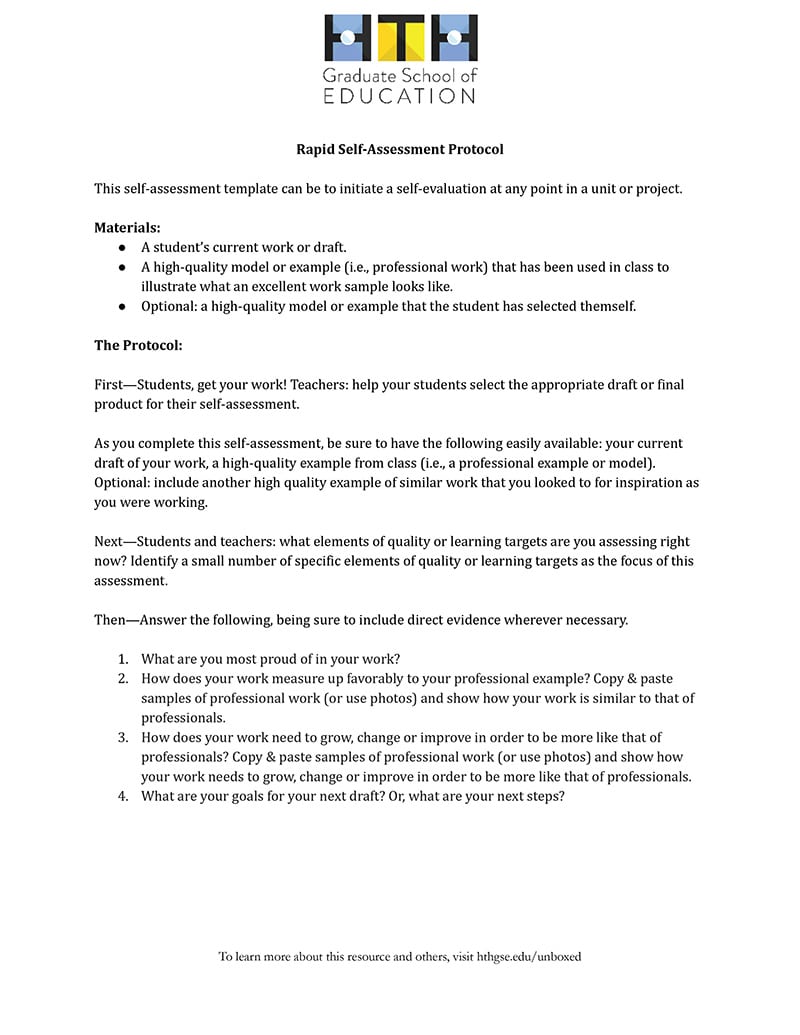
Quick Self-Assessment Protocol: Use this at any point in a unit or project. This can work with anything from a first draft to a final draft.
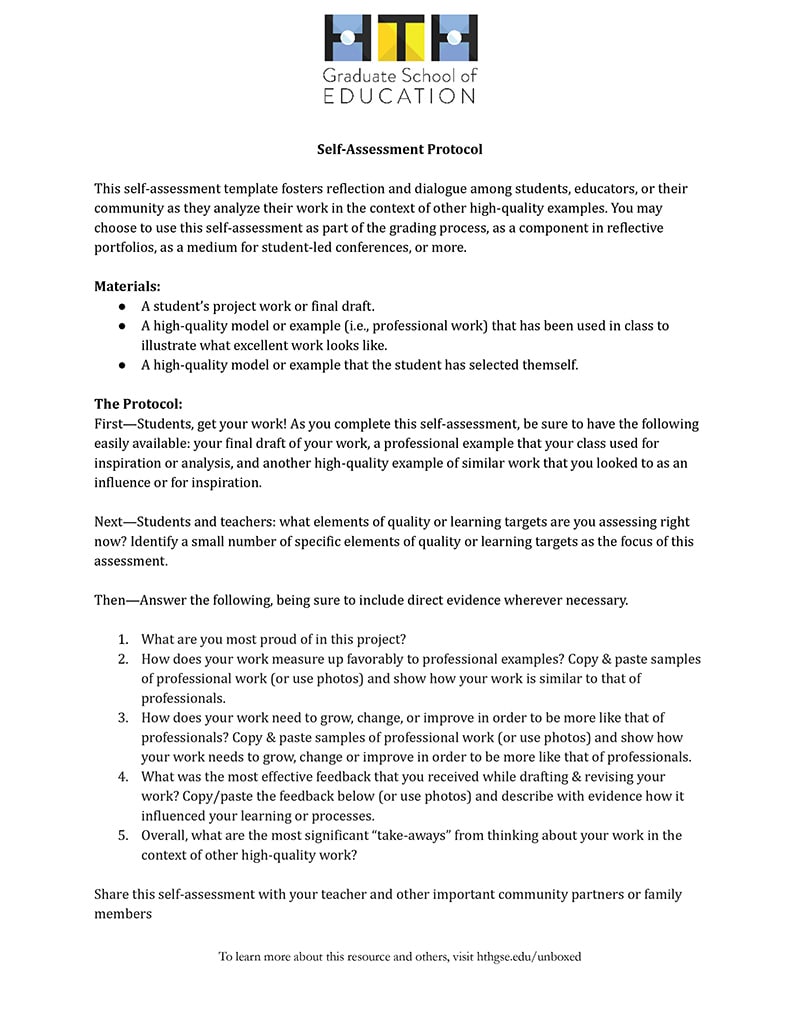
In-depth Self-Assessment: This is best used with a final draft of student work or for a culminating assignment or project.