Community partnerships in project-based learning, deeper learning, or career technical education can be understood across two variables: the nature of the relationship between students and the partner, and the context for working together.
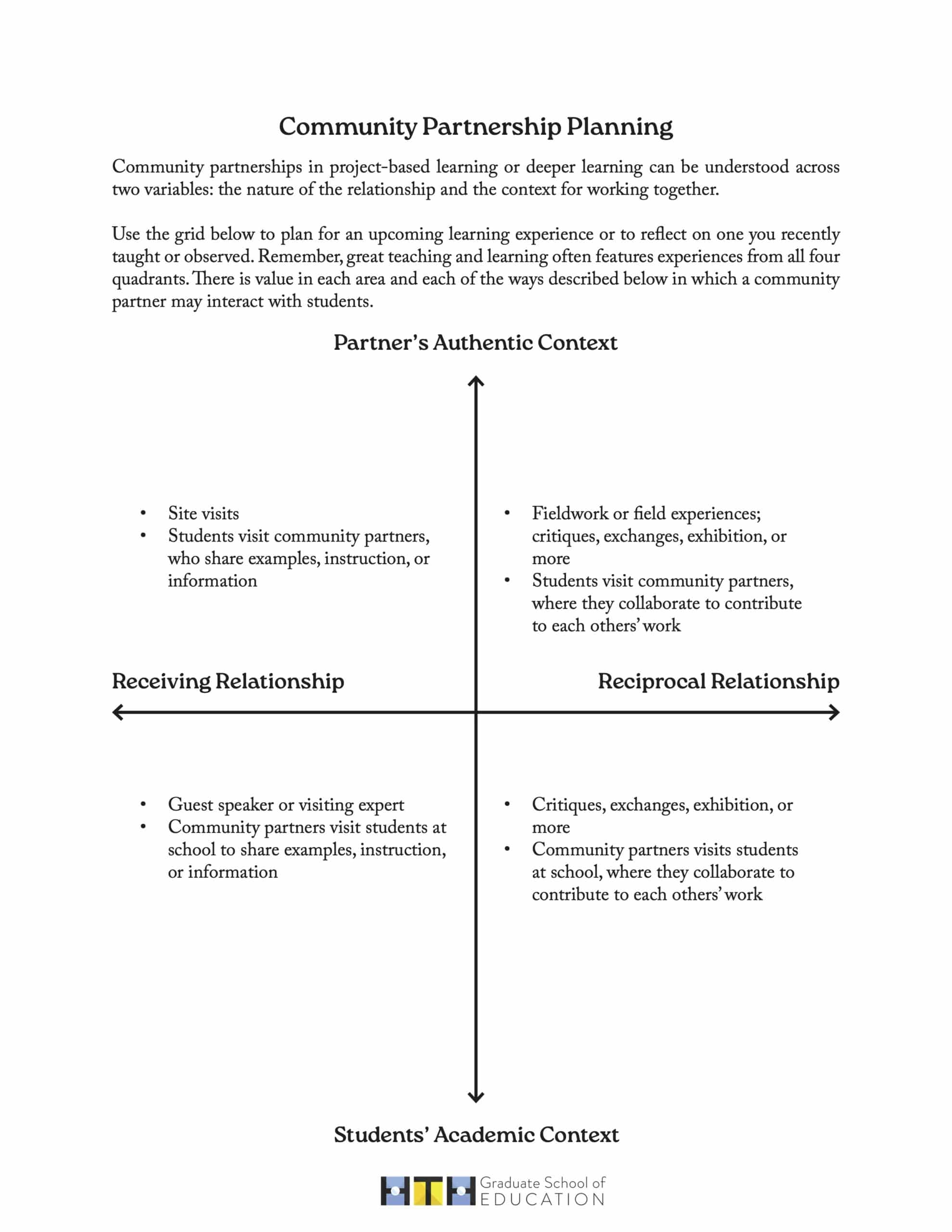
The relationships between students and their community partners exist across a spectrum. At one end, students are in a receiving role and learn from the community partner’s expertise; at the other end, students and their community partners engage in a reciprocal relationship and contribute meaningfully to each other’s work.
The varying contexts for students to connect with community partners impacts their experience differently, and creates opportunities for everyone involved. Again, thinking across a spectrum, at one end of the range, community partners meet with students within their academic context—typically this means visiting the school. At the other end, students visit community partners in their authentic contexts, which can include a job site, a natural environment, or, for some assignments or projects, the work might take place at the school.
Explore the two-by-two grid below to get a sense of how these variables may converge or diverge. Some educators may want to push their students’ interactions with their community partner toward the top right corner, prioritizing collaboration and reciprocity. Others may recognize the left side of the grid as familiar, as this is where many classic “guest speaker visits” or field trips may land. Great teaching and learning often feature experiences from all four quadrants. There is value in each area and each of the ways described below in which a community partner may interact with students.
Our aim is for educators to use this graphic organizer to create a balanced approach to community partnerships that meets the needs of diverse learners who are growing and changing over the course of a project or unit. There are many ways to do this, maximizing the dynamic possibilities for engagement and learning that each quadrant offers. What might it look like to start a new unit through a field experience, with students either in a receiving role or a reciprocal relationship? How might experts regularly offer examples, feedback, or instruction throughout the course of a unit? Where and how might a community partner engage with students at the culmination of their learning?
Use the attached graphic organizer to plan for upcoming learning experiences or to reflect on one you recently taught or observed.
See community partnerships in action in this video.