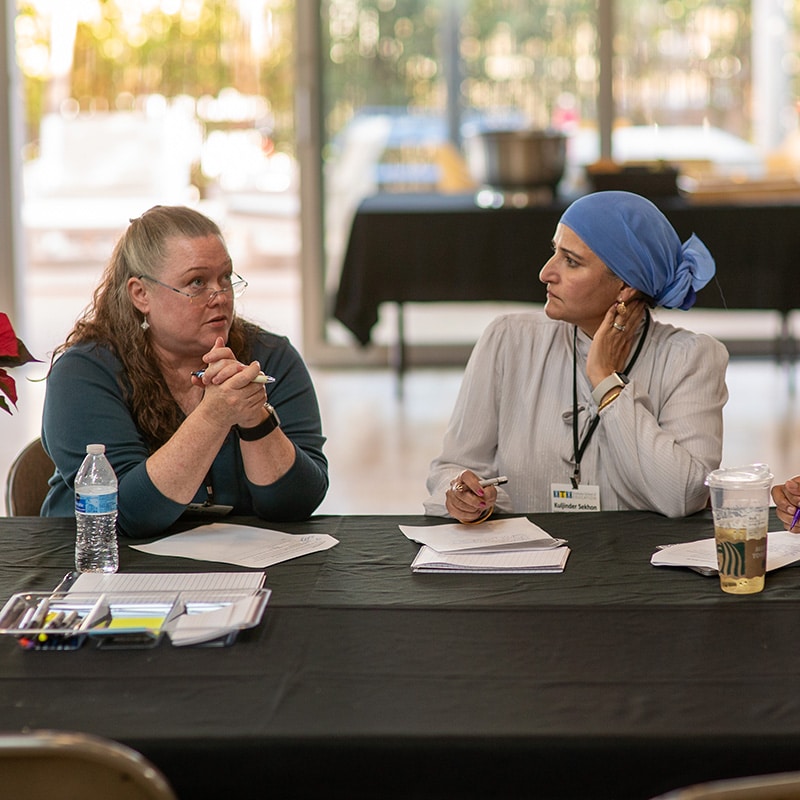
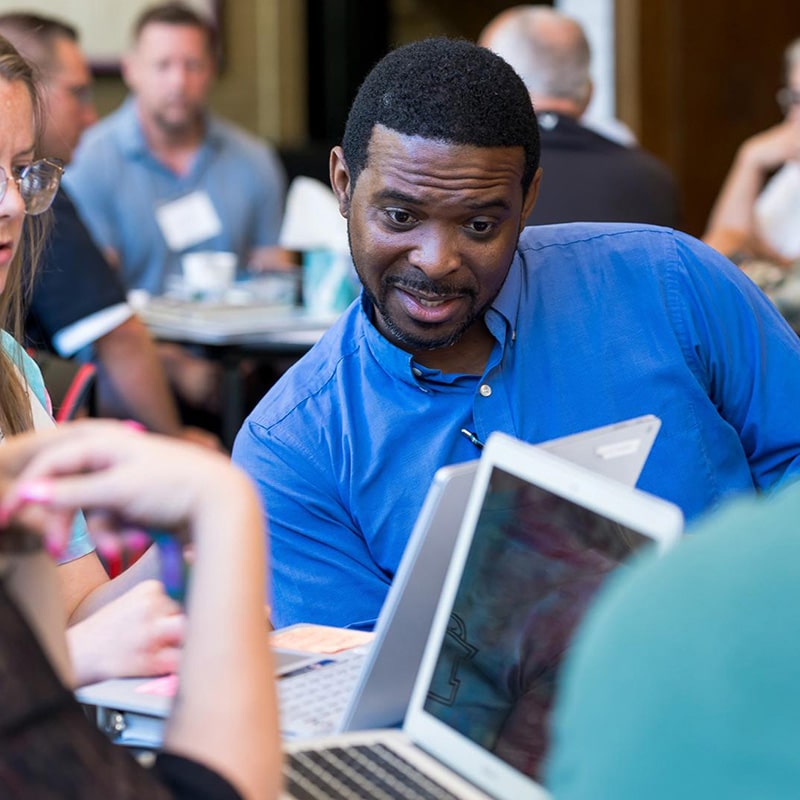
 We had just sat through another staff logistics meeting. The regularly scheduled meeting where we power through as much information as we can pack in 45 minutes and hear the same colleagues’ voices. We were arranging the classroom back in its usual formation for the teacher whose room had hosted the meeting as I asked a colleague how they were doing. After exchanging formalities we started talking about the meeting, how it was really long and not necessarily productive. I asked what he meant and he explained that although the information shared was vital to our success as a school, he also wished that we had more opportunities to share our “craft knowledge.” Until that moment I had not heard anyone use those words at our campus and it reminded me of Roland S. Barth’s “Improving Relationships Within the Schoolhouse” (2006). Barth talks about the extraordinary insights we each develop in our practice and how we become adversaries by withholding this knowledge and not sharing it with others. He also claims that, “If one day we educators could only disclose our rich craft knowledge to one another, we could transform our schools overnight” (p.2). With those words, he had my undivided attention.
My colleague was craving opportunities for us to share a success from our classroom, an anecdote about something we did, a celebration of a student, a new activity or structure that worked for us; simply put, anything positive about practice. Thanks to the open source movement we are able to download templates and resources online for free. We can use free versions of expensive software to create access to tools and resources that may have once seemed unattainable. Organizations across the country have opened their doors and shared their professional knowledge gained by experience, their ”craft knowledge.” In 2014 Tesla even shared their patents stating that, “Tesla Motors was created to accelerate the advent of sustainable transport” (Musk, 2014). So, why is it that we as educators don’t do the same?
I started thinking of ways that we could share our craft knowledge. I had heard about public events called “TeachMeets” where educators come together to share their craft knowledge in a format that is free and open to anyone who can attend. A sort of free conference where people gather to share resources and best practices. “PechaKucha,” another social presentation format where 20 slides are presented in under 7 minutes has also become an innovative way to share one’s experience and point of view. When could we do it? TeachMeets and PechaKucha’s usually happen in the evening. To ensure maximum participation I figured it should be during the time that we are already at school. Where could we present? During the logistics meeting just as my colleague had proposed! Then I had some questions that were not so easy to answer. How could we make sure that everyone, new staff and old, could have the opportunity to share a success? How would we decide who would present? Would my colleagues listen to the presenter or roll their eyes? Feeling adventurous I proposed the idea to my director and here’s what I pitched:
A two to three minute segment in our 45 minute logistics meeting where one volunteer shares a success from their teaching practice as a model. At least two of the first five volunteers should be new staff so that it doesn’t feel like only the veterans get to share. The purpose being to build a sense of community amongst all staff members, create opportunities for those that don’t usually share to do so, and most importantly, for all of us to learn from one another.
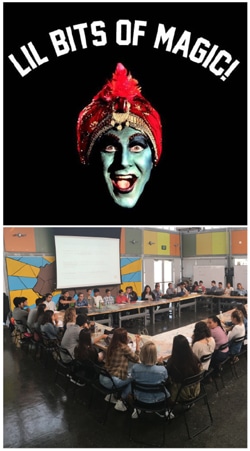
I wasn’t prepared for the response. My director said, “Sounds good, can you come up with a catchy name and start our next All-Staff Logistics meeting with this?” Immediately my mouth opened and said, “Yes, of course, thank you!” But in my head a million things were happening and none of them were saying anything about being prepared to do this! I had a week to get ready. I started thinking of a name, how I would hook my colleagues into the activity, who could be the first to present, and how I was going to get all of this done in time. Then it happened. The name came to me in a flash as most of my ideas for art pieces do. I named it Lil Bits of Magic or LBOM (pronounced: el-bäm), as the cool kids say. Now I had to find someone to present. The goal was to get colleagues who don’t usually speak up to participate so I asked someone who rarely shared his thoughts and who was within his first three years of teaching. (A time when most teachers are still figuring things out and don’t always feel like they have much to contribute). My colleague hesitated. “Hmmm, I don’t know…” So I quickly sweetened the deal and offered him a t-shirt in exchange for their participation! (During my free time I like to design and print custom shirts). He agreed and all I had left to do was figure out how I would present this new activity. In many ways this was like launching a new project in my classroom. You have to get your audience bought in and energized. A round of call and response was in order, just like the great MC’s do it. So now I had it all, a name, a presenter, and a hook.
The day came and my heart was jumping in and out of my chest. I stood up at the front of the room and presented the idea to my colleagues. All eyes were on me. Then I went for it, “Okay to get us started, everyone repeat after me. Mecca lecca hi, mecca hiney ho.” I think one, maybe two people repeated after me. So I went for the second verse “Mecca lecca hi, mecca chiney ho.” It didn’t do much better, but it got some laughs. I dated myself and told my colleagues that this call and response was from an old show I used to watch growing up called “Pee-Wee’s Playhouse.” Of course my friends in the room started laughing again. I went ahead and introduced my first presenter and when he was done sharing his magic (and after a round of applause) I presented him with the t-shirt I had promised. At that moment I also looked around the room and announced that anyone else who volunteered to present would also receive a t-shirt. I could finally breathe. After the meeting three colleagues approached me to volunteer as presenters, but all three added “I just don’t know what to share.” This would become a common theme amongst colleagues within their first five years of teaching.
This new challenge made me think about how I could help colleagues acknowledge that they did have contributions to offer our community. I also started to consider what we were doing towards establishing “trusting, respectful and reciprocal relationships” (Le Cornu, 2013) on our campus. These kinds of relationships are crucial when cultivating an environment of adult learning and continuous improvement. In Le Cornu’s research she found that new teachers flourished when they were able to participate in relationships that acknowledged them as professionals who had something to offer. This made it possible for teachers to become active participants not only as learners, but as contributors within their learning community. This could be an empowering experience for teachers, and one that helps them establish an identity within their setting. The playfulness of this presentation format, with the silly call and response to get everyone’s attention, and the recognition of our colleagues as presenters has definitely helped us towards establishing these relationships. There is a degree of vulnerability every time I lead this portion of our meeting that I believe also reinforces our collegiality. By putting ourselves out there each time, the presenter and myself, with the intention to strengthen our community through the sharing of craft knowledge we are creating a culture of sharing that is fun, safe, and full of love.
You’re probably wondering, “So, what IS Lil Bits of Magic exactly?” Well, as I mentioned earlier it’s a two to three minute segment in our logistics meetings which are scheduled once or twice a month throughout the school year. Because the call & response piece was not happening as I had originally envisioned it (only one to two actual responders), probably because I would get really nervous and awkward leading it, I began creating a video that presented the staff member and allowed me to hide behind my computer. The video is a clip from Pee-Wee’s Playhouse where Jambi the Genie grants Pee-Wee Herman a wish. After Pee-Wee makes his wish, Jambi engages the audience with the call and response. Participation in this modified version has been truly magical and full of joy! I edit the clip so that there is a voice over where I make a link to the craft knowledge being presented that day and then at the very end of the clip calls for the volunteer presenter to step up and share her or his magic. Everyone claps and when I scan the room I see lots of smiles and excitement. Our volunteer stands at the front of the room and they present a lil bit of magic from their practice as a resource that others can then implement and/or adapt into their own. They share a resource handout with the following details:
This resource is then posted online where colleagues can access, download, and put it into action. The process is not perfect but has already proven to be successful. When asked about LBOM colleagues have stated that it is fun, a great way to build culture and community, something to look forward to in staff meetings, a great way to spotlight “best practices” and new ideas, and that it is a great opportunity to find potential collaborations with others. It was great to read my colleagues’ positive responses to the structure; it gave me motivation to continue this work and reaffirmed my passion towards creating opportunities for these exchanges. It was also great to read ideas for improvement; these helped me think bigger about LBOM as a structure. The most striking of these was a request for more variety in the resources shared, specifically, resources and strategies for classroom management and the cultivation of positive environments, areas that most educators struggle with at first and that arguably are the hardest for teachers to admit that they struggle with because doing so “proves I am a bad teacher.” It was refreshing to see this request made as it was not something I had encouraged previously. It also highlights that as educators we often fail to acknowledge the practices that help our classrooms run smoothly. A suggestion that I had not considered was to have our staff experience the presenters’ magic by actually participating in the activity. I loved this idea! Another suggestion that was made, and the one that has made me think the most, is creating alternative opportunities for staff to share their ideas and reduce the anxiety of presenting to the whole staff.
Overall the LBOM structure has been a success amongst our colleagues. It is a portion of our regular meetings that many have stated is “their favorite part of the logistics meeting.” A big reason for this is that they are hearing the voices of colleagues who don’t normally participate or take the lead in staff meetings unless they are the assigned “meeting facilitator.” We have a list that cycles through our whole staff for this, although given the number of meetings and the size of our staff it can be a school year or two before you actually have to participate. LBOM has also facilitated a new opportunity for us to share our work and be celebrated for it, I mean, you get a round of applause before you even present! You also have the opportunity to share what you feel is a strength in your practice which allows others to also acknowledge these strengths. This has been instrumental in the strengthening of our staff culture because it has given us the opportunity to learn from one another, helps us realize our similarities as educators, and has taken advantage of a scheduled time when we are all together.
A few of the bits of magic that colleagues have shared are:
Classroom Stations: A series of interactive activities where students engage with a subject in more depth by using multiple learning modalities.
Outdoor Reading: Taking students out of the classroom and turning reading into an event.
Planning Field Experiences: Giving teachers resources on how to find community partners, request donations to pay for field trip transportation, template letters to send out to parents and organizations, and showing teachers how easy it can be to get students out into the community.
Check-In Protocols: Structured check-in activity that allows for a whole class to enter a safe space and share how they are feeling and to feel support from both the teacher and their peers.
The number of resources shared is growing slowly, mostly because we only have 10-15 of these meetings a school year. Because of this the website is still not at its full potential and we are working on ways to increase participation. Even though the LBOM segment of our Logistics meetings has become something that is entertaining, informative, and beneficial to our staff community, it is not for everyone. Not everyone is comfortable standing at the front of the room sharing their ideas, just how many of us like to sing, but very few of us would actually do it on a concert stage. Much like our students require unique access points to the learning experiences offered in our classrooms, educators need a variety of opportunities to receive and exchange new knowledge. This helped me realize that the sense of safety and trust required to share the dilemmas and challenges we face in our classrooms is closely linked to the depth of the relationships we cultivate as a staff. Dedicated time and space are needed for the development of what Judith V. Jordan (2006) calls “growth-enhancing relationships.” These are relationships that not only offer support, but “also provide an opportunity to participate in a relationship that is growth-fostering for the other person as well as themselves” (p. 88). When we are engaged in positive relationships we tend to thrive by finding a better balance in our personal and work lives or, as Daniel Goleman (1995) says, “resonant relationships are like emotional vitamins, sustaining us through tough times and nourishing us daily” (p.4). In a study looking at building teacher resilience and the role of relationships Rosie Le Cornu (2013) states: “A key insight from the study was that in order for the new teachers to feel confident and competent they needed to be sustained by – and be able to sustain – relationships based on mutual trust, respect, care and integrity” (p. 2).
When we trust, respect, and care about the people around us we tend to be our true selves. Lil Bits Of Magic appeals to our sense of humor and pushes staff to participate as one through the call and response. Those two points along with the quick five to ten minute format help towards the building of trust and respect amongst our staff. However, for us to reach the level of resonant and growth-enhancing relationships that facilitate shared experiences we don’t need magic, we need time and willingness to share. Do you have any?
Barth, R. S. (2006). Improving relationships within the schoolhouse. Educational Leadership, 63(6), 8.
Goleman, D. (1995). Emotional Intelligence: Why it can matter more than IQ. London: Bloomsbury.
Jordan, J. V. (2006). Relational resilience in girls In Goldstein, S. & Brooks, R.(eds). Handbook of Resilience in Children.
Musk, E. (2014). All our patent are belong to you. Palo Alto, CA, Tesla Motors, June, 12.