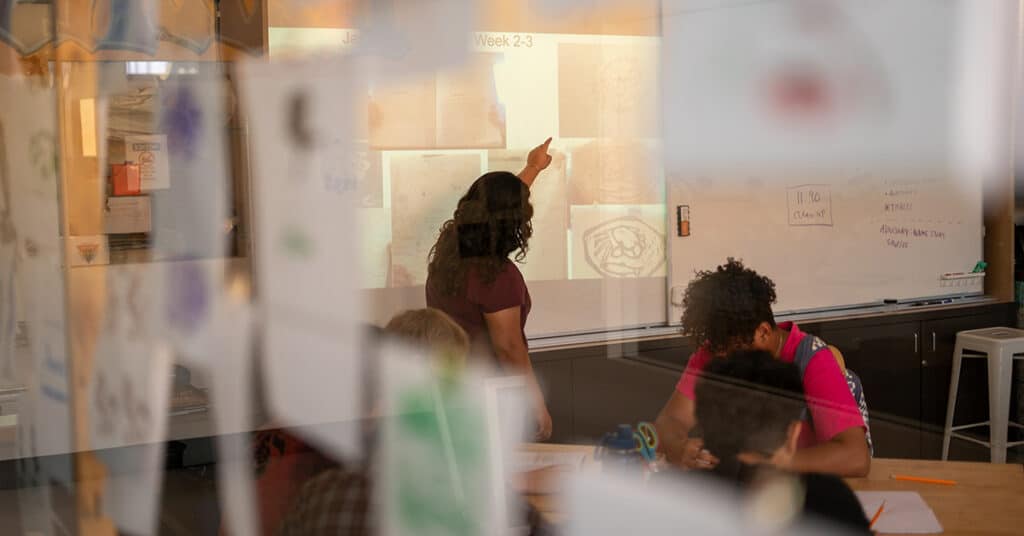
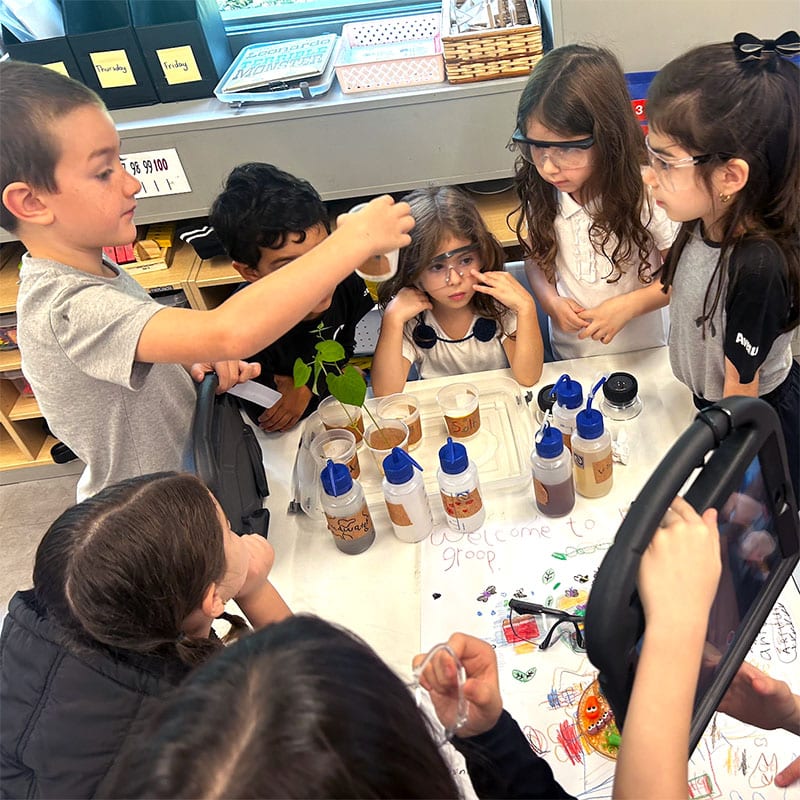
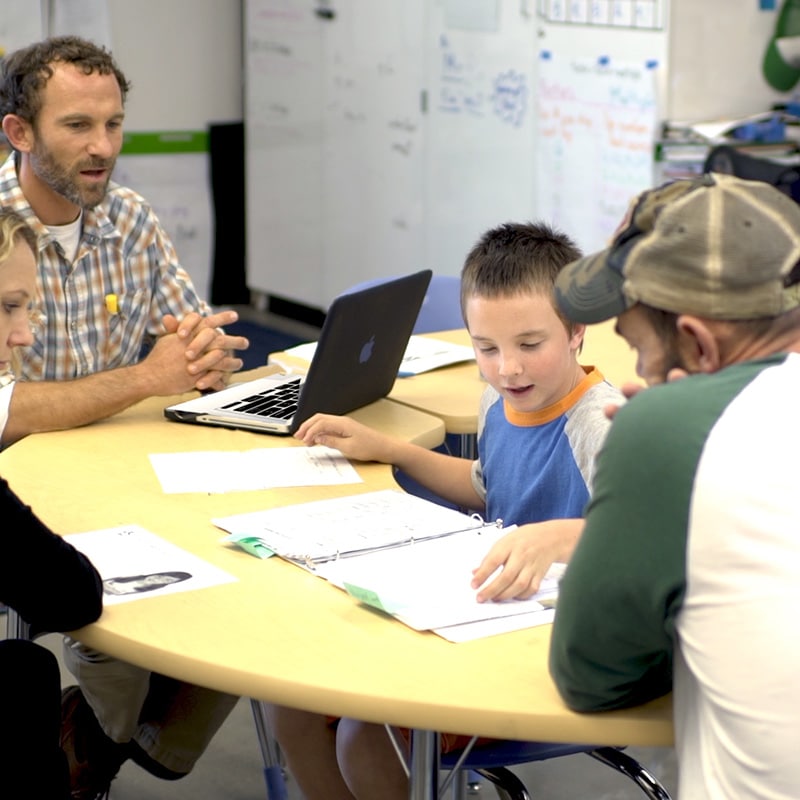
A ninth grade student is wrapping up her presentation to her classmates. The teacher scans the room. “Does anyone have a question for Monica?” he asks. Three seconds of uncomfortable silence elapse. “OK, I have a question!” the teacher cheerfully announces. “What was the hardest part of completing this project?” Monica responds. The teacher asks, “Any other questions?” in a tone of voice that suggests that no questions are actually expected. This time two seconds go by. The teacher starts clapping. The class half heartedly joins in. Monica sits down. The next student stands up. The process repeats. The year was 2000, the setting was the first year of High Tech High, and the teacher was me.
Fortunately, a colleague who was observing gave me feedback on how I could increase audience engagement. He advised that I do three things:
- Before the next presentations, ask students to think about what strikes them, and what questions they have.
- Turn to their neighbor to share.
- Then, and only then, ask the students for questions.
When I next asked the class for questions and comments, almost every hand in the room shot into the air.
Fast forward 25 years. High Tech High has grown to encompass 16 schools. I frequently observe student presentations, and the good news is that we have successfully spread this practice across our organization. The bad news, however, is that sometimes presentations play out just the way they did back in 2000 when I was a young teacher. We know a better way to give students feedback at the end of their presentations, but we do not consistently implement it. We have spread a practice, but have not spread it with consistent quality. And audience feedback on student presentations is but one of many practices where there is important nuance to share.
This brings me to the first reason that deeper learning needs continuous improvement.
Reason 1: Teaching is a complex task that demands a rigorous improvement method
The practices that lead to deeper learning are nuanced and complex. It’s not just, “Have students present their work.” How we prepare students to present, what we ask them to present, how we assess their work, how we provide feedback—these are a series of teacher moves that can be undertaken with higher or lower quality. And how to spread this craft knowledge across a system of schools, let alone a state or country, is not obvious, at least not to me.
Edwards Deming, a founder of continuous improvement methods, once brutally summarized the field of education as “miracle goals and no methods.” Having spent the past 30 years trying to spread deeper learning to more students more often, I recognize myself in this sentence. I agree that we deeper learners have not always had clear plans or disciplined methods. In fact, if we want to implement deeper learning practices at scale and with quality, then the methods of continuous improvement—such as knowing if the change is actually an improvement, seeing the system, and trying small tests of change—are those that we would do well to learn and apply. And this brings me to the second reason that deeper learning needs continuous improvement.
Reason 2: Instruction is the thing, but not the only thing
Camila, a Latina, first generation college student from a low-income family, got good grades and was accepted to a California State University. She was a High Tech High success story. But then, over the summer, she got a letter from her college. She had apparently taken the wrong math class in high school, so she needed to take a college class over the summer that cost $2,000. Well, Camila didn’t have $2,000. So she thought, “That’s OK, I’ll go to community college instead and then transfer to the university.” But what she didn’t know is that when she went to community college instead of directly to a four-year university, her odds of graduating from college dropped by a factor of at least 6. Because for students who start at a community college, particularly students in remedial math, fewer than 1 in 10 ever earn a college degree.
But that wasn’t the worst part of this story: The worst part was that Camila did not take the wrong math class. The university just misinterpreted the name of the class she took. So her chances of earning a college degree dropped to under 10 percent because a high school math class had a name that a university administrator found confusing.
When I heard this story, I was shaken. Here we are, knocking ourselves out, trying to enact project-based learning across a system of schools, which is hard work. But I realized, no matter the quality of our projects, if a student can get put on the wrong path in college because of a mistake in the handoff, then what are we doing here?
And so I realized that as much as I want every student to have rich deeper learning experiences, in order for students like Camila to be set up for success, we needed to attend to mundane details like how we describe our math classes on our transcripts. And look at data on which students are getting into which colleges. And systematically look for failure points, and correct them. Which is not as exciting as innovative project-based learning. But it’s important.
This is the second reason that deeper learning needs continuous improvement. Of course good schools pay attention to instruction, but to be a successful school system, they need to pay attention to other things, too. In our enthusiasm for implementing more innovative and engaging learning environments, we must still attend to details that can interfere with our students’ success. And this brings me to the third reason that deeper learning needs continuous improvement.
Reason 3: We need to know if our innovations are working
The three improvement questions are:
- What is your goal?
- What will you change?
- How will you know if the change has led to an improvement?
While these questions are simple, consistently answering them is profound. That last question, “How will you know?” bedevils educators seeking deeper learning. We deeper learning advocates are often clear about what we don’t want to measure. We are often skeptical of the value of standardized testing. We worry that accountability metrics interfere with authentic learning. We point out that not everything that can be counted counts. There are good reasons for this: The most widely-used standardized tests measure an extremely narrow slice of the learning that most people want to make sure is taking place in schools. This is especially unfortunate since standardized test scores have too often been used as a means of rewarding and punishing teachers and schools, and this has left its mark on the profession. And yet, if we are trying to enact deeper learning at any kind of scale, how will we know if our efforts are actually leading to deeper learning? Are students developing as better communicators? As more critical thinkers? As better collaborators? How would we know?
This is the third reason that deeper learning needs continuous improvement. If we are serious about spreading deeper learning to more students more often, then we have to take the measurement question seriously. It is a maxim in continuous improvement that we cannot improve at scale what we cannot measure. Just being opposed to current, simplistic measures is insufficient. How can we build our capacity to measure deeper learning, in good enough ways, to guide us towards better practice?
From this perspective, deeper learning needs continuous improvement because to scale practices with quality requires disciplined methods, so that other new teachers can quickly build upon the best work of others, rather than having to learn everything on their own. Deeper learning also needs continuous improvement so students like Camila can benefit from high quality, student-centered instruction, but also from school systems that attend to all the details that can interfere with or ensure their success. Finally, deeper learning needs continuous improvement because we need measurements that capture a wider range of student outcomes if we are to be serious about how we know if our efforts for change are succeeding.
Fortunately, there’s good news. In March 2026, the High Tech High Graduate School of Education is hosting two national education conferences in the same place at the same time. The Deeper Learning conference is a premier gathering of educators committed to deepening the learning experiences of students everywhere. For the first time, HTH GSE is also hosting the National Summit on Improvement in Education, formerly the Carnegie Summit on Improvement in Education, which brings together educators committed to continuous improvement in education. Join us as we bring these two important communities together and explore the opportunities for overlap and shared learning.