Deeper learning and continuous improvement are often presented as belonging to different communities. Different conferences, different vocabularies, different temperaments. Deeper learning is the language of vision, of human flourishing, of what schools are for. Continuous improvement is the language of method, measurement, and disciplined iteration. The two camps do not always recognize themselves in each other.
Deeper learning, as articulated by the Hewlett Foundation, names a set of competencies young people need to thrive in a complex world. These include mastery of academic content, critical thinking, collaboration, communication, learning how to learn, and academic mindset. Although grounded in the economic conversations of the late 1990s and early 2000s, the framework reaches for something larger than economic preparation. It points toward agency and adaptability—toward young people with the relational intelligence and adaptive capacity to thrive not only as economic agents but as civic and social ones. Jal Mehta and Sarah Fine’s book, In Search of Deeper Learning, adds to the Hewlett framework by locating the experiential core of deeper learning at the intersection of mastery, identity, and creativity. Where the competency framework gives us outcomes, Mehta and Fine give us the experience of what it is to be immersed in discovering and becoming oneself through the process of deep learning. Without the competency frame, deeper learning floats free of accountability. Without the experiential frame, the practices that animate deeper learning contract into another facile checklist item for teachers.
Continuous improvement names a discipline for getting better at getting better. It houses a robust toolkit—fishbone diagrams, driver diagrams, plan-do-study-act (PDSA) cycles, run charts—but I have come to understand it less as a toolkit and more as an orientation: a way of treating our daily work as a meaningful frontier for inquiry. W. Edwards Deming, one of the founders of improvement as a discipline, quipped that “a goal without a method is nonsense.” The improvement orientation addresses that critique by insisting on three questions: What is your goal? What will you change? How will you know whether the change is an improvement? The tools give us a method for answering those questions in public, with colleagues, over time.
I have spent enough time in both camps to be convinced that it is a mistake to treat them as separate, self-contained ideas. Neither on its own is sufficient for the transformation our students deserve. Each provides something critical to the other. Without one another, both fall short of their intent—systemic transformation at scale. Together, they have a chance.
The persistent challenge for deeper learning as a vision of educational transformation has been that it has proven difficult to scale both the outcomes and the experience of deeper learning.
The question of how it gets to every student—equitably, reliably, across systems that were not designed for it—is precisely the question deeper learning has struggled to answer on its own. Continuous improvement offers deeper learning a method to examine and advance the challenge of scale. And this method offers more than a simple understanding of whether a change is an improvement. It offers a method to construct shared meaning. This is critically important.
In the pursuit of organizational change and system transformation, we must have a method for constructing shared meaning. Even when the values driving a school come from a tradition I believe in deeply, like deeper learning, shared meaning cannot be handed down as a fixed set of normative practices by the formal leader of an organization. Shared meaning must be cultivated communally over time. Continuous improvement provides a set of tools for doing exactly that—and it is important to understand the process is not reducible to just its tools. The fishbone diagram, the PDSA cycle, the run chart—these are not substitutes for judgment, and they are not ends unto themselves. Rather, they create the conditions within which collective wisdom can emerge. They are instruments for making thinking public, so that individual observation, intuition, and experimentation can travel toward shared meaning, common purpose, and collective action. Great schools, like great organizations of any kind, are not simply a product of individual brilliance. They are a function of what a community holds in common. Continuous improvement gives us a disciplined way to cultivate that commons.
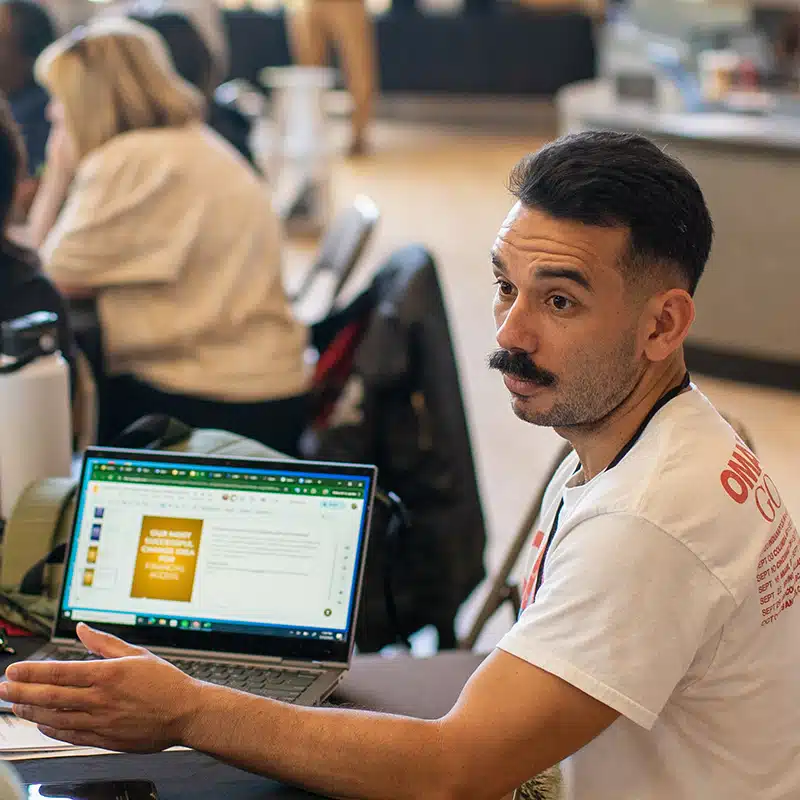
The clearest example I have seen of this in mature form comes from a networked improvement community led by my organization, New Tech Network. From 2019 to 2023, New Tech Network ran the College Access Network, an improvement community of 49 schools across Texas, California, and Arkansas focused on closing postsecondary enrollment gaps for Black, Latino, and low-income students. One of those schools was Mission Early College High School in El Paso, Texas. I want to dwell on their work for a moment, because what their team produced together captures something the formal language of continuous improvement struggles to convey.
The Mission team was doing rigorous improvement work. They held themselves to disaggregated, equity-specific aims alongside their general aims. They tested change ideas at a small scale and rated each one on its readiness to become standard work. They tracked FAFSA completion year over year and watched it climb from 24 percent to 91 percent. They named progress that was worth celebrating and what they still needed to improve. All the improvement tools were there. What is most striking about their story is not the use of such tools, but rather how the team took ownership of them. Their change ideas had names like “Supa Hot SuperMatch Fire,” “Operation Believe It Or Not, George Isn’t at Home,” and “MECHS Goes to Hollywood II: The Revenge.” Their team biography cast each member as a character—Grand Vizier, Royal Counselor, Knight of the GO Center. Their sustainability poster was titled “Riding Our Future Together” and rendered in marker on chart paper. Their stated core values were collaboration, innovation, and humor.
None of this is what a casual observer expects from a continuous improvement artifact. And that is precisely the point. The tools of improvement—the PDSA cycle, the disaggregated aim, the standard work rubric—were not substitutes for the team’s culture, identity, and judgment. They were the scaffolding within which that culture could become public, durable, and improvable. The Mission team’s vision of equity, written in their own words, describes wanting students to feel “as if they are not an other who has snuck into education, but that it was made with them in mind.” That is not a goal you can hand down from above. It is shared meaning, cultivated communally over time, made visible through the disciplined practice of improving together. The tools of continuous improvement are the scaffolding for the culture and practice of constructing shared meaning.
The reverse case gets less attention, but I think it is just as important. To make it, I want to borrow a distinction from organizational theory between first-order and second-order learning. My wife is a cardiologist. As such, she often has conversations with patients about the relationship between their cardiovascular health and their lifestyle. After seeing her, patients often leave with both a prescription for a statin to help treat their cholesterol or heart condition, and a list of things they must consider changing about their lifestyle. Some patients will take the statin and, after seeing improvement in their cholesterol numbers, conclude there is absolutely nothing wrong with their lifestyle. Other patients will take the statin and make systematic changes to their diet, exercise, sleep, and the management of stress.
Both categories of patients engage in learning and change, but these are different categories of learning. The first category of patients, who only took the medication, engage in what organizational theorists would refer to as first-order learning. While there are different types of first-order learning, what they all have in common is that they leave the prevailing system intact. The medication makes the existing pattern marginally more sustainable; thus, they conclude there really is no need for system change. The second category of patients, who also change their lifestyle, engage in second-order learning, which fundamentally transforms the system (their lifestyle) that produced poor cardiovascular health to begin with.
Deeper learning and continuous improvement both have an orientation toward transformation. But they hold that orientation differently. In deeper learning, the need for transformation is an assumption you argue from, not towards. The starting premise is that our schools, as currently designed, are not built to consistently produce the relational, adaptive, identity-rich outcomes we say we want—and that no amount of tuning the existing system will get us there. In continuous improvement, by contrast, transformation tends to be an assumption you argue towards, not from. The implicit bet is that if you incrementally improve enough of the surrounding pieces, a transformed system will eventually emerge.
That distinction matters greatly. Improvement, by its nature, reduces dissonance. It makes the prevailing system feel a little better, a little more humane, a little more functional. The metaphor I find useful is a pot of water. Water does not transform into steam unless the heat stays high enough to release it as a gas. Improvement, applied within a system that is not having an explicit conversation about the need for transformation, can quietly turn down the heat. The system feels less broken. The pressure for fundamental change recedes. And improvement begins to function as validation—proof that there was nothing fundamentally wrong with the system in the first place.
This is what deeper learning offers continuous improvement: a way to front-load the conversation about transformation, so that the discipline of incremental work does not collapse into a quiet defense of the status quo. Continuous improvement can tell us whether things are getting better. It cannot, by itself, tell us what “better” means. Deeper learning can. Without clarity about the transformational intent, the rigor of improvement methods can be turned, quite efficiently, toward improvement goals that are not worthy of our efforts.
Deeper learning also offers a counter-argument to an oft-cited critique of continuous improvement: that improvement science is just incrementalism dressed up in better clothes. I take that critique seriously, and I believe the improvement community should too. But I think it confuses two different things: small steps and small ideas. Continuous improvement, properly understood, is not about pursuing modest ambitions. It is about testing big ideas at a small scale, so that we do not burn community will and trust by spreading something that does not yet work. Or as Tony Bryk advises, “learn fast so you can implement better.” In the presence of a transformational vision, increments are how a transformed future actually arrives.
Transformation is the result of disciplined, rigorous, incremental work, sustained over time, in service of an aspirational marker on the horizon. Deeper learning gives us that navigational bearing on the horizon.
Deeper learning makes an argument for the type of humans that schools must strive to develop. Continuous improvement gives us the discipline by which that vision can become communal, equitable, and sustainable. Deeper learning, alone, describes a destination. Continuous improvement, alone, tells us whether we are moving. We need both—the destination and the path, the meaning and the method, the why and the how—to get anywhere worth going.
Deeper learning and continuous improvement are answers to different halves of the same question. And if we zoom out from the specific question about continuous improvement and deeper learning, I believe there is a larger lesson for us about integration. The future of schooling, and the future of our communities, depends on our willingness to reintegrate things we have allowed to drift apart. Stories and spreadsheets. Strategies and relationships. Evidence and meaning. Improvement and transformation. System and soul.