Ten years ago, I walked past a newsstand and out of the myriad of multicolored covers, one jumped out at me: MAKE magazine. As someone who grew up making stuff, this magazine spoke directly to me.
I bought copies and immediately brought them to the director of my school. I remember triumphantly exclaiming “We should show this to all of the teachers—think of the projects we can do!” A decade later, well-intentioned schools that create dedicated “maker spaces” worry me.
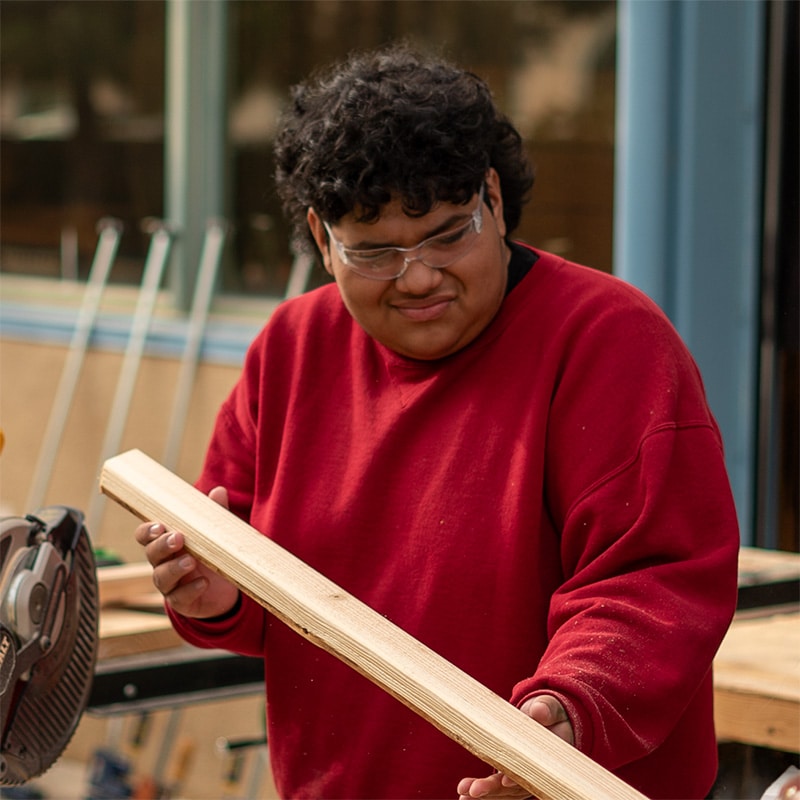
For the uninitiated, a maker space often houses ultramodern tools like a laser cutter or 3D printers, mixed with drill presses, table saws, and soldering irons, or perhaps screen printing equipment or sewing machines. My fear is that stand-alone maker spaces will cause the powerful act of creation to be confined to only certain parts of the school building. I worry that yesterday’s centralized computer lab—which we rightly democratized and decentralized by putting computers in every classroom—is today’s maker space.
When I walk past a new room being outfitted with a laser cutter or a drill press and hear, “This is our maker space!” I am tempted to ask: “What happens in all of the other spaces? What do people do there?” The act of creation is transformative. An individual’s self-image is forever changed when he or she can hold up a real object—a real contribution to the world—and say, “I made this.” In a time when students’ lives are increasingly virtual, abstract and vicarious experiences, it is every teacher’s job to make learning, and life, “hands-on.”
In the 11th grade humanities classes I have taught at High Tech High, we confront these issues in the context of English and history. As a result of my belief that deeper learning grows out of active, transformative experiences, we make things in class; because of my experiences in and out of school, and out of a love for a prominent aspect of my discipline, we often make books.
The tried-and-true way to learn about great literature is to force students to read it, and then prove that they read it by writing an essay in which they explore a theme or elements of the author’s style. Though a classic assignment, the student likely made nothing new. It is unlikely that the essay explored a theme found in Shakespeare or The Great Gatsby that had previously gone undiscovered. It is also unlikely that anyone other than the teacher will read that essay. The teacher probably wrote many of the same comments on each essay that was graded. The students likely stuck them in a pile or threw them away after the grade was received.
In my classes, I want us all to learn from great literature by reading. However, we access that content—and much more—by making things in response. Last semester, we published books. Every eleventh grader in my class was partnered with a second grader as a “reading buddy.” Twice a week for six weeks, we met with our reading buddies and did focused work around literacy with their books from class, the library, and from home. Every day, I reminded my students that they had three jobs: to help their buddy become a better reader; to help their buddy love reading so much that he or she would read independently over the summer; and to secretly learn everything they could about their buddy so that they could surprise him or her with an original published work of children’s literature at the end of the project.
Early on, I held up published books ranging from 50 to approximately 150 pages. “This is what you will make,” I told the class. Naturally, there were gasps of disbelief.
“It’s no big deal,” I told them. I flipped through one of the books, emphasizing the fact that it is a real thing, and cool. “This will be pretty impressive when you hand your book to your buddy and it has your name on the cover.” I smiled broadly. Maybe two or three students were convinced.
In between meetings with our second-grade buddies, we read and analyzed classic literature, and we also drafted our own stories. Everyone read The Great Gatsby and Slaughterhouse Five, which I selected for the lessons that they offer for young writers. Many students selected other authors to study in depth, such as Zora Neale Hurston, Ray Bradbury, and Harper Lee. We held regular Socratic Seminars and analyzed each author’s style. We discussed themes and structure, setting and character development, and diction and figurative language.
Every eleventh grade student identified his or her literary influences, and the specific elements of individual author’s styles that they hoped to capture and apply in their original children’s literature. We tried to understand what specific elements of each author’s style we could emulate. What could we learn from F. Scott Fitzgerald’s character development that could inform the development of our own characters? What could we take from Kurt Vonnegut’s illumination of the possibilities of narrative structure? What other authors and literary works were guiding our choices as writers? Students often said things like, “I want my dialogue to sound real,” or “I want her to love this character,” or, simply, “I like this part.” We worked together through critique protocols to understand the specifics of what we saw in these books, and how we could apply these principles in our own original work. Importantly, not one of my students wanted to let down the second grader who looked up to them, whom they sat on the carpet and read with twice a week.
Six weeks into this project, each student had an original manuscript that had been drafted, critiqued, and revised, and everyone could speak thoughtfully about the authors, literature, and literary techniques that had influenced their writing. We did layout and design work in class, striving to meet publishing industry standards and we published through an online, on-demand service. The shortest book was just under thirty pages. The longest was over 160 pages. Nearly every one was published professionally, although some chose to hand bind one-of-a-kind artwork as their covers. Importantly, each book was created for an individual reading buddy and aligned to that second grader’s interests and reading level. Nearly all are currently for sale on Amazon.com, and have been purchased in our community (Search “High Tech High Media Arts” on Amazon).
At the end of the project, we went to our second grade buddies’ classrooms while they were in another part of their school. Each of my students clutched their novels, careful to not bend the pages. When our buddies returned, we yelled “surprise!” and gave every second grade student a gift of an original book, written just for him or her. Many didn’t initially realize that we created the books—everything looked so professional. At first, they thought we bought these books for them. My students had to point at their names on the covers and their buddies’ names in the dedication of each book.
I share this story because it illustrates my belief that every classroom should be a space to make things, and that all students and all teachers should have access to the transformative and deeper learning experiences that “making” provides.
As exciting as makerspaces may be, they are fraught with politics and equity issues—budgets must be allocated, equipment ordered, perhaps even new construction undertaken. The decision to purchase tools and place them in a specific location needs to be understood as a pedagogical choice. When schools centralize resources, they can purchase bigger or better tools. However, when the tools are centralized in one part of the school or in one room, that can limit who uses them. In addition, a dedicated makerspace can send the message that this space is for making, and other spaces are for something else, which in the past has been often disconnected, abstract work labelled as “academic.”
I also believe that maker spaces can be amazing. They can redefine the nature of the classroom. They are multi-age, multi-purpose rooms in a time when it seems that students are perpetually coming and going from one form of standardization to another. Maker spaces offer the opportunity for students and teachers to learn side-by-side and collaborate in heterogeneous groups. And, yet, maker spaces make me nervous, for what seem to be other pedagogical, political and economic decisions that they reveal.
In high schools and universities across America, some disciplines are dominated by one gender. Engineering classes are overwhelmingly male; nursing and education are predominantly female. We have a significantly lower percentage of female computer science majors in college today than we did in the 1980s (37% of computer science majors were female in 1984; last year it was more like 18%). I am unconvinced that centralizing resources in dedicated spaces will address those problems. We need to ensure that all students have access to all of the resources they need, and that all are encouraged to follow their passions and to take risks to try new things.
To make something, a student has to use the right tools for the job, whether they are the traditional tools of the woodshop or tools like cameras, MIDI software, desktop publishing suites, vinyl cutters, 3D printers, sewing machines, microscopes, cameras and more. Whether they are developing prototypes for inventions, writing and recording songs, building a greenhouse, or writing and producing a play, all students and teachers need tools to be readily accessible to facilitate their production. I remember being a student and only being able to work on a computer when our teacher scheduled time in the computer lab; I hope that today’s students do not only get the chance to take abstract knowledge and bring it to life if the teacher can schedule time in a stand-alone maker space.
The placement of these tools and the creation of these spaces in the school matters in how and when they are used, and by whom. The decision to purchase specific tools and place them in a specific location needs to be understood as a pedagogical choice. This challenge has always existed at schools and is now manifested in a new way: how do we to make decisions around people and their talents? I worry about the temptation to solve this problem with technology instead of humanity: how does a school leader best encourage all students to achieve at their highest levels?
Regardless of what teachers hope to teach and what students hope (and need) to learn, there’s a tool that can make it better and more accessible to all. We need to know what those tools are, and ensure every student can access them.
As ambivalent as I am about makerspaces, I appreciate that they have thrust a challenge in front of us. This is an opportunity to reflect on the nature of the technological age. We must ask, when did making things become a capital letter word—when did it become new and cool to be a “Maker”? And, how can we get to the point where all students and all teachers create things in every class? Every classroom should be a maker space, because designing and creating new things is part of what makes us human.
Note: A version of this article was recently published on the Education Week “Learning Deeply” blog. You can find it at blogs.edweek.org/edweek/learning_deeply/2015/11/every_classroom_should_be_a_maker_space.html